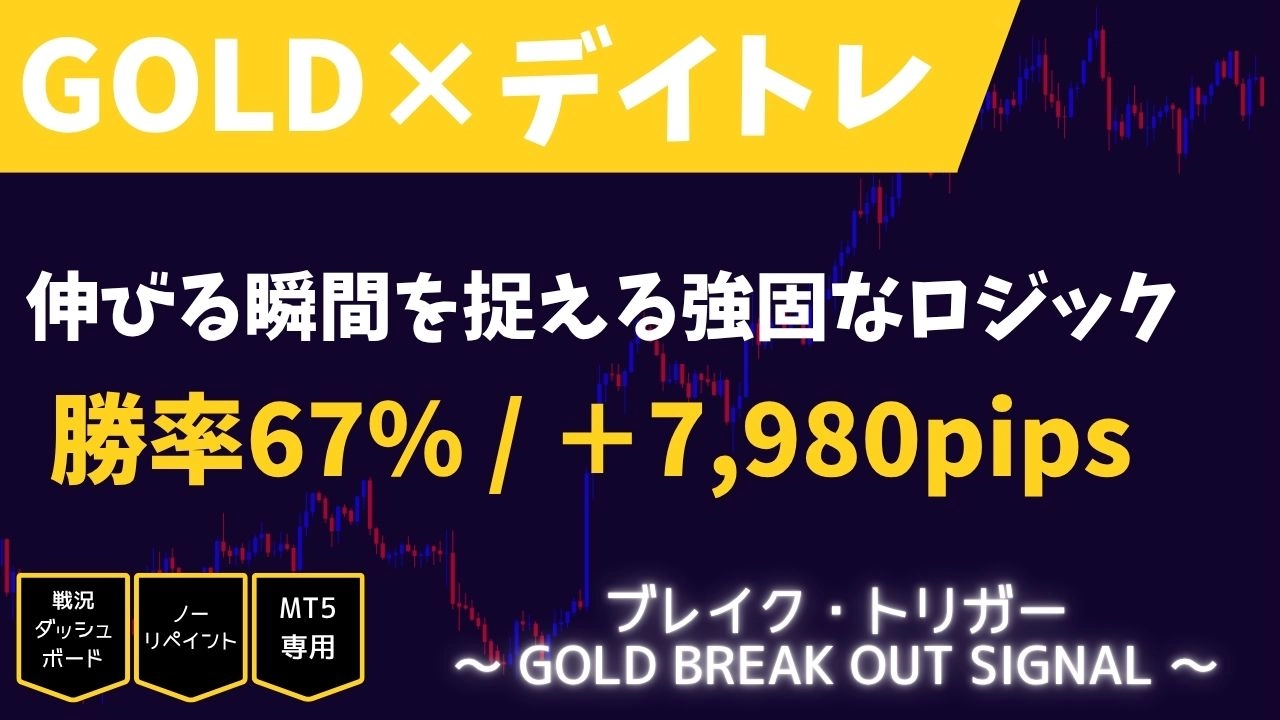
【Postscript: 73% win rate scalping対応】 The "about 8000 pips" born from the despair of averaging down―― a part-time trader's beloved tool makes its first listing
I've added an update on 10/9!
【Ver 1.11 Update Notes】
Based on feedback and verifications from readers, we have newly implemented a recommended parameter specifically for 5-minute and 1-minute scalping.
Especially the 5-minute setting achieves a high win rate of 73.0% / +5,592 pips, surpassing 15-minute day trading.
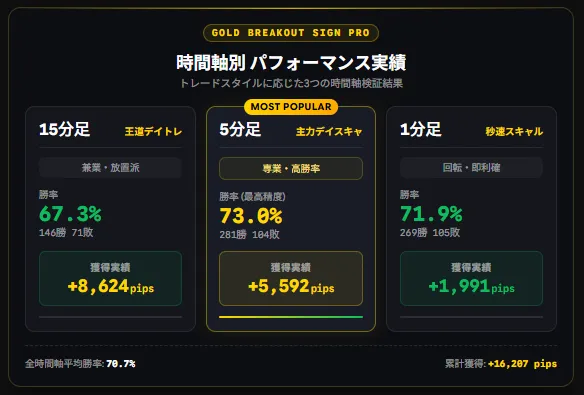
Actual chart sign behavior and detailed results for each time frame have been publicly published on the product page with images.
Those who favor scalping, please check the product page for details!
(※ Commemorative launch – the first 10 customers can still get the 7,800 yen tier)
▶ Click here for product details and to acquire the 'Break Trigger'
Chapter 1: Introduction (A Reluctant Confession from the Past)

Nice to meet you, I am a part-time trader who also works as a company employee,YoChiChi.
This is my first listing on “GogoJungle.”
Since I work as a company employee and continue trading, I had not disclosed my own methods externally until now.
However, amid the recent abnormal gold market, I became convinced that I could help other part-time traders who are also losing funds, and
there were verifiable results (67% win rate, about 8,000 pips) that supported this, so I proudly write this article for the first time.
That said, I want to make clear from the start that I am not a genius who started winning from the beginning, nor an elite.
Rather the opposite. Until a few years ago I was a slave to the typical “prospect theory.”
If I earned profits, I would take profits early in just a few pips. Conversely, when I carried drawdowns, I would delay stop losses with thoughts like “it will come back someday,” and ultimately faced late-night forced stop-out notices…
I knew, in my bones, that I must cut losses where my entry rationale collapsed, but I engaged in unfounded averaging down and couldn't bear to look at the amount…
I accumulated countless losses and felt utterly desperate as my emotions ruled my days.
Chapter 2: The attempt to purge emotions through systematic trading and the trap of averaging-down EAs
Unable to withstand emotions, I sought a path in “systematic, mechanical risk-cutting (automatic trading).”
However, what awaited was another nightmare. I ventured into high-monthly-profit averaging-down EAs that were popular at the time.
In the first few weeks, as the account balance rose, I thought, “I can win like this.”
But when the powerful uptrend of gold (XAUUSD) hit, within just a few hours the account balance became zero.
If I had withdrawn… if I had not been greedy to compound… I thought about that too, but I realized that “putting funds into others’ logics would not let me survive in the market.”
After paying painful tuition, I finally understood that obvious reality.
Chapter 3: Turning point — quantifying discretionary experience with AI
“Stop relying on others’ logic.” This marked the true start of my development.
Fortunately, I had the experience to survive in the FX world. As many of you may have, I had spent many nights glued to charts until 3–4 a.m.
In the early days, I set off on a journey to find methods through various salons and SNSs in pursuit of the holy grail (ultimately not profitable, but educational).
From those experiences, I had learned certain chart patterns and candlestick movements that tend to develop in markets.
In particular, I focused on the fractal structure often used in FX and noticed that the same chart patterns occur on any time frame.
In any market, at the “turning point of Dow Theory,”and after the energy condenses, the breakout (squeeze) holds universal edge. I then used modern AI technology with a development partner to turn my discretionary rules into unambiguous programming.
Even without coding knowledge to build EAs or tools, partnering with AI allowed me to create various tools.
From there, I tested each method using fixed data and conducted rigorous mathematical validation and backtests.
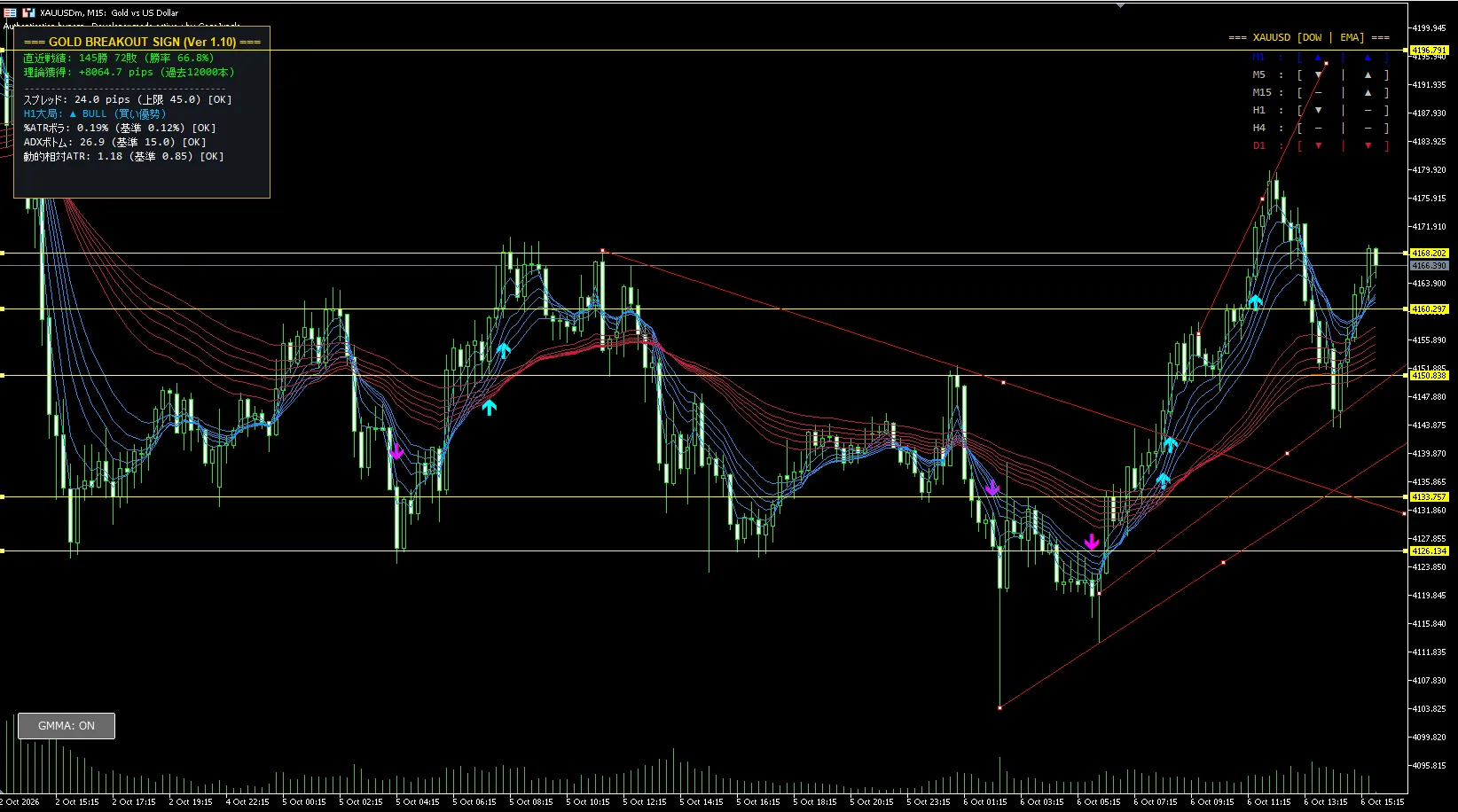
※ This is my MT5 screen where I run a variety of indicators for validation.
“GMMA contraction, Dow Theory turning lines, MTF environment recognition” — these were mathematically modeled on MT5, and I performed validations over the most recent 12,000 bars on the actual development screen.
Chapter 4: Why don’t past methods and tools work now?
As I progressed with validation, a harsh reality emerged.
“Methods that worked in the past do not work at all with today’s gold.”
First, please look at the weekly chart of gold (XAUUSD).
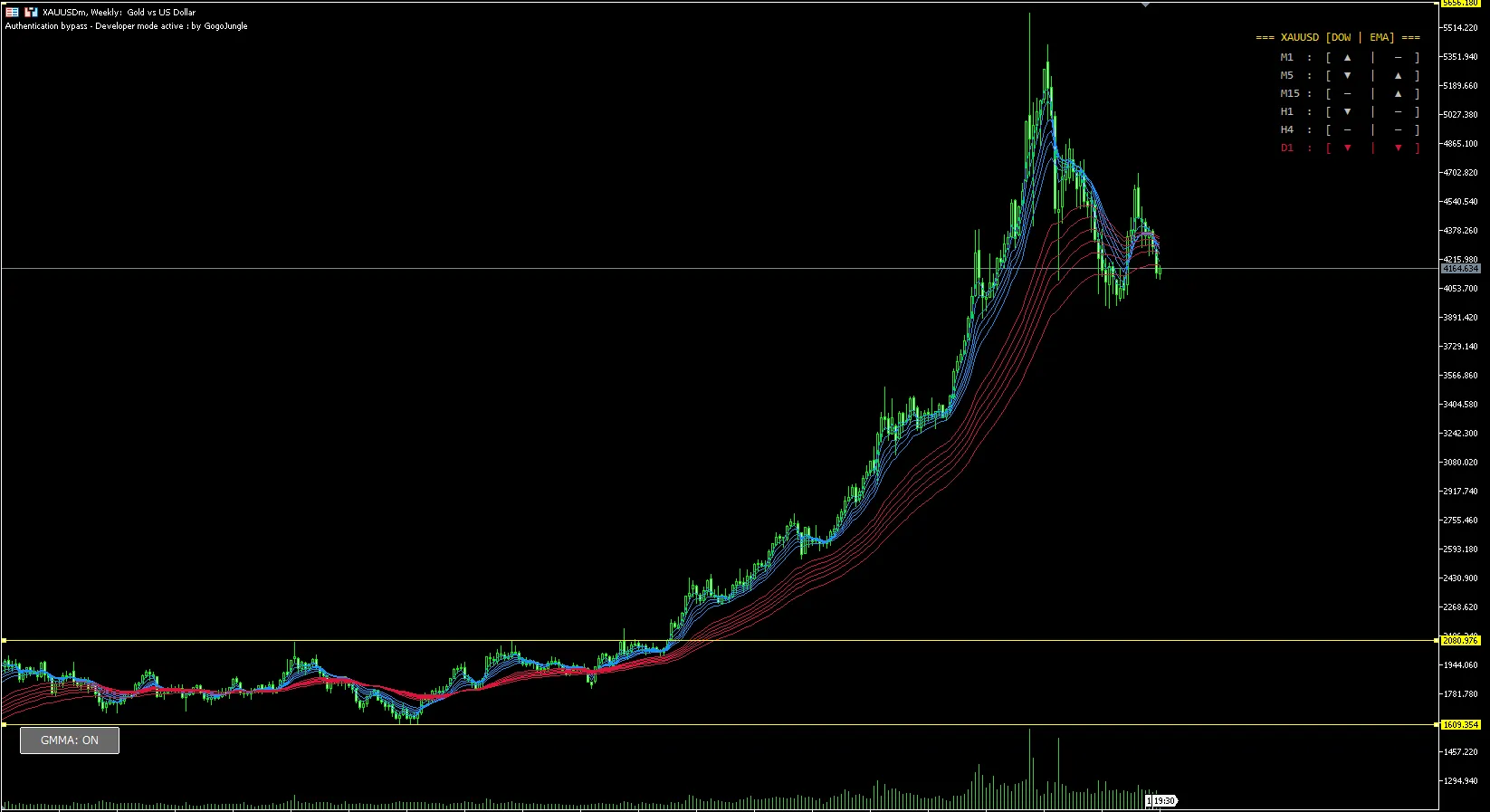
Note the yellow horizontal line in the $1,600–$2,080 area.
During the years this was considered normal, the range contained small candles and low volume.
(Back then, volatility was still considered high.)
However, compare the moves after breaking through the $2,000 level in real bodies to the most recent moves.
Candle sizes and trading volume at the bottom of the screen transformed into a different, otherworldly realm.
Yes—the “size of volatility” in today’s GOLD has jumped into an unregulated, extraordinary range.
In such recent markets, using “too shallow fixed entry values” and averaging down against the trend leads to instant stopouts from noise or sharp reversals.
Based on world events, central bank actions, and institutional investors’ movements, I believe the possibility of returning to volatility below $2,000 is low.
Therefore, I deemed essential a dynamic ATR monitoring and a smaller target distance for stop-out that differs from traditional fixed entry movements to secure small profits while maintaining flexibility.
I consider this “small-profit, carry-out” approach particularly crucial.
In the current market, have you ever seen a move go as expected, then pull back to your entry only to extend again?
Even a move of $10–$30 can be just a pullback that then breaks through in the original direction. Skilled traders turn those exit points into wins.
To prevent capital erosion from such “entry hunting” or too-small fixed entry moves, I adopted a method that combines logical, statistical analysis and aims for small profits to exit successfully.
Chapter 5: The answer — “1.5 ATR / +50 pips lock” as a golden defense
As briefly introduced earlier, to fit the current market I derived a defense logic called the “golden fixed-value defense.”
Concretely, we dynamically monitor the average market movement (ATR), and when unrealized profits reach “1.5 ATR,”the stop loss line is automatically moved to a positive position at entry price + 50 pips.
If it does not extend and goes against you — cut losses small within the prescribed risk width (small loss).
If the trend truly takes hold — extend to a target with a 1:2 reward-to-risk ratio (big profit).
If there’s a sudden reversal —secure +50 pips and exit safely (defense)
To be honest, the entry logic I use is a classic, universal approach such as Dow Theory and volatility breakout.
It’s not a secret, gimmicky indicator. Yet,“Why can’t anyone win with the well-known logic in today’s GOLD?”
The answer was tuned to today’s high-volatility market: the skill to identify squeezes and the precise 1.5 ATR distance for defensive exits.
By validating and tuning for the current market, I was able to produce these results.
By stacking small profits, I secure win rate and compress risk on losses, aiming to win big when a strong trend emerges.
By embedding this defense rule and applying selective filters (ADX, squeeze, spread monitoring),
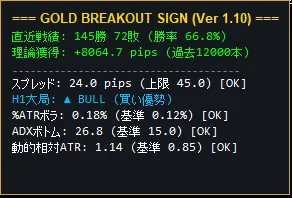
in the latest 12,000 confirmed bars I achieved an exceptionally strong edge: win rate 67.0% / theoretical gain +7,980 pips+,
and profits while keeping drawdown low due to higher win rates.
*The image shows the dashboard as of 1:20 AM on 10/7. (1 pip ≈ ¥10; even with 0.01 lot, based on recent confirmed bars you can expect profits over about ¥120,000. However, with spread at 0 and optimal execution timing.)
Chapter 6: A message to traders who share the same struggle
Past losses from emotional trading and the despair of blowing accounts with averaging-down EAs.
Because I have spent much time and suffered, I created a genuine defensive weapon to never again lose funds unfairly.
Now I officially released the indicator “Break Trigger Ver 1.10” on GogoJungle, which encapsulates all of these logics.
I hope it becomes a reliable ally for part-time traders who are tired of being tossed around by gold’s volatile swings.
As a launch promotiona limited-number special discount coupon has also been issued.
For details on the tool’s logic and dashboard specs, please refer to the product page below.
▼ 【GOLD Exclusive】 Break Trigger Ver 1.10 Product Page
https://www.gogojungle.co.jp/tools/indicators/87382
【First-come, first-served launch price for monitors】
With the new version, for those who can test in a real trading environment and leave reviews,
we are offering to the first 10 customers a launch price of 9,800 yen → special price 7,800 yen.
Please note that once the 10 slots are filled, the price will revert to the standard price without notice.
P.S. If you are a contrarian scalper…
Up to now I’ve discussed a trend-following method that aggressively breaks the initial movement of a trend (Break Trigger). But trading style is personal and varies widely.
“Rather than chasing rapid breakouts, I want to pull back and aim with high risk-reward.”
“I keep getting squeezed trying to hit the top or bottom and end up stop-out.”
“I want to conquer the urge to overtrade and ride big players’ intents with contrarian positions.”
There are people who feel this way.
Therefore in the second article I reveal the contrarian scalping essence based on SMC (Smart Money Concepts) used by overseas professionals and institutions, focusing only on large-order imbalances (distortions).
Why do standard support/resistance lines and oscillators get hunted?
What are the two “waits” that dramatically change win rates?
If you want stable profits from contrarian trades, please also read this column.
▼【II】 For contrarian scalpers, click here (Investment Navi+)
【GOLD Scalping】 Why contrarian calls for tops and bottoms lose? A simple approach that targets only large orders’ distortions
https://www.gogojungle.co.jp/finance/navi/articles/128290