

Why was the EA that had been winning until yesterday suddenly struggling?
Even EAs have “strong markets” and “weak markets.”
Of course, even with the same EA and same settings, daily results will not be exactly the same.
One day you may be doing well, and the next day you suddenly face a large unrealized loss. When operating an EA, you will encounter such situations.
One of the reasons is the difference in market conditions.
Range market and trending market
A averaging-type EA that adds positions while using pullbacks tends to accumulate profits more easily in a range market where prices move up and down within a certain range.
Even if prices briefly move in the opposite direction, if they revert afterward, you can close multiple positions at once.
On the other hand, you need to be careful about trending markets in which prices move strongly in one direction.
If the price continues moving with few pullbacks, the number of positions will increase and unrealized losses will also tend to grow.
When the market makes a big move
When watching the market, there are times when the price level that many higher-timeframe traders are watchingbreaks out significantlyor after a trend reversal’s third waveand then a large price swing occursin one direction.
Such moves can be opportunities for discretionary traders, but they can be a harsh development for EAs that rely on returning to a range.
However, even if you think, “then just stop the EA before the trend begins,” it’s not that simple in actual markets.
Sometimes it breaks and then returns to a range, or it continues in a range and then suddenly moves strongly from there.
Even if it’s obvious after the move, it’s difficult to judge accurately every time before the move.
What to do when you hit a difficult market
If you cannot avoid all difficult markets, another important consideration is how much you can minimize the damage when you actually encounter that market.
In EA trading, it’s easy to focus on increasing profits, but taking a large loss even once can severely reduce the profits you’ve been accumulating.
That’s why you can’t just think about “how much you can win.”“How much loss can you tolerate when a difficult market comes?”This perspective is also necessary.
This is not simply solved by increasing margin.
For example, simply setting a personal upper limit like “continue trading up to X% of account funds in unrealized losses” can help you make calm, well-informed decisions when it matters.
Also, rather than assuming you operate the same every day, consider reducing operating hours or giving yourself time to monitor the market under certain conditions as a way to reduce damage.
Therefore, more than looking at profits or losses alone, it’s important to reflect on“what kind of market led to large unrealized losses”and learn from it.
Keeping records reveals “difficult markets.”
Still, manually recording daily profit/loss and unrealized losses every day is quite a task.
So what I personally use is MT4/MT5 charts displaying daily profit/loss in a calendar format“Tenda Calendar Pro”.
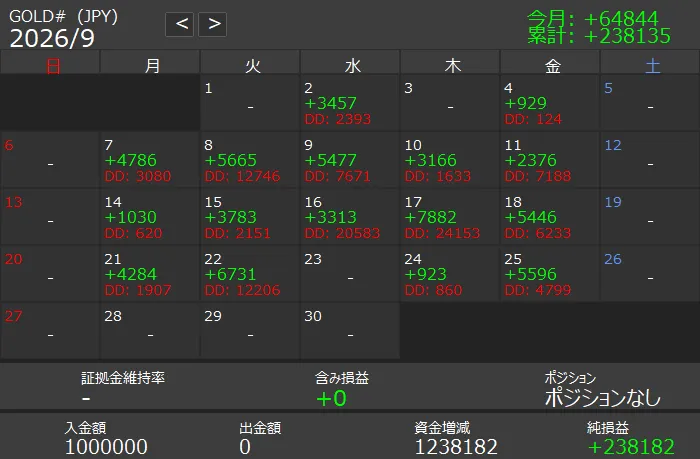
Not only daily realized profit/loss but also the day’smaximum drawdownis recorded, allowing you to later check things like “this day ended in profit, but the unrealized loss grew significantly in the middle.”
If you find a day with large unrealized losses on the calendar, review that day’s chart.
“There was a big breakout day.”
“It moved in one direction on the day of an indicator release.”
By repeatedly reflecting like this, you’ll gradually see numerical characteristics of markets that your EA struggles with.
Because you can separate records by magic number, you can compare the tendencies of multiple EAs operating simultaneously.
Leave not only profits visible but also risks in the record.
That is“how much loss can be tolerated?”as a solid basis for evaluation.
▼Details of Tenda Calendar Pro
Summary
If you only look at profits during good times, you may be seeing only one aspect of that EA.
Learn how it behaves across various markets and how to work with that EA. I believe that continued accumulation of such experiences leads to long-term operation.