
After the midpoint price, will USD/JPY really go down? Counted 11 years and 9 months of 1-minute bars and 894 GOTO days
Nice to meet you. I am the “Verification Sommelier” selling indicators.
EA will also be listed.
The first article counts, over 11 years and 9 months of 1-minute data, whether the post-quote retracement after the fixing (the nakadane) really exists as the foundation of my product.
In short, the conclusion
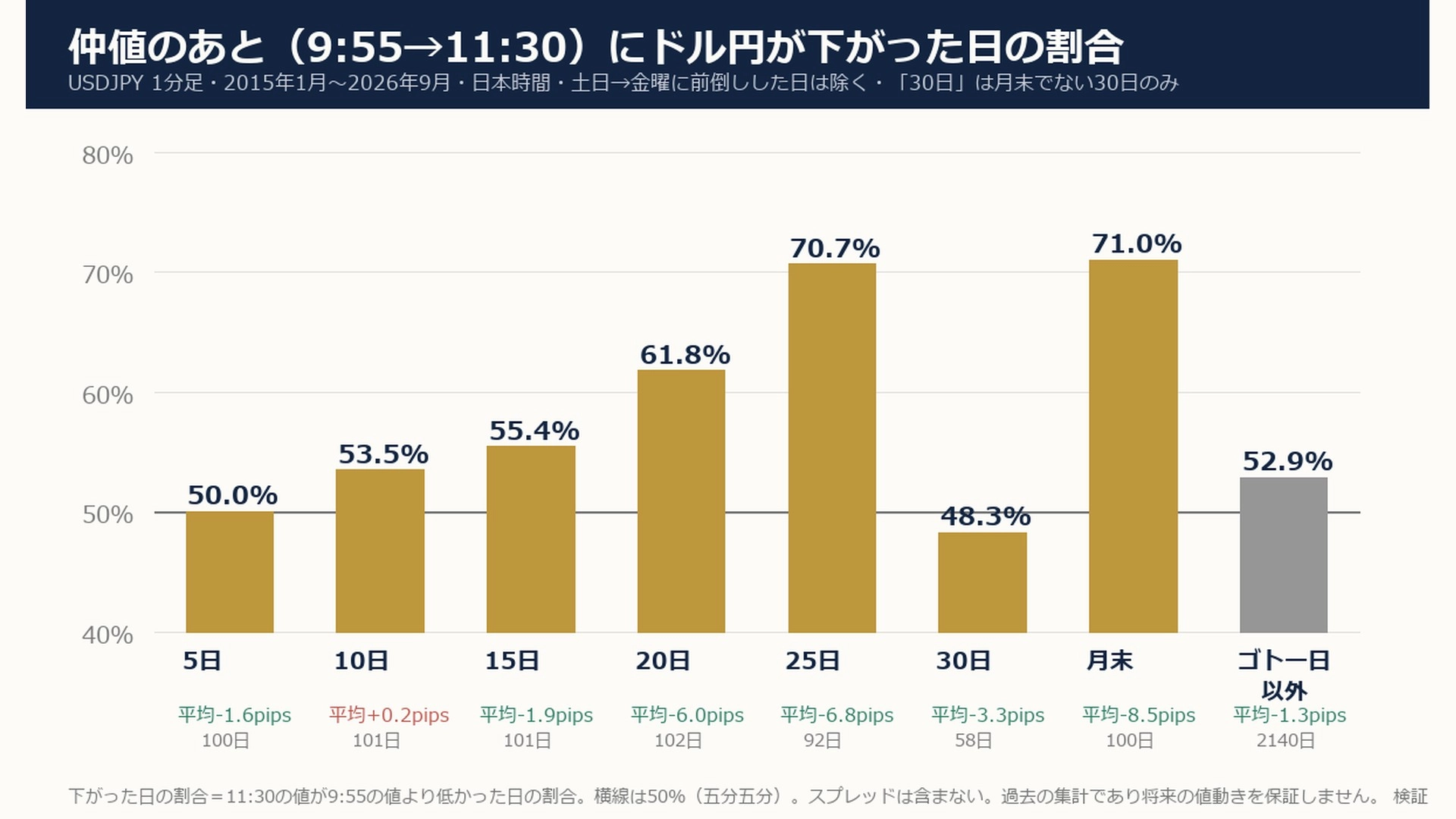
・On Goruto days, between 9:55 and 11:30, the USD/JPY fell on 59.8% of days (894 days). On other weekdays, it fell on 52.9% (2,140 days).
・The average change from 9:55 to 11:30 is −4.0 pips on Goruto days and −1.3 pips on other days (negative = decline). Although the difference is small, when viewed year by year, all 12 years from 2015 to 2026 show more than half the days were down.
・The commonly stated tendency of “rising toward the nakadane” is weak; the days that rose from 9:00 to 9:55 were 55.9%, with an average range of +1.6 pips.
Nakadane and Goruto days
Nakadane is the benchmark at which banks set the exchange rate for that day's customers, determined in the 9:55 market on each business day.
The 5th, 10th, 15th, 20th, 25th, 30th, and month-end are called “Goruto days,” when corporate settlements tend to cluster, and importers buying dollars (selling yen) tend to cluster toward nakadane.
Traditionally, it has been said that on Goruto days the USD/JPY rises toward nakadane, and once nakadane is fixed, buying pressure eases and the price tends to revert. Although it is said so, there are surprisingly few sources quantifying how true it is, so I counted it myself.
Method
・Data: MT5 USDJPY 1-minute chart, January 1, 2015 to September 30, 2026 (11 years 9 months).
・Times are converted to Japan time (keeping server time would shift by 1 hour during daylight saving time).
・Definition of Goruto day: 5, 10, 15, 20, 25, 30 days and month-end. If it falls on a weekend, use the previous Friday. Japanese holidays are not distinguished (same definition as EA).
・“Movement after nakadane”: value at 11:30 minus value at 9:55. A negative result means “fell.”
・“Movement before nakadane”: value at 9:55 minus value at 9:00.
・Also counted are simple trades where you short at 9:55 and cover at 11:30, with a 20 pips stop if the price moved 20 pips against you; spreads are not subtracted (in reality, trading costs of about 0.2–1.0 pips apply from here).
Result 1: Goruto days and other weekdays
・Goruto days (894 days): down days 59.8%, mean −4.0 pips, median −2.8 pips
・Other weekdays (2,140 days): down days 52.9%, mean −1.3 pips, median −0.9 pips
・Sell at 9:55, buy back at 11:30, and cut loss at 20 pips (excluding spreads): Goruto days win rate 58.9%, average +4.1 pips per trade, total +3,705 pips, profit factor 1.99. On other weekdays, win rate 50.8%, average +1.1 pips, profit factor 1.20.
→ The tendency to revert after nakadane is clearly visible on Goruto days. It is present on other days as well, but after subtracting costs, the effect nearly disappears.