

What percentage of traders win with scalping?
The Cruel Reality Seen in Data and the Conditions for the Winners
Scalping is the practice of buying and selling repeatedly within an extremely short span of seconds to minutes, accumulating small profits.
Many traders are drawn by the ease of “earning in a short time” and “finishing in the off-hours,” but in reality, there are many who ask, “What percentage of people survive scalping in the long run?”
In conclusion,Only about 1% to 5% of scalping traders reliably sustain net profits over the long term.
Based on various statistics, this article explains the actual win rates, the structural reasons why many drop out, and the common traits of the top few percent who survive.
1. The Reality of “Scalping Win Rate” Seen in Statistics
There is no public, consolidated statistic solely for scalping, but the reality can be inferred from data from exchanges domestically and internationally, academic papers, and broker trade-history surveys.
① Academic survey: only 1.1% managed to profit for more than a year
A tracking study published in 2020 on about 19,600 individual day traders (futures market) shows highly stringent results.
・Among those who traded for more than one year, only 1.1% achieved net profit (total positive)
・Additionally, when restricting to those who earned above minimum wage, the figure is under 0.5%
The majority of individual traders deplete their funds within a year, illustrating the difficulty of sustaining a full-time trading livelihood with short-term trading.
② Account analysis: higher-frequency trading styles have lower survival
Analysis of about 500,000 accounts by overseas brokers shows clear differences in the portion of accounts that end in profit by trading style.
・Swing trading (holding for days to weeks): about 27% are profitable
・Scalping (ultra-short-term trading): about 19% are profitable
The shorter the holding period and the more trades, the more trading costs and psychological burden tend to degrade overall performance.
③ Domestic data: gap between single-year wins and “sustained wins”
According to surveys by the Financial Futures Association and others, in some years approximately 60% of FX accounts show a positive result in a single year.
However, this includes swing and long-term investments and results from favorable market environments. When scalping is continued for 3 to 5 years with consistent annual profits, the portion that remains is less than 10% (effectively a few percent).
2. Why is the Survival Rate for Scalping So Low?
Behind the widespread losses in scalping lies not just individual skill butstructural hurdles in trading.
① Accumulation of spreads and trading costs
Scalping involves dozens to hundreds of round-trips per day.
For example, even a spread of 0.3 pips costs 15 pips per day if you trade 50 times. In a world where the target profits are a few pips, this fixed cost erodes most of the gains and gradually reduces capital even when the market is evenly balanced.
② Risk-reward collapse (constant small gains, big losses)
Because scalping involves many entries, traders tend to take profits quickly and hesitate to cut losses.
“Even if you accumulate a profit of 3 pips ten times (+30 pips), one delayed stop-out can wipe out -50 pips,”the trap of small wins and big lossescauses many to end up negative in total even with win rates of 70%–80%.
③ Impact of order timing and slippage
During volatile releases or breakouts, orders can slip unfavorably from the quoted rate. In scalping, even a 1–2 pips slippage can determine the outcome, and slippage can heavily diminish trade expectancy.
3. The Three Conditions Thoroughly Observed by the Top 5% of “Surviving Scalpers”
A very small group that remains profitable under harsh conditions follows extremely mechanical rules rather than trading intuition or luck.
1. Limit losses instantly (mechanical stop-out)
A common trait among winning traders is the speed of stopping loss. They fix a stop loss at the moment of entry or throw the position away the moment the assumed scenario breaks (a few pips of adverse movement). Not creating large losses at once is the best defense to preserve capital.
2. Optimize the trading environment
To prevent tiny cost disadvantages and latency, they do not compromise on narrow spreads, high order-fill reliability (slippage-free brokers), stable communication lines, and the choice of order tools.
3. Hunt “where others’ stops accumulate” rather than “chart patterns”
Instead of trying to predict the market’s future, they target points where other traders are forced to liquidate—outside recent highs/lows, round numbers, etc.—where stops are likely to cluster. By catching the moment when stops are suddenly pulled into the market and price moves, they extract the “seconds of physical energy” and quickly exit, avoiding pointless congestion.
Scalping is a specialized sport that demands strict discipline
The reason why only about 1%–5% of scalpers survive is due to the heavy cost burden and the fact that a single mental wobble (delaying a stop) can be fatal given the trading characteristics.
Conversely, for those who can meet three hard hurdles—strict stop-loss discipline, minimal trading costs, and securing an edge in triggering concentrated stop-loss areas—scalping can maximize daily capital efficiency regardless of long-term market uncertainty. If you’re interested, start with small lots to verify expectations and rule reproducibility, and eliminate structural losing patterns.
Honestly, I could never do scalping. I have no track record of being able to win.
My trading style is trading on 15-minute candles or higher. This is materialized as an indicator...
A high-performance “Signal Indicator + EA” called the Tiger Sniper System.
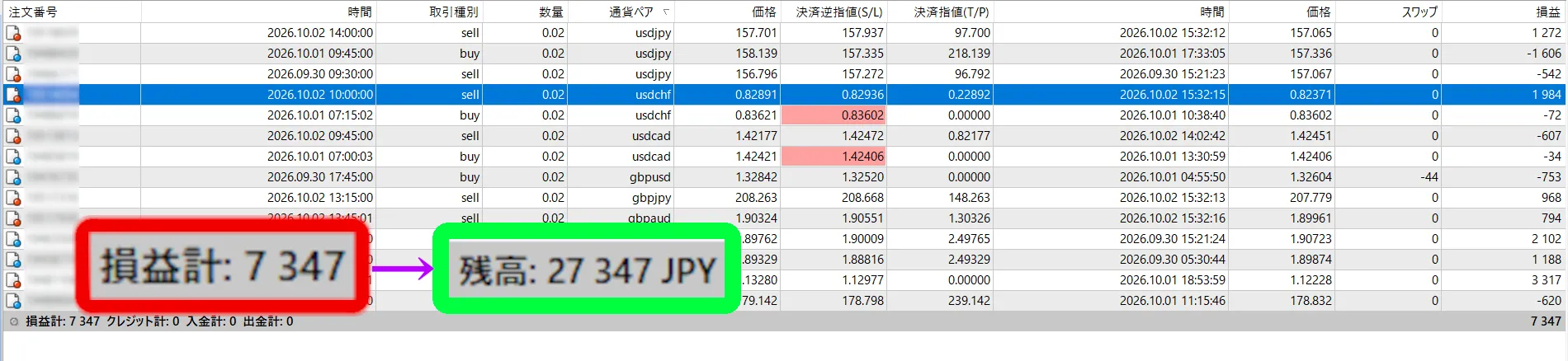
Do you think that’s little?That is the thinking of people who don’t know how to win.
The strength of this system is its trend-following with small losses and large gains. It follows a conventional higher-timeframe trading style.
Even five consecutive losses can be recovered with one win, and two consecutive wins quickly push into the positive range.
Stop being fooled by emotionally draining trades or meaningless promotional oscillators that say nothing meaningful.
To be blunt.”That won’t make you win!”
Please take a look and consider purchasing.