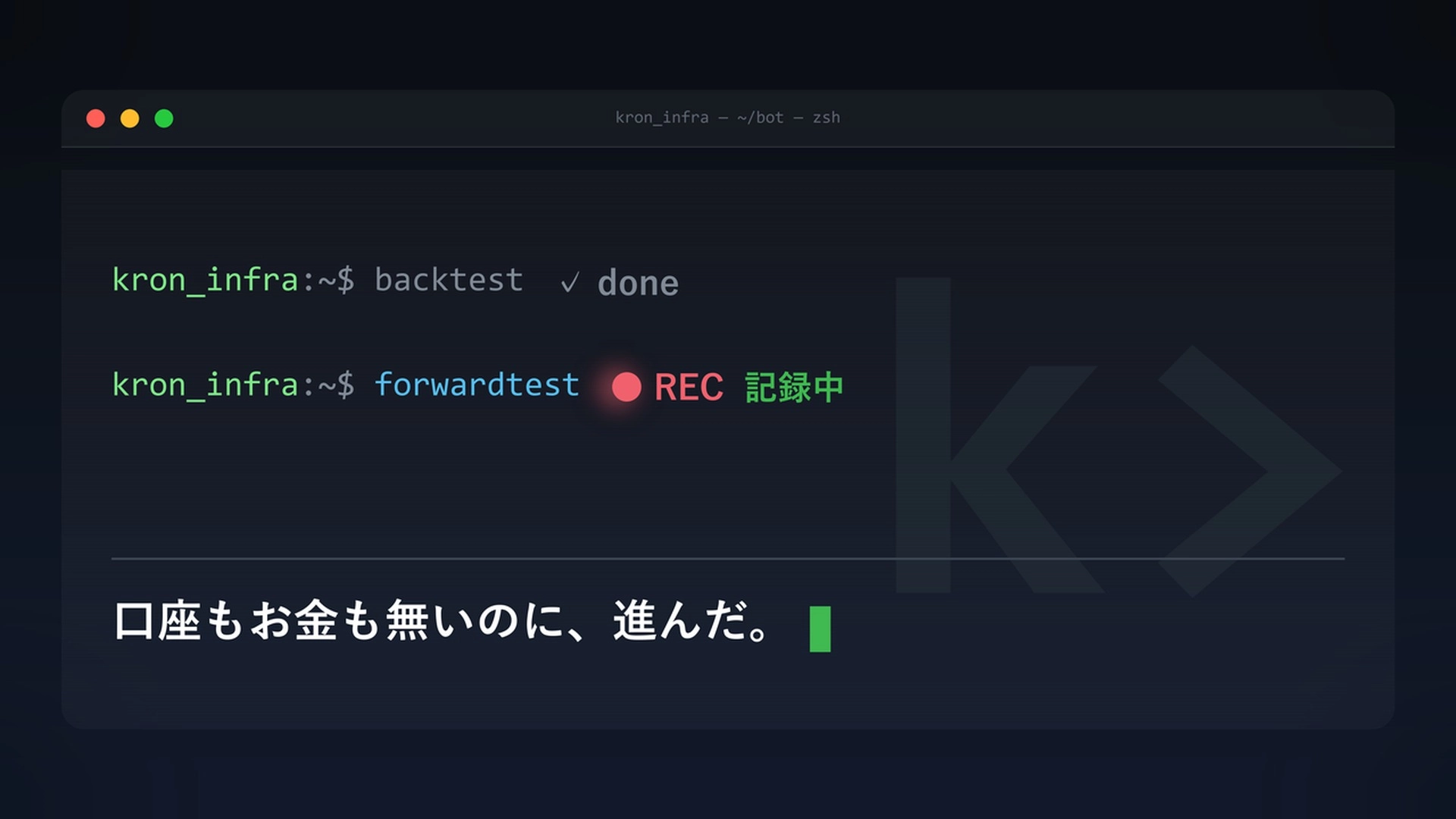
Next comes "Forward Test" after backtesting. You can start today even with a zero account
Hello, I’m Cron. While holding a management position as an infrastructure engineer, I’m building my own swing bot for Japanese stocks with AI (Claude Code). I’m a beginner at both programming and day trading.
Note: This article is a development record as of September 1, 2026.
Previously, when I verified the numbers from backtesting (performance tests on historical data), the conclusion was “good numbers should be taken with a grain of salt.” So, what should I trust next?The answer is forward testing. And what I did today was the preparation for that.Even though I don’t yet have a securities account or money, I’ve progressed quite a bit.
What is forward testing?
In short, it breaks down like this.
- Backtesting: Calculating what would have happened if I had bought/sold using this strategy on past markets. It’s like solving with the answer known—a cheating-like method.
- Forward testing:From today onward, testing in the live market. It’s a genuine test where you don’t know the answers.
Forward testing is used to compensate for the weaknesses of backtesting (it’s easy to mistake a strategy that happened to perform well in the past as “profitable”) (source: OANDA Lab). It records trades on paper without real money, like a paper tradingpaper tradingis also a kind of forward testing (source: Myforex).
And here’s the key point,forward testing doesn’t require an account or money. Since markets move every day, you can start simply by recording “today’s bot instructions.” No, you should actually start even before the account arrives.
Created thing ①: Every morning, gather the market atmosphere
This is something I’ve been doing for a while. Every morning I summarize world economic news and save a score indicating whether this week is higher risk or lower risk.
The bot has a filter that says “stop new purchases in weeks likely to be volatile,” but the data used for this judgmentis only available from late August. I can’t verify in the past whether this filter would have worked during events (crashes or rate hikes). So I have to “gather from today and move forward.” This becomes the foundation of forward testing.
Created thing ② Records → Auto-run daily and weekly reports
Today’s main focus is here.
- Recording trades: Record each trade with “when, what, how many shares, at what price” bought/sold. Data are consolidated into one file (database).
- Automatically generating daily/weekly reports: Revalue holdings by current stock prices daily, and automatically write a narrative of total assets, cash, unrealized P/L, and how far from the high. The scores from the economic news I’ve been compiling each morning are also attached.
In short,you only need to enter one trade—the rest is automatically prepared as retrospective notes. Forward testing takes months or longer, and if you slack off midway, it defeats the purpose (source: FX terms glossary). So I wanted to minimize the hassle of recording as much as possible.
Created thing ③ Dashboard and “Improvement Proposals”
Additionally, I built a dashboard viewable in a browser.
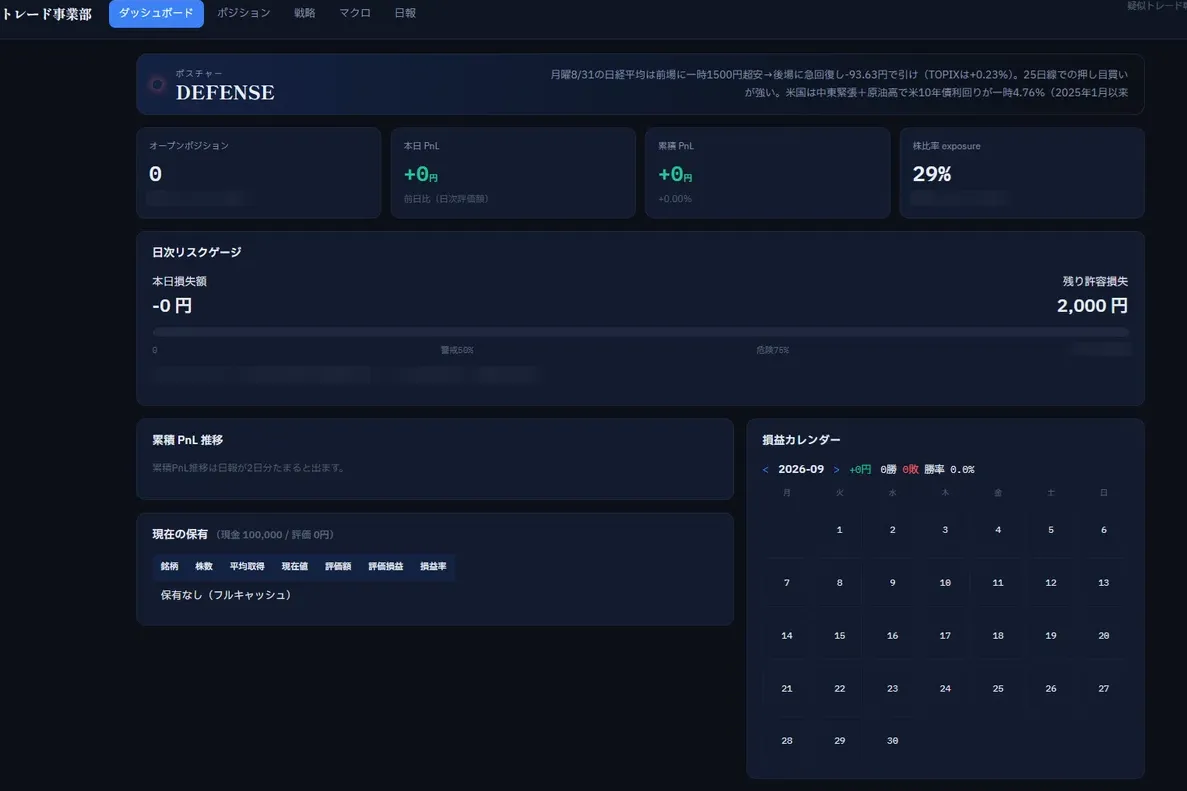
From the top: a band for action/monitoring/protection, four key numbers, a daily risk gauge, asset trend curve, and a monthly profit/loss calendar. In fact, this layout was inspired by a dashboard from an AI development video. If it looks professional, it’s easier to keep going. Simple yet important.
※ All the numbers on the screen arepractice test data. I haven’t moved a single cent yet.
I also created a script to generate “improvement proposals.” It looks at the latest results and market mood history and suggests things like, “since risk has been high for several weeks, reduce stock exposure a bit.” ButI won’t change things automatically. It only proposes, and I decide whether to adjust settings. I think this is something that should not be automated.
What I did for writing this article, I used here as well
While building, I realized this approach is the same concept used for writing this article.
For article production, roles like “researcher,” “writer,” and “title creator” are separated. This time, the trading side was divided into “execution (record),” “record (daily reports),” “review (proposals),” and “visualization (dashboard).”If one person does everything, it becomes messy, but if you break it into small roles, each piece can be done quickly. The same trick worked in other places as well.
Summary: a sustainable system before numbers
I previously wrote that you should doubt backtest numbers. So what’s the answer this time?
- Next is forward testing (testing with future markets)
- And you can start today even without an account or money
- First thing I did was,make the recording process easy to sustain
Honestly, there’s no glamour here. There’s no asset growth. But forward testing hinges on “whether you can keep going,” so I prioritized solidifying that.
Next, when the securities account actually arrives, I plan to do an initial “practice order with just 1 share.”
Note: This article is my development record. It does not endorse specific stocks or methods. Investment is a personal judgment.