
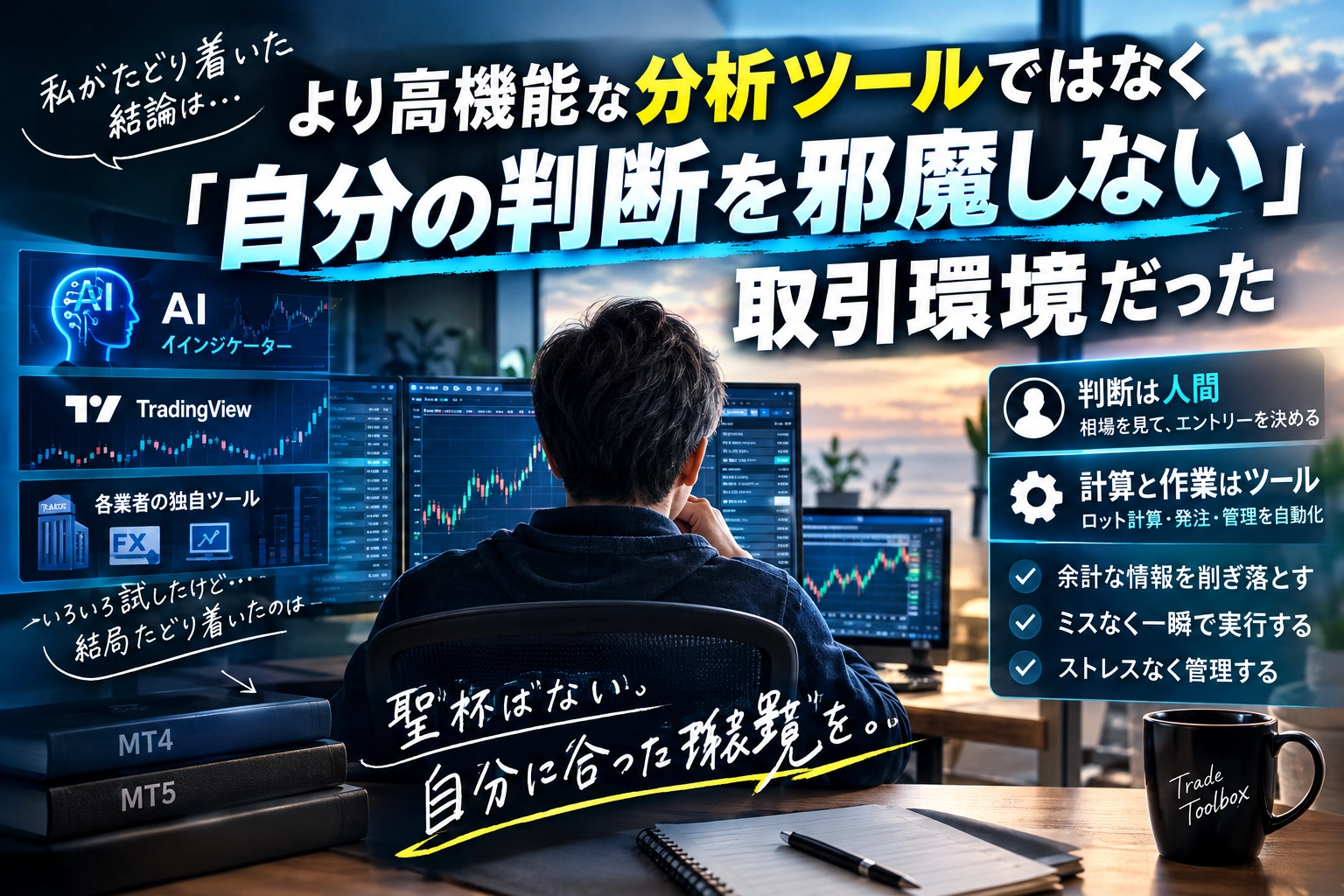
[Trading Environment Conclusion] The reason why a developer who tried countless TradingView, broker tools, and AI indicators ultimately returned to MT4/MT5
I am Meister.
This time I will shift my perspective a little and talk about the “trading environment” in FX, including my own experiences.
Normally I develop MT4/MT5 EAs and indicators, but I didn’t always think from the start that “MT4/MT5 is the best.”
In reality, I’ve tried paid and free plans on TradingView, tested proprietary tools offered by domestic and international brokers,
recently I’ve also tried AI-based indicators and EAs... I’ve really wandered through all sorts of environments (lol).
From that, my final conclusion was
“What I needed wasn’t more powerful分析 tools, but a trading environment that wouldn’t hinder my own judgment.”
That was the point.
■ 1. What I felt trying the trendy “AI indicators”
I’ve also tried the AI-based indicators that have been making headlines lately.
The strength of AI lies in learning, aggregating, and analyzing vast amounts of historical technical data and fundamental information, and providing probabilistically “optimized” answers.
However, that’s precisely why there is a black box: it becomes too highly optimized, and humans cannot understand why that signal (or entry) came about (the calculation process).
No matter how sophisticated the tool’s aggregation and optimization, if you can’t explain “why you’re buying here” in your own words,
your judgment axis will blur when the market moves against you.
In the end,“No matter how excellent AI is, entrusting the final judgment and responsibility to it isn’t suitable for my personality.”was my honest feeling.
■ 2. The “absolute reality” of discretionary trading, and what kind of tools I wanted
Here’s why I chose discretionary trading.
In the market, there is absolutely no method or tool that guarantees 100% wins.
No matter how excellent a method is,“there will definitely be a stop-loss scenario”that will come.
And what troubles many traders is the risk of a slow and steady climb followed by a big loss (“cotsu-dokan” risk).
Even profits painstakingly accumulated can be wiped out in an instant by a single stop-loss for various reasons...
I had a strong desire to do something about this limit of “relying only on human willpower for risk management.”
Even when winning, if losses mount, it can lead to mistakes and a mental breakdown.
What I wanted wasn’t a holy grail indicator that tells me where price will go next, but
“An environment that handles the inevitable stop-loss mechanically, prevents cumulative losses, and lets me execute and manage my decisions precisely and instantly.” .
In other words, the division of roles is: humans make judgments; calculations and tedious tasks (risk management) are handled by tools.
■ 3. Why I returned to MT4/MT5 even after the development effort
As mentioned in a previous article, MT5 is not an easy platform due to bugs from updates and the high difficulty of development.
(TradingView also has an excellent development environment, but in terms of language expressiveness, debugging ease, and the freedom to deeply intervene in order execution and fund management,
MT4/MT5 still has the upper hand, after all)
“If it doesn’t exist, I’ll create what I need.”
That’s how I started coding for myself, and that became the origin of the current “Trade Toolbox” series.
■ Finally
Having ten indicators lined up or adding 100 features doesn’t automatically make you a better trader.
In fact, too much information can create “indecision.”
What matters is not increasing features but reducing decision doubt and operational stress.
What I want to create isn’t a magical tool that guarantees you will win.
It’s a stress-free environment for discretionary traders to focus 100% on their own judgments.
“Judgment is human. Calculations and tasks are tools.”
Stop chasing the Holy Grail and build an environment that correctly executes your own judgments.
That’s my basic stance.
【Details on the MT5-only tools introduced this time】