
What are trading edges and reproducibility? ~ About the Grand Principle of Investing: the Law of Large Numbers ~
Hello! I’m SAKU!
Have you ever wondered aboutedgeandreliabilityin trading?
In fact, many analyses only work effectively because of thisedgeandreliabilitythat are so deeply involved!
Today I’ll talk about such tradingedge, advantageandreliabilityas well!
Previous article is here↓
Are you misunderstanding trading? That image might be dangerous!
What is edge (advantage) in trading?
As mentioned in earlier articles, there are buyers and sellers in the market.
However, whether price goes up or down, intuitively, is 50% and 50%.
But, thebalance of power between buyers and sellers tilts in one direction, breaking the equilibrium.
And with that direction, further strength is added, and what was 50% can become 60% or 70%.
If more people are buying than selling, prices rise; if more are selling, prices fall.
Thisbalance of power, which direction it’s leaning toward, in other words, which side is stronger, that is edge in trading.
This edge can be discerned through past price movements and accumulated experience, which is one of the roles of technical analysis.
For example, it includes trends in Dow Theory, trend lines, and moving averages.
What is the Law of Large Numbers?
Have you heard of theLaw of Large Numbers?
It is a theorem in probability theory and statistics that
the probability of a specific event (P) tends to approach the theoretical probability as the number of trials increases.
For example, the probability of rolling a 1 on a die by calculation is 1/6.
So, in six rolls, you would expect a 1 to appear roughly once.
But in reality, what happens?
You may get no 1s or you may get more than expected.
So the actual probability of rolling a 1 in six throws is not exactly 1/6.
….
(゜Д゜) Huh?
No matter how you calculate it, it should be 1/6, right? Can’t you at least do elementary school math, you slackers!
You might think that, but it’s unavoidable.Because it doesn’t actually turn out that way.
So how do you make the probability 1/6 in calculation?
You roll the dice again and again and again, many sets of rolls.
After hundreds or thousands of rolls, the probability gradually approaches 1/6.
The dice are drawn to the probability of 1/6, DAN DAN, you’re captivated, which is strange even to me..
As the number of trials increases, the probability converges toward the theoretical value. This is the Law of Large Numbers.
Believe it or not, Barnian…If you actually try it, you’ll understand.
In practice, it’s more efficient to prepare a large batch of dice and roll them simultaneously than one by one.
What is reproducibility in trading?
So, some of you might be thinking, does the Law of Large Numbers matter in trading?
Absolutely.
For example, suppose a trading rule has a winning probability of 60% in backtests.
According to the Law of Large Numbers, under that trading rule,as you repeatedly win and lose through many trades, the probability will approach 60%.
At this time,a trade with risk-reward ratio of at least 1:1 and win rate 60% will eventually yield profits greater than losses if you continue testing.
This is what seekingreproducibilityin trading means.
At this point, not only win rate but risk-reward also becomes important.
You can’t ignore risk-reward even if the win rate is high.If risk-reward is too bad, even with a high win rate, you’ll end up whittling away at profits.
So, today we discussed trading’sedgeandreproducibilityandthe Law of Large Numbers.
Rather than getting excited or discouraged by single wins or losses, by validating results and trading according to a proven edge in the right situations, profits accumulate steadily!
Trading isn’t about aiming for a one-shot reversal; to survive in a tough market, you must aim to accumulate overall profits.
For my trading method, see below↓
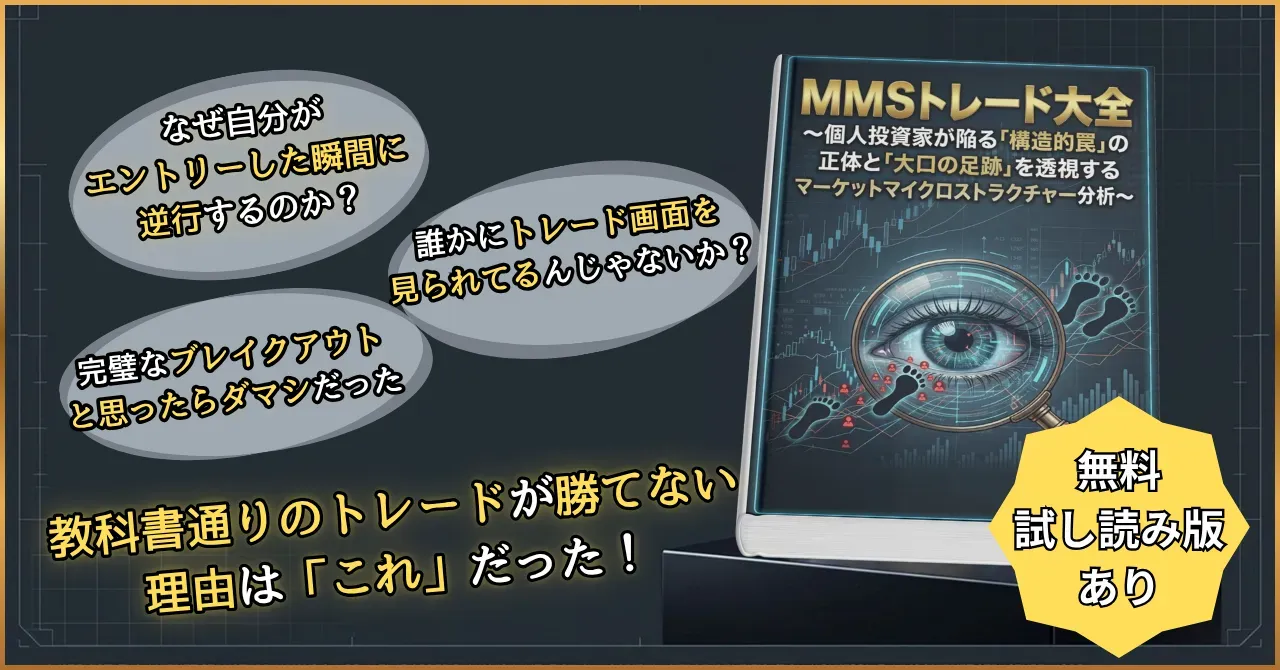
【Limited-time early access campaign!】→ MMS Trading Encyclopedia—The structural traps that individual investors fall into and a market microstructure analysis to see the footprints of the big players— (There is also a free trial version)
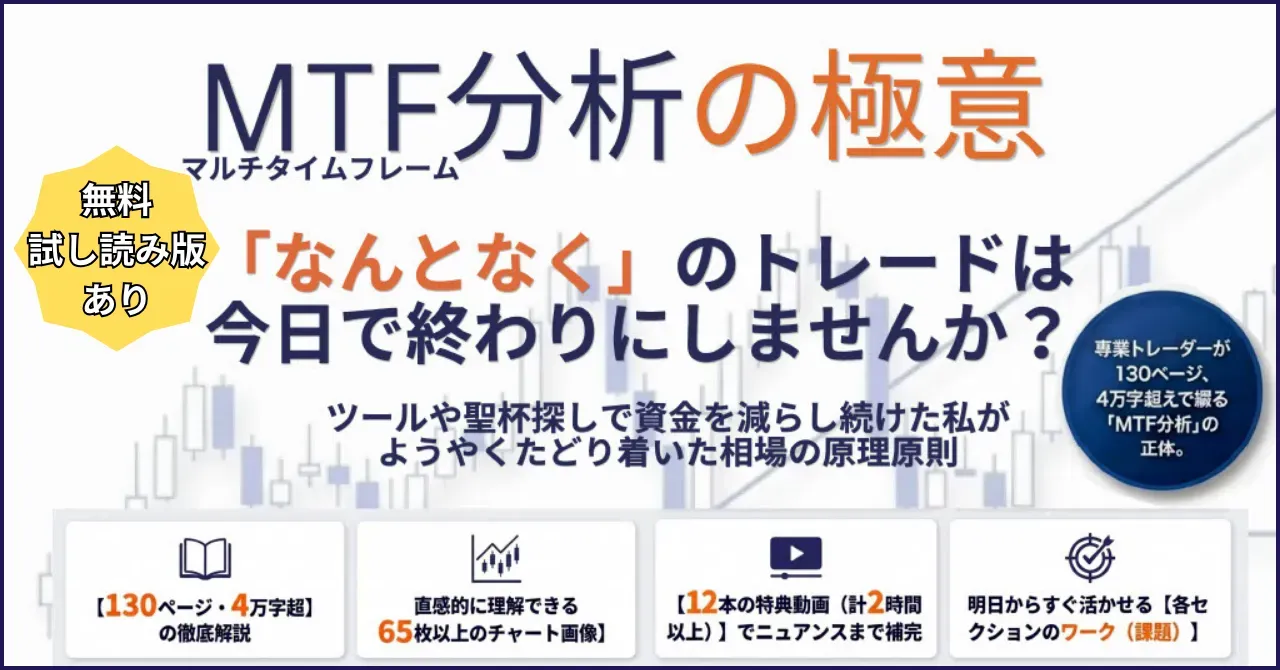
→The Secret of MTF Multitimeframe Analysis (There is also a free trial version)