
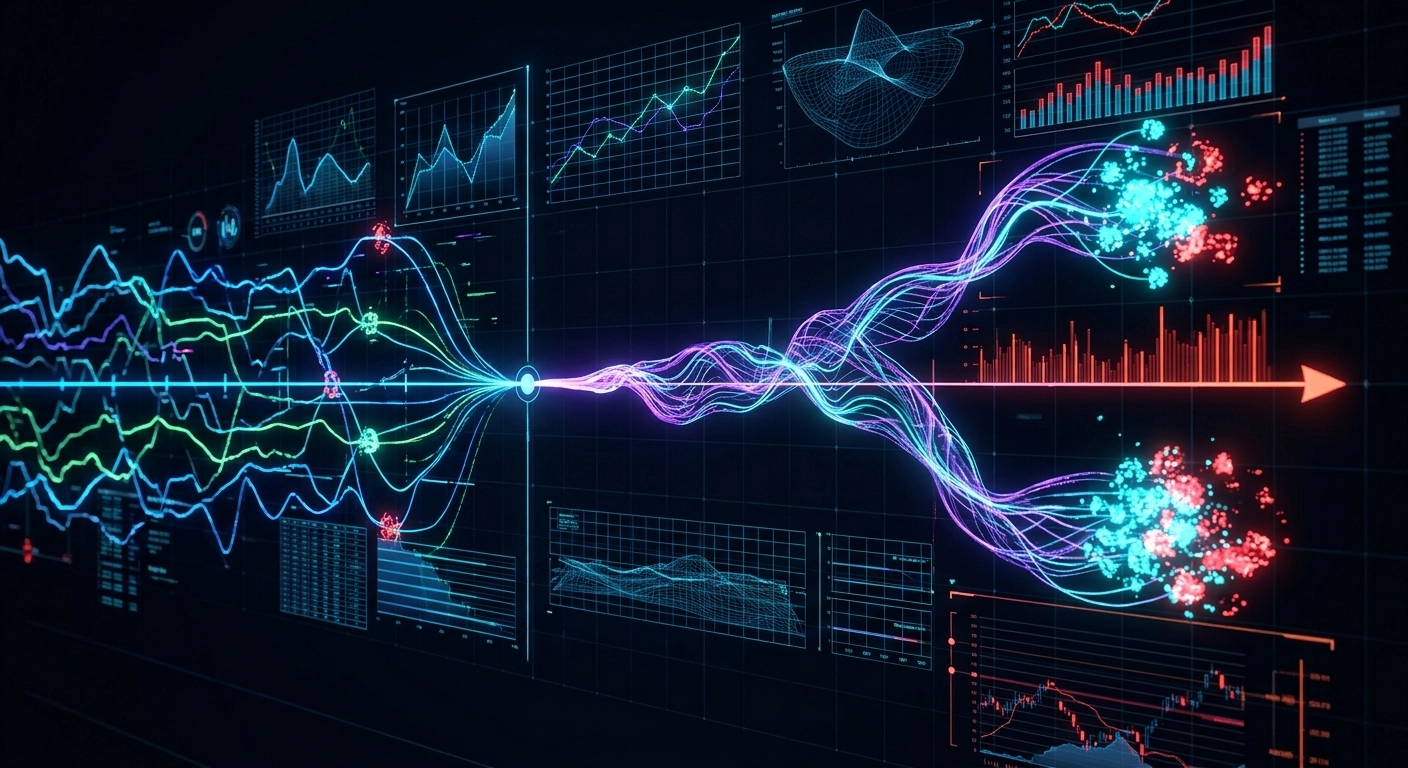
【Development Log】Look-Ahead Bias — The Trap of Verification that Makes You Peek at Future Data
■ Definition of Look-Ahead Bias
Look-Ahead Bias refers to a verification mistake where information from the future, which should not be reachable at the time of validation, is inadvertently used as part of the decision material. In the world of system trading, it is known as one of the typical causes that makes backtest results look better than the real performance.
The essence of the problem is not about “intentional cheating.” Even if developers are not conscious of cheating, in most cases the results end up referencing future data due to the implementation method of the logic or platform-specific quirks.
Also, it is necessary to distinguish it from a similar concept, “curve fitting (over-optimization to past data).” Curve fitting reduces generalization to future data by overfitting to past data, whereas Look-Ahead Bias has a different cause in that it uses information that is inherently unavailable at the validation time. The remedies are also different, so designing the validation process while conflating the two may fail to achieve a fundamental resolution.
■ Major Causes
The representative causes can be organized into three items.
First, reference to an unresolved bar. The currently forming candlestick has not yet closed, yet real-time price at that moment is often used as the “close” in the decision criteria. Differences in platform or script implementations make this discrepancy hard to surface, which prolongs the problem.
Second, use of repainting indicators. Some custom indicators are designed so that past drawing results can be rewritten later. On the chart during validation, signals may look timely, but they are results revised afterward and differ from what was available in real time. This is common in zigzag-type and some oscillator indicators, and it is advisable to check for repainting before introducing them.
Third, reference to unresolved higher-timeframe data in a multi-timeframe configuration. It is not rare to design logic on a short timeframe that incorporates information from longer timeframes, but it is necessary to verify individually whether the higher timeframe values are being referenced before they are confirmed.
■ Concrete Example
As an example, suppose a logic that “enters when the mid-point of the day’s high and low is broken.” If the high/low are calculated based on values that were confirmed only when the day ended, it means the decision used information that was not knowable during the daytime. In backtest environments that read daily data in bulk, this type of contamination tends to occur and be difficult to detect.
■ Impacts
Backtests that include Look-Ahead Bias tend to overestimate both win rate and expected value because they are computed based on information not available in real market conditions. The more optimized a strategy is under such conditions, the larger the performance discrepancy when moving to forward tests or live trading. There are many cases where the complaint is “backtests were good but do not work in live trading.” In addition, developers often are not aware that such contamination exists, which complicates detection.
■ Countermeasures
The first countermeasure is to limit the values used in the decision logic to candles that have already been confirmed. This is easy to overlook in implementation, so it is valuable to explicitly check this as part of an existing logic review. This is particularly important when inheriting logic from a third party or adapting existing sample code.
Second, implementing walk-forward validation is effective. This method splits the validation period and requires decisions to be made using only information available up to each point in time, structurally reducing the chance of future information creeping in.
Third, running forward tests (real-time operation in a demo environment) in parallel with backtests and continuously monitoring the differences in results is also a practical approach. A large divergence suggests structural problems in the validation process that may need attention.
■ Checkpoints
Practically, the following points are recommended to verify: whether the referenced candles for entry conditions are already confirmed, whether the indicators used do not repaint, whether the higher-timeframe reference takes into account the timing of its confirmation, and whether there is a significant discrepancy between backtest and forward-test results.
Also, Look-Ahead Bias can be an issue not only for a single logic but also for portfolio management that combines multiple EAs. Even if individual EAs are sound, referencing pre-confirmation information during portfolio-level evaluation can distort the overall expected value. It is desirable to incorporate such checks early in the development process to prevent later rework.
These issues are often easier to detect by third-party verifications than by developers themselves. Because developers tend to work under the assumption of how their code should behave, blind spots are hard to notice. If there is prolonged, unresolved divergence in performance, having a third party review the verification process is one option.
If you have concerns about the verification accuracy of your logic, it is recommended to start by reviewing the verification process itself. For consultation, please contact the GoGoJungle Miscellaneous Consultation Desk below.