[Interdimensional Interest Rate Gap 37%] Why is the CHF/TRY (Swiss Franc/Turkish Lira) catching attention now? The bright and dark sides of Turkey's economic normalization, and the decisive blow to Lira/Yen operations
As of September 2026, there is a currency pair quietly gaining attention in the global market. It is the Swiss franc / Turkish lira (CHF/TRY).
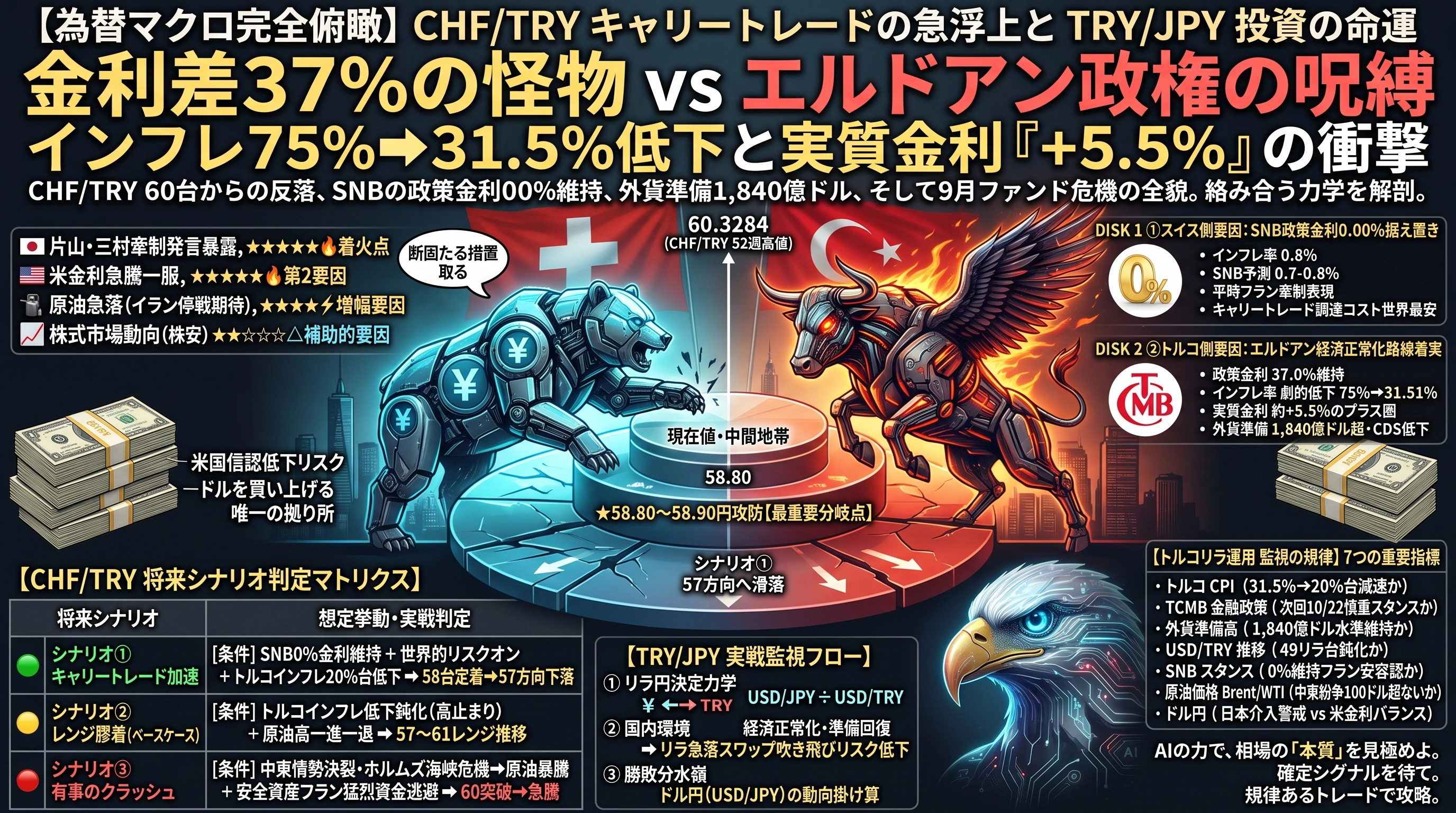
The Swiss franc, which maintains an ultra-low interest rate (0%), and the Turkish lira, which offers an extremely high policy rate of 37%. The interest rate differential reaches a remarkable 37 percentage points.
“Has the Turkish lira stopped being a currency that continously plunges unilaterally like in the old days?”
“What is driving the carry trade in CHF/TRY?”
“And how will this affect our investment in Turkish lira against the yen (TRY/JPY)?”
Beyond superficial high interest rate appeal, we will dissect in detail from a practical perspective the political risk under the Erdogan administration, the inflation and real interest rate situation, and the synthetic structure of CHF/TRY.
Chapter 1: The Phenomenon Now with CHF/TRY — Retreat from the 60s
First, we examine the recent rate trend of CHF/TRY.
【CHF/TRY Recent Trend (September 2026)】
・August 20: 52-week high recorded at “60.3284”
・Early September: trades around 59.80–59.70
・Late September: retreat to around 58.80–58.90 (about 2.4% drop from the high)
A falling CHF/TRY chart means that the Turkish lira is being relatively bought back against the Swiss franc.
However, it would be premature to conclude that the Turkish lira is strongly and independently rallying. Behind this price movement lie the dynamics of “economic normalization on the Turkish side”and“the Swiss side’s franc weakness and ultra-low rates” acting together.
Chapter 2: Swiss-Side Factors — Keeping the policy rate at 0% and a stance to restrain franc strength
The Swiss National Bank (SNB) at its policy meeting on September 24, 2026,kept the policy rate at 0.00%, marking the fifth consecutive hold.
【Swiss Macro Environment】
① Thoroughly low inflation:
Swiss inflation is around 0.8% recently. SNB's long-term projections (2026–2028) show 0.7–0.8% as very stable. There is no urgent need to raise rates.
② Normalization of franc strength restraint tone:
From a period of emergency intervention against excessive franc strength during the Middle East tensions, it has reverted to a normal expression of “acting in the market as needed.”
③ Revival of the funding currency status:
With the Bank of Japan’s rate hike (policy rate 1.25%), some yen carry trades are relocating to the Swiss franc, which still maintains 0% rates.
In other words, while the Swiss franc has a solid foundation as a safe haven (current account surplus and fiscal soundness),it remains a currency with the world’s cheapest funding cost for carry trades.and tends to be sold under these circumstances.
Chapter 3: Turkish Side Factors — A Sharp Fall from Inflation 75% to 31.5% and Positive Real Rates
Meanwhile, Turkey’s economy is moving away from years of “unconventional monetary easing,” following a conventional normalization path led by Finance Minister Simsek and the Central Bank (TCMB).Orthodox normalization path is being steadily pursued.
【Dramatic Changes in the Turkish Economy】
① Maintenance of policy rate at 37%:
TCMB kept the policy rate at 37.0% at the September meeting (overnight lending rate at 40.0%). A hawkish stance is maintained, with a willingness to tighten further if inflation worsens.
② Inflation halved:
From a peak around 75% in May 2024 to 31.51% in August 2026, inflation has fallen sharply.
③ Real interest rate in positive territory around +5.5%:
Policy rate (37%) minus inflation rate (31.5%) = +5.49%. Domestic and foreign money’s desire to hold lira has surged.
④ Dramatic rebound of foreign exchange reserves:
Central bank reserves exceeded $184 billion. Pure reserves excluding swaps recovered to about $56 billion. Five-year CDS (credit default swap) fell to 220 bp, greatly reducing default risk.
In recent years, the vicious cycle of “foreign exchange reserves drying up and the central bank being forced to cut rates, causing the lira to crash” is clearly stopped for now.
Chapter 4: Remaining Achilles’ Heel — Political Unrest, September Fund Crisis, and Oil
Even as Turkey’s economy normalizes, it is not a worry-free state. The market still bears these structural risks that cast shadows over it.
【Three Major Potential Risks Turkey Faces】
① Domestic political tinder (Judiciary and opposition suppression):
Disputes surrounding CHP’s Imamoğlu and internal party conflicts continue. Foreign investors remain wary that Erdogan’s regime may again threaten independence of the judiciary and central bank.
② September domestic investment fund crisis:
Around $18 billion of investment funds faced redemptions and liquidity issues in the stock market. Resignations of ruling-party executives amid insider allegations revealed vulnerabilities in the domestic financial system.
③ Energy import dependence and Middle East geopolitics:
Turkey is a net energy importer. Rising oil and natural gas prices due to Middle East tensions directly worsen the current account deficit and trigger renewed inflation, exerting pressure on the lira.
Against the USD/TRY, the rate remains around the 49 lira level (about 48.99), and the lira-down trend has not completely stopped.
Chapter 5: CHF/TRY Structural Decomposition — Is it Lira Strength or Franc Weakness?
The CHF/TRY cross is governed by the following equation.
CHF/TRY = USD/TRY ÷ USD/CHF
Plugging in current values, it is calculated as follows.
48.98 (USD/TRY) ÷ 0.831 (USD/CHF) ≈ 58.94 (CHF/TRY)
From this relationship, there are two patterns in which CHF/TRY can fall (Lira strength and Franc weakness):
Turkish lira strengthens against the dollar (USD/TRY declines)
Swiss franc weakens against the dollar (USD/CHF rises)
The current fall below 60 in CHF/TRY reflects that “trust in the Turkish central bank has led to a slower USD/TRY rise.”and“SNB holding at 0% and the consequent dollar up – franc down – adds to this effect.”
Chapter 6: The 3 Major Scenarios That Will Shape the Market Moving Forward
Depending on the global environment going forward, CHF/TRY is likely to follow one of the three scenarios below.
【CHF/TRY Future Scenarios】
? Scenario 1:
Carry trades accelerate (CHF/TRY in a downtrend) [Conditions] SNB holds 0% rate + global risk-on + Turkish inflation drops to the 20s + [Behavior] settle around 58, move toward 57. A dominance of “franc selling and lira buying” driven by the 37% interest rate differential.
? Scenario 2:
Range-bound (base case) [Conditions] Turkish inflation growth slows (remains high) + oil prices fluctuate. [Behavior] High-rate support (lira buying) and Middle East risk caution (lira selling) offset to produce a 57–61 range.
? Scenario 3:
Crisis in a conflict — CHF/TRY spikes sharply and lira crashes [Conditions] Middle East breakdown and Hormuz Strait crisis → oil surge + massive flight to safe asset franc → [Behavior] “safe-haven franc buying during crisis” and “lira selling due to energy gains” explode simultaneously, breaking 60 and surging.
Chapter 7: Practical Message for Turkish Lira-Yen (TRY/JPY) Investors
Currently, for investors who hold TRY/JPY for swap income, this framework provides highly important insight.
TRY/JPY is determined by “USD/JPY ÷ USD/TRY.”
Domestic Turkish environment:With economic normalization and foreign exchange reserves recovering, the risk of “swap loss from a lira plunge” has diminished significantly compared with past years.
Key determinant:Not only whether Turkey is improving, but also how USD/JPY moves due to U.S. interest rates and the Bank of Japan, and the interaction between the two.
If USD/JPY remains stubbornly near 157–158 and Turkey’s inflation continues to fall while high rates persist,the accumulation of swap points will sufficiently offset the gradual depreciation of the lira.This situation is becoming more feasible.
Conclusion: 7 Important Indicators to Watch
The seven check points that determine the success or failure of Turkish lira management are as follows.
Turkish Consumer Price Index (CPI):Whether it accelerates a steady deceleration from 31.5% toward the 20% range
TCMB (Turkish Central Bank) Monetary Policy:Whether the cautious stance can be maintained at the next meeting on October 22
Turkey’s foreign exchange reserves:Whether they can be increased without dropping below the level of $184 billion
USD/TRY trend:Whether the rise in the 49 lira range slows the pace of lira depreciation
SNB stance:Whether 0% rate retention and franc weakness tolerance continue
Oil prices (Brent/WTI):Whether oil staying above $100 due to Middle East tensions is avoided
USD/JPY:Balance of Japanese intervention risk and U.S. interest rates
Rather than deciding with emotions like “buy because rates are high” or “danger because of Turkey,” observe macro indicators as fixed points and maintain a smart investment strategy with strict risk control.
If you found it helpful at all, please consider following me, as it motivates updates!
Updates would be greatly encouraged by your follow!
? [GogoJungle Listing Page]
https://www.gogojungle.co.jp/users/723420/products