

Cryptocurrency Market Analysis (September 29)
As of Tuesday, September 29, 2026, the cryptocurrency market isrecovering from the early observed downturn and entering a phase of so-called "post-correction stability". Although macroeconomic headwinds (such as rising U.S. long-term interest rates and surging oil prices) are weighing on risk assets including stocks, the crypto market is being strongly supported by persistent buying from institutional investors and strong inflows into ETFs (exchange-traded funds).
Today’s notable currency movements (overview)
According to data from major data sites (such as CoinMarketCap) as of nightly figures, the price levels of each currency are following the below trends (slight price differences may arise depending on the exchange rate used and the exchange).
・Bitcoin (BTC): hovering around $84,400. Over the past 24 hours, essentially flat with a slight positive gain (~+0.1%). In the morning, it briefly dipped to the low $83,000s, but subsequently showed a strong recovery. The current market capitalization remains around $1.67 trillion.
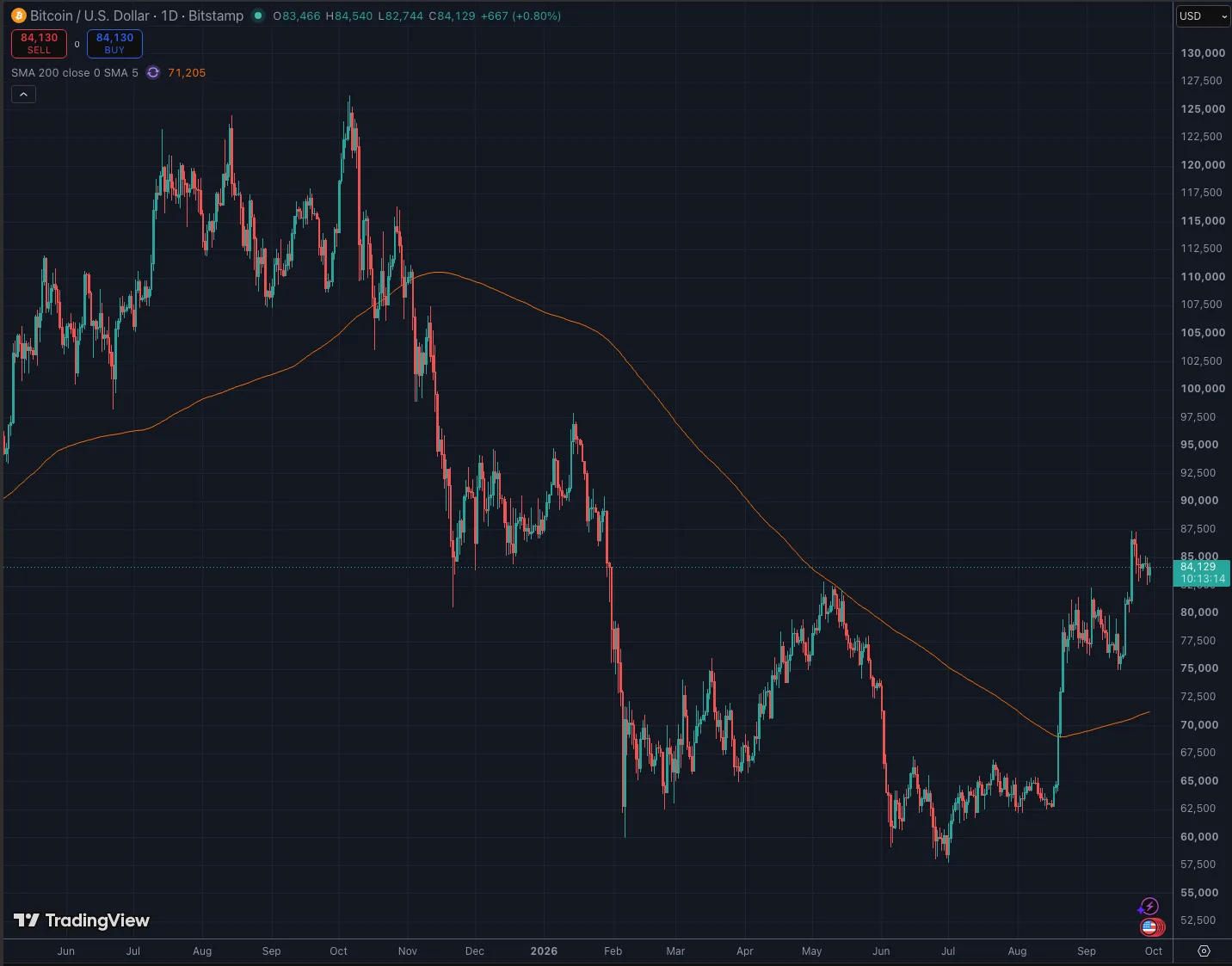
Bitcoin daily chart
・Ethereum (ETH): around $2,740. Over the past 24 hours, a slight gain (~+0.3%). From the recent high in the $2,800 range, it has tempered somewhat.
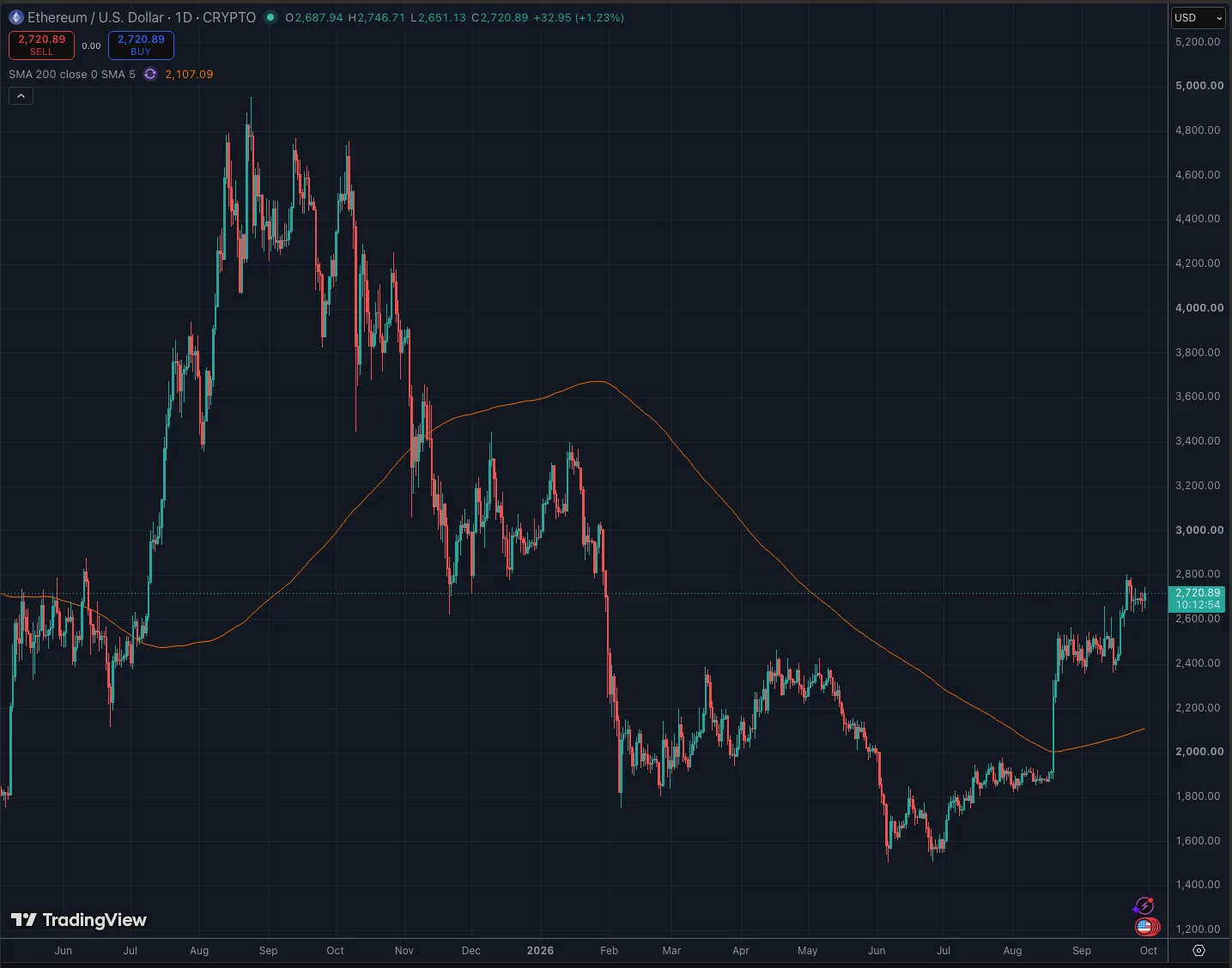
Ethereum daily chart
・BNB: around $766 (roughly flat over 24 hours).
・XRP: around $1.54 (relative strength over the past 24 hours).
・Solana (SOL): around $121 (slight upward trend).
・Other major coins: Major altcoins such as TRX and DOGE have shown only modest fluctuations. The overall market cap stands at about $2.89 trillion, and the "Fear & Greed Index" indicating investor sentiment in the market is at 69 (greed zone). Also, BTC dominance, indicating Bitcoin’s share of the crypto market overall, is around 58.5%.This reflects the overall investor sentiment in the market.
Morning reports had stated that Bitcoin fell by over 1% to push into the $83,000 range, but after that the demand for dip buying entered and a smooth rebound followed.
Main factors driving price movements (macroeconomics vs. institutional investors)
The primary cause of the market decline and price correction this time is changes in the macroeconomic environment and rising geopolitical risks.
【Downside/Pressure factors】
・U.S. 10-year Treasury yield surged: U.S. 10-year yields surpassed 5.2%, reaching a high not seen since 2007.A rise in government bond yields makes risk-free assets more attractive, reducing relative appeal of risk assets like cryptocurrencies.
・Rising oil prices and inflation fears: Reports that Brent crude rose to around $105 per barrel, and renewed geopolitical tensions involving the U.S. and Iran are fueling concerns about prolonged global inflation.
・Resilience of U.S. economic indicators and hawkish rate-hike expectations: Stronger-than-expected U.S. data such as PMI (Purchasing Managers’ Index) have heightened expectations for continued monetary tightening by the Federal Reserve..
【Upside factors (institutional investor activity)】
・Additional purchases by Strategy (formerly MicroStrategy): The largest holder of Bitcoin, Strategy, announced it added about 1,666 BTC (≈$143 million) this week. This brings their total holdings to over 847,000 BTC, with an average cost basis around $75,437..
・ETH purchases by BitMine: BitMine has been increasing its Ethereum holdings, approaching about 4.9% of the total issued supply.
・Capital inflows into spot BTC ETFs: Ongoing strong inflows into U.S. physical Bitcoin ETFs continue to underpin market supply-demand dynamics.
Price movement since last week (context and background)
Looking back at price action since around September 22, the pattern appears to be a “healthy correction after a surge.”
・Around September 21, Bitcoin jumped from the $81,000 range to briefly exceed $87,000 (about a 7% one-day rise).
・Afterward, profit-taking amid rising long-term yields and overheating concerns pushed the price back to the $83,000–$84,000 range.
・Nevertheless, even after this correction, September’s monthly performance remains in positive territory, with a very high likelihood of achieving three consecutive months of gains (July, August, September), with September alone rising by about 7%.
・ETH also remains in an uptrend for seven weeks, currently pausing around $2,800. Some altcoins like SOL showed relatively strong moves across the week.
In summary, “major coins like Bitcoin and Ethereum are reacting to macroeconomics and interest rates in a straightforward way, while infrastructure- and data-oriented altcoins with clear individual catalysts (institutional adoption and practical use) surged locally. Going forward, the outcome of Wednesday’s PCE inflation data and the trajectory of U.S. interest rates will be key drivers for market direction.”
BTC ETF capital inflow status (last 1 week trend)
A major market driver remains the U.S. physical Bitcoin ETFs. In particular, the rate of inflows during the week of September 21–25 was remarkable.
During this week, the net inflow to U.S. spot BTC ETFs reached about $2.39 billion, the largest weekly inflow of 2026 and a high since October 2025. This has clearly turned year-to-date performance into positive territory.。
【Daily inflow benchmarks (referencing SoSoValue, etc.)】
・September 21 (Mon): approx. +$0.99 billion (one of the largest single-day inflows this year)
・September 22 (Tue): approx. +$0.715 billion
・September 23 (Wed): approx. +$0.347 billion
・September 24 (Thu): approx. +$0.191 billion
・September 25 (Fri): approx. +$0.135 billion
Led by BlackRock’s IBIT, which raised about $12 billion in a week, inflows reached a notable scale. Fidelity’s FBTC also continued strong inflows. As of September 28, inflows were about +$31 million, with the pace still sustaining its momentum. Ethereum ETF (ETH ETF) also saw net inflows of about $690 million in the same week..
Notable movements in individual assets and altcoins
Over the past week, Quant (QNT) has been the most talked-about asset in the market.
・Background and events: On September 24, The Clearing House, a major payments consortium involving the world’s top 25 banks processing over trillions of dollars daily, announced it would adopt Quant’s technology for its tokenized deposit clearing and settlement network “On-Chain Money Initiative.”
・Price impact: In response, QNT surged over threefold in a week, from the $60s to briefly exceed $300, with a push toward around $370 at the peak. Volatility remained high with sharp swings; while some questions remain about direct payment use, it has garnered strong attention as a potential enterprise infrastructure adoption example in traditional finance.
【Other notable coin movements】
・Chainlink (LINK): Sturdy weekly gains of around +17% driven by demand for oracles that bring real-world data.
・The Graph (GRT): Data indexing demand surged, with temporary gains around +18%.
・Hedera (HBAR): News or expectations related to IBM sparked a big buy-in for the stock price at one point.
・ZEC (Zcash): Fell more than 12%, reflecting the broader volatility in the crypto market.
・HYPE (Hyperliquid): Market concerns rose ahead of a large token unlock scheduled for September 29, raising supply pressures.
Overall outlook indicates that major currencies like Bitcoin and Ethereum react straightforwardly to macroeconomics and rate trends, while infrastructure- and data-oriented altcoins with clear, material catalysts surged locally. Going forward, the results of Wednesday’s PCE inflation data and U.S. interest rate movements will be a major determinant of market direction.
Other market, macro, regulatory, and political news
【Macro economy and AI-related news】
・U.S. 10-year yields rising to 5.2% pushed gold below $4,200 and caused oil to rise again amid increasing Middle East tensions; the macro environment remains very challenging. However, investment enthusiasm for AI-related stocks remains strong.
・The Philadelphia Semiconductor Index (SOX) rose 6.27% week-over-week, with AMD, Arm, and Intel each climbing more than 10%.
・This week's biggest events in stocks and IT markets are Micron Technology’s earnings and OpenAI-hosted “OpenAI DevDay.”
【U.S. presidential and political news】
・President Trump’s latest asset disclosure has been released. It reveals purchases of Coinbase and Strategy stock, each up to about $100,000 in July, while he was found to have sold holdings in crypto-mining companies CleanSpark and Marathon Digital. Coinbase is the largest crypto exchange in the U.S., and Strategy is the world’s largest Bitcoin holder.
【 regulator moves (SEC/CFTC) and data privacy】
・SEC Commissioner Hester Peirce, known as the “Crypto Mom,” has decided to step down on October 2. For about nine years, she advocated for crypto regulation with a view to fostering a sound industry, and after stepping down she plans to become an associate professor at Regent University Law School from November. She is regarded as one of the early champions of crypto regulation.
・Before leaving, Peirce warned about the dangers of the current excessive KYC regime, stating that “the current KYC/AML system is merely creating a vast personal data database, exposing crypto holders to phishing and real-world physical risks in case of hacks or data leaks.”
・As a solution, she strongly advocates proactive use of zero-knowledge proof (ZK) technology to satisfy regulatory requirements without directly exposing personal information.
・CFTC announced it will intensify the development of clear rules for crypto markets, delivering a strong statement: “GO TIME” (time to act).
・As regulatory progress continues, the SEC has partially approved tokenized stock trading, and the CFTC has significantly relaxed registration requirements for derivatives developers, accelerating regulatory updates.
【Paid subscription notice】
In the paid subscription area, we offer deeper, more valuable analysis of individual assets.
“We want to invest in the next big asset that will generate profits beyond Bitcoin and Ethereum.”
“We want to understand the essential flows and future of the crypto market and ride that wave confidently.”
If this is your view, please consider subscribing. Continuous high-quality research is the key to big success.
(This report has been delivered at the forefront of the market since its launch in 2016)