
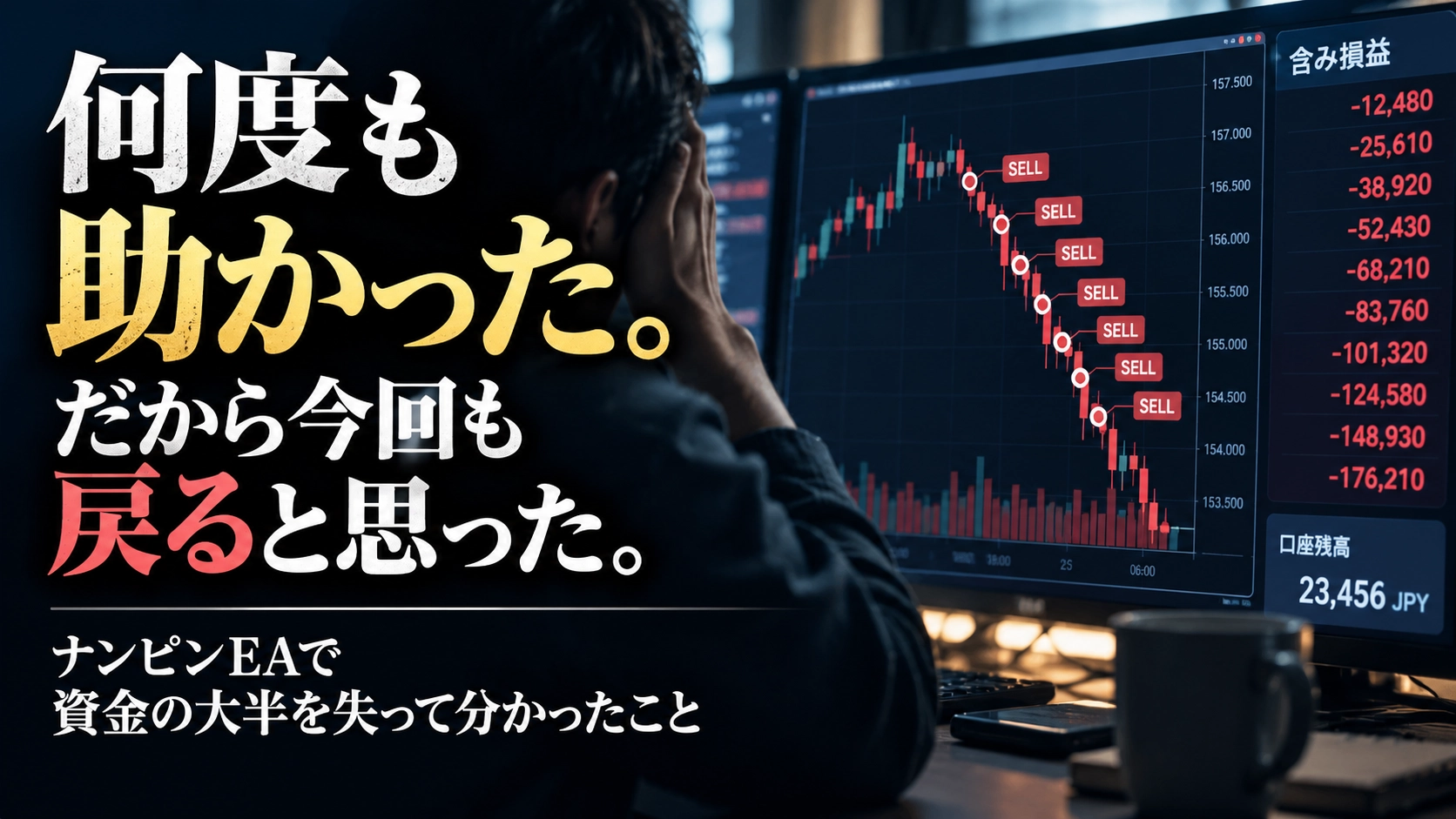
The story of being repeatedly saved by an Averaged Entry (Nampin EA) and finally losing most of the funds
Using EA, the funnest moment was when?
If asked that, I would probably answer, “When I was running the grid trading EA.” It’s a story from about seven years ago, not long after I started using EAs.
I traded almost every day. Even when I was in a drawdown, I added more positions.
And when the market slightly recovered, it would all close out at a profit.
Whenever I opened MT4 or MT5, my balance was gradually increasing, and I’d confirm, “Today I made a profit,” “This week was also in the black.”
When viewed as a monthly rate, 10–15% persisted for about three months. Honestly, that was incredibly enjoyable.
With ordinary EAs, there are times when stop-losses keep piling up. But with a grid EA, even if there is a drawdown, it doesn’t instantly mean you’ve lost.
In the past, I’ve thought, “This time surely it’s over,” only for the market to rebound and close out profitably as if nothing happened.
After seeing that many times, strange as it may seem, you start to think, “In the end, this will rebound again.”
Then one day. It doesn’t rebound.
At first, it was the usual drawdown
The trigger was after a major economic release.
At the moment of the release, I had a rule to turn the EA OFF manually, but I couldn’t prevent a one-sided trend from continuing afterward.
What frightened me more was the trend after the news, rather than the move in the news itself.
I didn’t think it was dangerous from the start. Rather, at first I felt, “Again, I’m averaging down.”
One position, two positions, three positions—the unrealized losses kept piling up, but I’d had similar situations many times before.
And every time, the market came back. So I waited. If it would come back a little more, it would close at a profit.
If I’ve come this far, it’s better to wait for the rebound than to cut losses.
As I thought that, I ended up increasing my positions even more. The unrealized losses grew larger.
Still, I had been saved by experience in the past. This was troublesome. If an EA had been consistently losing from the start, I think I could have given up sooner.
But grid EAs had saved me many times before.
I had the feeling, “This time, I might be saved again.”
It wasn’t about “How much can I earn today” anymore
Normally, I would look at my account thinking, “How much profit will today bring?”
But as drawdowns grew, what I watched shifted completely.
Margin, unrealized losses, and the room before a margin call—the question I asked every time I opened a chart was, “When will I get margin-called?”
The daily profits I had accumulated seemed barely noticeable anymore.
At the time I was doing this part-time alongside a full-time job, and honestly, I could hardly focus on work.
Looking back now, I think the big factor was that I was operating beyond what I was willing to invest as capital, in my own mind.
If it were 100,000 yen, it wouldn’t matter. But with 1,000,000 yen, it would matter. It’s simple, but that’s how it is.
And I kept thinking, “If only I had withdrawn more when profits were there.”
When the balance was rising, I believed it would rise further. I told myself to withdraw once the margin doubled.
I felt it was more logical to withdraw after winnings were confirmed.
But when I held a large drawdown, that idea shifted to, “If I had withdrawn then.”
Of course, withdrawing wouldn’t have saved the EA itself.
Still, at least a portion of the profits accumulated up to that point remained in my hands.
When profits were still growing, I rarely thought that way.
Backtest DD and real money losses were completely different
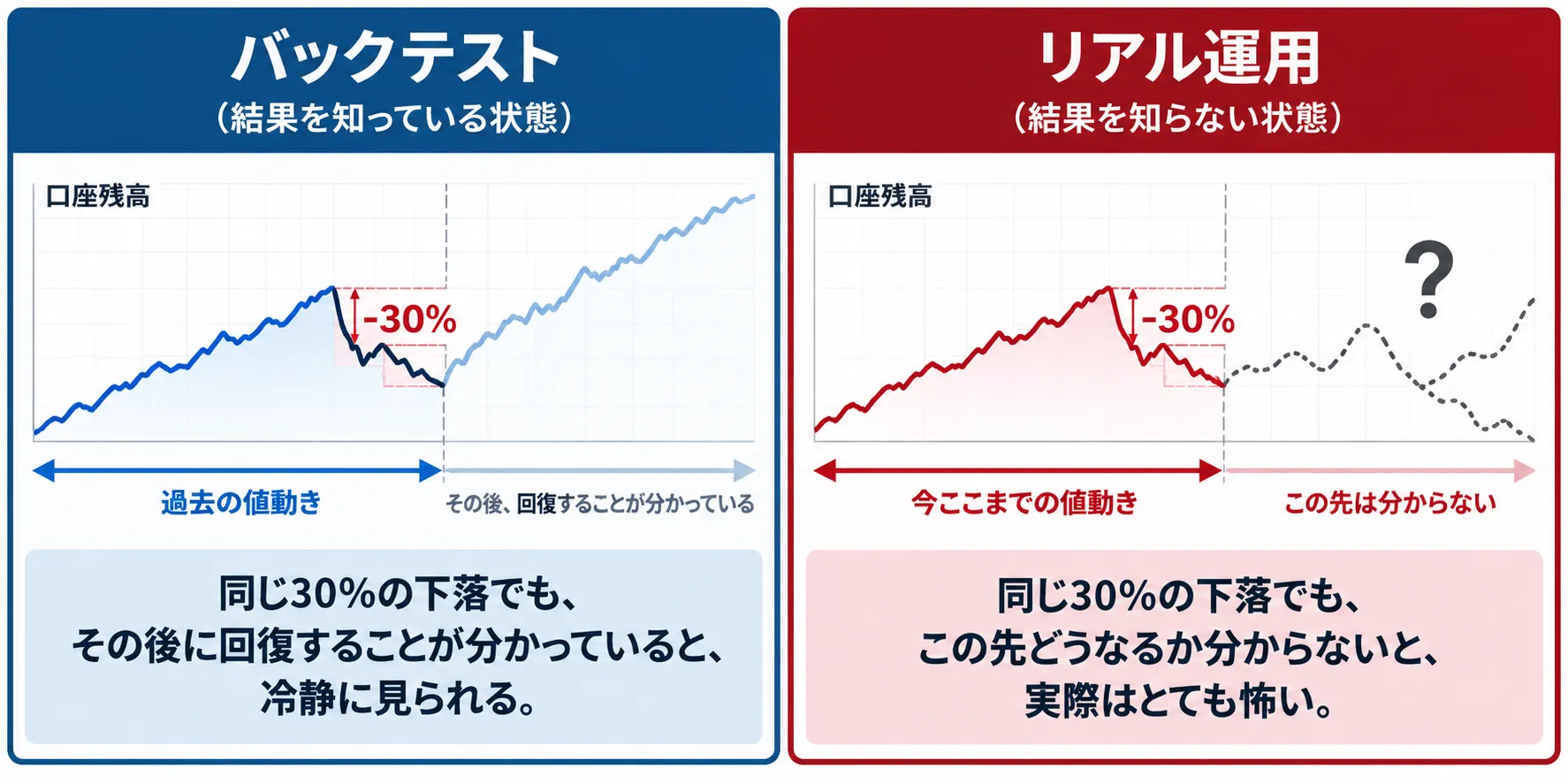
In the previous article, I wrote about maximum drawdown. In backtests, you can calmly look at a “maximum DD of 30%.”
If the graph is under water but shows recovery afterward, you can analyze, “Did it drop about 30% here?”
But in real time, you cannot see what lies ahead. Even if you’re down 30% now, you don’t know if this is the bottom.
Tomorrow it might bounce back. It might go further down.
And in the case of a grid EA, as the market moves against you, your positions increase.
Seeing a completed figure like “maximum DD 30%” beside experiencing your own money continually decreasing with an unknown future is a totally different thing for me.
This is something I really felt after actually running it with my own money.
The grid EAs I used didn’t survive long in the end
Until now, I’ve actually used several grid EAs. Of course, this isn’t about all grid EAs out there.
This is just within the scope of what I used.
Among them, I didn’t experience a grid EA that stayed stable for more than a year.
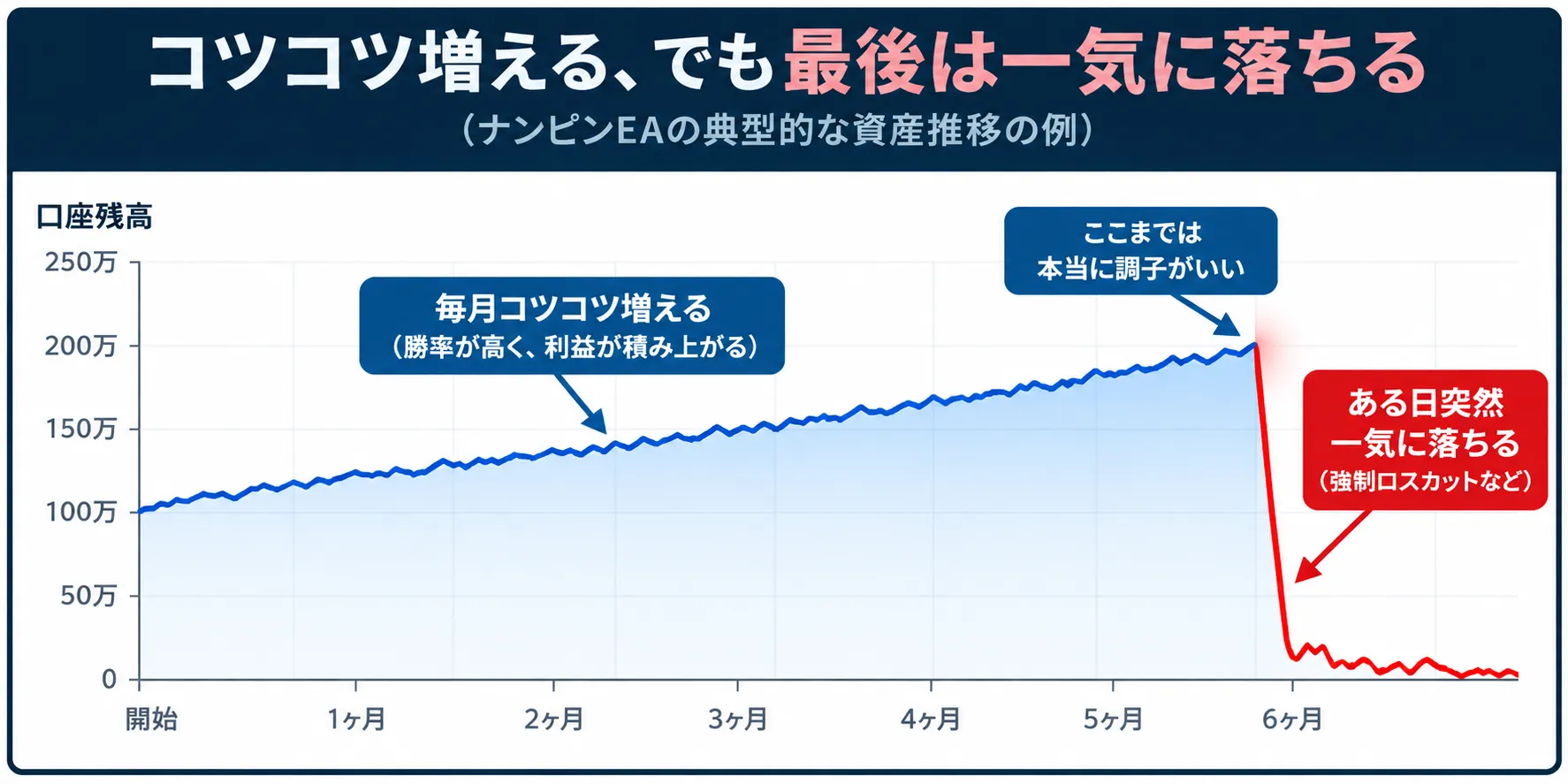
Some performed really well for a while. It would profit every month. The balance would grow. “This might be usable for a long time.”
But in the end, a long trend would drag it into a forced stop-out, nearly wiping out the account or wiping out about 80% of the funds.
I’ve experienced this several times.
Honestly, when the number of positions increased and I carried unrealized losses for a long time, I began to feel a kind of half-giving up.
I don’t remember much about the moment of forced stop-out, but I feel there was a sense of relief somewhere.
So now, when I see an EA whose daily profits are neatly accumulating, I look at something a bit different than before.
Rather than asking, “How much can this EA earn?” I ask, “How far can this EA lose?”
Still, there is appeal in grid EAs
Reading this far, you might think, “Then you shouldn’t use grid EAs.”
But I don’t think it’s that simple.
The reason grid EAs become popular is that, once you try them, you understand why.
They tend to have higher win rates.
Profits are often realized daily.
In ranging markets where prices move up and down, they can accumulate profits very cleanly.
And above all, the experience of “not letting losses be realized, letting the price rebound to profit” is extremely powerful.
One time you’re saved. Then saved again. Then saved again. As this continues, you feel, “This EA is strong.”
But what scares me is more likely right there. If an EA keeps losing, you can tell it’s dangerous quickly.
At least for the ones I’ve used, after a long stretch of winning, a loss of a different magnitude would come suddenly.
So “high win rate” and “profits every month” aren’t enough to judge risk.
I’ve experienced that many times with real money.
The lens of fund management changed
In the past, when I looked at an EA, I cared a lot about monthly returns, annual growth, and win rate.
Of course profits are still important. There is no point in operating an EA that doesn’t profit.
But just as important now is, “How much remains when it fails.”
For example, if you invest 1,000,000 yen and there’s a chance to gain 200,000 yen in a year, that doesn’t look bad on the surface.
However, if earning that 200,000 yen means you could eventually lose almost all of your 1,000,000 yen, that changes things.
Conversely, even if profits are small, where you cut losses, where you stop adding positions, and how much maximum risk you take—those aspects are easier to manage when known from the start.
It’s easier for me to operate when those parameters are clear from the beginning.
Ultimately, a grid EA’s fund management isn’t only about “how much can you earn,” but also about “how much can you lose and under what assumptions.”
Through past failures, I’ve come to think this way.
Even so, I’m building another grid EA now
Even after suffering with grid EAs, I’m now building another grid EA myself.
I know it sounds a bit contradictory.
The EA I’m building isn’t aiming from the start to be “a safe EA.” On the contrary.
From the premise of grid risks, I’m considering how far to add positions, when to stop adding in drawdown, where to give up, and what losses to tolerate in the worst case.
That’s what I’m thinking about.
In the past I’d think first about, “How can I increase profits?”
Now I’m thinking first about, “When will this EA die?” Even the same grid EA looks at it in a very different way.
Grid is not evil; it was scary to use it unknowingly
I don’t want to negate grid down to its core. In fact, I’m making one again now.
If I could tell my past self one thing, it would be: when daily profits are rising, think about how this state could end and what its end would look like.
Daily wins, high win rate, consecutive months of profits—these figures are alluring. I’ve been drawn to them many times.
But what I truly want to know in fund management might be the opposite of those numbers.
When you lose, how much will you lose? And can you truly accept that loss?
Even if backtests answer easily, you might not be able to give the same answer when your own money is actually decreasing. At least I couldn’t.
I now believe grid EAs will someday break. Whether that is tomorrow or ten years from now, no one knows.
That’s why I’m not designing to withstand with a heavy margin, but exploring how far you can risk with a small margin.
I’m testing that now. Decide in advance how you will end it with the assumption that it will break.
I hope to write again about what becomes clear through that testing.