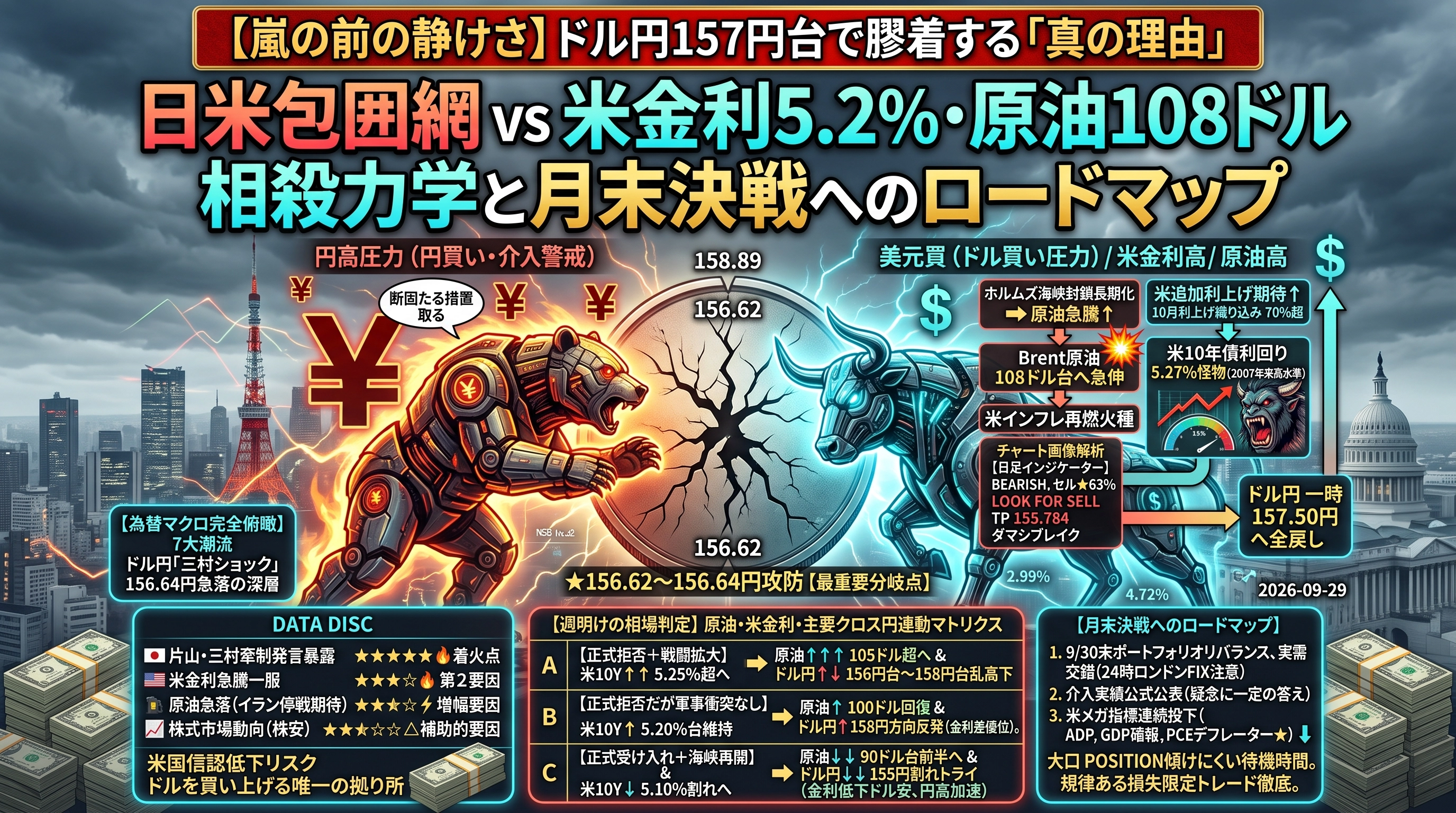
The Calm Before the Storm: USD/JPY Stalled in the 157 Yen Range over the "Real Reason"―― Japan-U.S. Yen Weakness Encirclement vs the Offsetting Dynamics of U.S. Interest Rates at 5.2%, Crude Oil at $108, and the Roadmap to the Month-End Battle
On Tuesday, September 29, 2026, in the afternoon, USD/JPY has been consolidating in an extremely narrow range in the early 157 yen area (around 157.30–157.40).
On the previous day’s late afternoon, after a strong verbal intervention by Finance Minister Nimura, it briefly fell toward around 156.50 yen, but subsequently, supported by higher crude oil prices and a sharp rise in U.S. long-term interest rates, it fully retraced to the mid-157 yen range.
“If the Japanese and U.S. leaders and financial authorities are restraining the yen’s depreciation so aggressively, why isn’t it falling?”
“Why doesn’t a risk-off yen appreciation occur when equity markets are falling?”
From the surface of the market, the current environment may seem full of contradictions. We will exclude all forced over-interpretations and speculation, and present a precise and logical整理 of “what is offsetting now” and “what to prepare for tonight into tomorrow.”
Chapter 1: The true nature of the “offsetting structure” that is immobilizing the 157 yen range
The principal reason the dollar/yen can’t break up or down isthat a “very strong yen-buying pressure” and a “very strong dollar-buying pressure” are colliding head-on and completely offsetting each other.
【Two major vectors currently dominating the market】
[The force pushing down from above (yen strength and policy intervention factors)]
• Speech by Nimura, the Finance Minister:
“The message from both governments is very clear. It would be best if the market took it at face value.” “We are not satisfied or confident about the current exchange rate” “There are no funding constraints,” he stated clearly.
• Telephone discussion between Finance Minister Katayama and U.S. Treasury Secretary Yellen:
“The yen is undervalued a problem,” and they reaffirmed cooperation to maintain order in the foreign exchange market.
• Fear of actual intervention:
The upper 157 yen range to the upper 158 yen range is a super-alert zone where rate checks occurred in overseas markets on the 18th last week.
VS
[The force pushing up from below (dollar strength and higher U.S. rates)]
• Historic high level of U.S. long-term rates:
The U.S. 10-year yield briefly around 5.27% (a high since 2007), and the 2-year near 5%.
• Reacceleration of inflation concerns due to a sharp rise in crude oil:
Because President Trump rejected Iran’s ceasefire proposal, Brent crude briefly surged toward the $108 range.
• The Fed’s next rate hike priced in at “over 70%”:
The overwhelming interest rate differential between the U.S. and Japan strongly supports the dollar/yen moving toward the 156 yen area.
“There are reasons to buy yen, but there is no reason yet to sell dollars.” This is the cold, hard fact behind the range-bound movement around 157 yen.
Chapter 2: Phenomena that defy textbook explanations — the trap of “rising stock prices despite a yen depreciation”
On the 28th, U.S. stocks fell sharply with the Dow Jones down 347 points and the NASDAQ down 248 points, and the Nikkei in Tokyo extended losses on the 29th.
Typically, one would expect the classic chain: “stock declines → risk-off → buying of the safe-haven yen.” However, that chain is not triggering this time.
【Current market mechanics】
Tension in the Middle East (Gulf of Hormuz risks)
Crude oil surge (around $108)
Re-inflation fears in the U.S. & prolonged expectations of Fed rate hikes
U.S. long-term rates jumping to the 5.2% area
“Stock declines due to high rates” and “dollar buying and yen selling driven by widening rate differentials”
occur simultaneously
In other words, today’s stock market decline is not a panic like a financial crisis, but a “correction caused by higher oil prices and higher rates.” Since the dollar/yen is most sensitive to rate differentials, theドル高・円安 becomes the dominant force.
Chapter 3: Tonight’s timing—forex releases and a relay of Fed officials
From tonight through early tomorrow morning, a flood of important U.S. economic indicators and remarks from Fed officials are due.
【Tonight through early morning a focus timetable (Japan time)】
・22:00 ?? U.S. July S&P CoreLogic Case-Shiller Home Price Index
・23:00 ?? U.S. August JOLTS Job Openings ★Important (measures labor demand softness)
・23:00 ?? U.S. September Consumer Confidence Index
・24:00 ?? Bowman, Fed Vice Chair, speaks (voting member)
・25:40 ?? Barkin, Fed Governor, speaks (voting member)
・26:00 ?? Dalai, Chicago Fed President, speaks
・26:30 ?? Kashkari, Minneapolis Fed President, speaks
・27:00 ?? Williams, NY Fed President, speaks (central bank's core, voting member)
・28:00 ?? Waller, Fed Governor, speaks (central bank's core, voting member)
How to read tonight
The market has already priced in a probability of a further rate hike in October FOMC at over 70%.
Therefore, if Fed officials merely make typical hawkish remarks (inflation sticky, not ruling out additional rate hikes, etc.), the catalysts may be exhausted and the market may not rise sharply.
Upper limitation trigger:If JOLTS job openings surge, and officials speak of additional hikes, the 157.80–158.00 yen range may be retested.
Lower limitation trigger:If employment data clearly slows and officials hint at dovish risks of over-tightening, the 156 yen range may quickly give way on a fall in U.S. rates.
Chapter 4: The real battlefield tomorrow, September 30 — a mega-event at month-end and quarter-end
If you want to see the market clearly, tomorrow, September 30 (Wednesday) is the event to watch more than tonight.
【Bombshell events concentrated on September 30】
① End of the month and end of Q3: A large portfolio rebalancing by institutions and funds worldwide. Running into the London Fix (Japan time midnight), there will be trades where demand-driven selling and buying decouple from technicals.
② Official disclosure of the Ministry of Finance’s “FX intervention record” (19:00):
Whether the government and the BOJ actually intervened with real money from August 27 to September 28 will be laid bare. (A certain answer to the doubts raised after the rate check on the 18th will be provided.)
③ A string of major U.S. indicators:
• U.S. August ADP employment statistics • U.S. Q2 GDP (second estimate) • U.S. August PCE deflator (the Fed’s most closely watched price indicator) ★
With so much important material concentrated at once, today the 29th, large investors are also in a “wait-and-see” stance, reluctant to drastically tilt their positions.
Summary: Today’s practical trading posture
There is no need to force a scenario to predict the market.
Near 157.80–158.00 yen:Policy restraint by the U.S. and Japan and the fear of actual intervention are at their peak, so aggressively chasing higher prices on the long side is strictly discouraged.
Near 156.50–156.80 yen:As long as U.S. rates are supported at 5.2%, there is a tendency for dip-buying to provide a solid downside cushion.
Today, base your approach on “continuation of the 157-yen range, centered there,” and only react when U.S. rates and crude oil move decisively due to JOLTS or official remarks, maintaining a disciplined, protective stance.
If you found this at all helpful, a follow would be appreciated and encourages updates!
It would be a motivation for updates!
[GogoJungle Listing Page]
https://www.gogojungle.co.jp/users/723420/products