

Are you properly cutting losses? ~About extremely important loss-cutting~
Hello! I’m SAKU.
In previous articles, we’ve learned the basics of technical analysis and line analysis, but today I want to focus on what is important in any analysis method or theory: risk control and cutting losses.
It’s easy to overemphasize entry at first, but please never think you can win by neglecting this!
What is a Loss Cut
A loss cut means closing a position that is in a loss, as the name suggests.
In other words,locking in the loss.
It is also called a stop or a stop-loss. This time, I’d like to examine the idea of loss cutting.
Loss Cutting in Trading
First of all,loss cutting is inevitable in trading.
No matter how skilled a trader is, there isn’t anyone who has never cut a loss.
Even the best methods involve losses.
There is no absolute certainty in trading.
There is no 100% winning method, the so-called “grail.”
Therefore, there will inevitably be times to cut losses.
Since trading can result in both wins and losses,“loss cutting” is part of the method anda necessary expense to consider.
Is “Loss Cutting” = “Loss”?
When you hear “loss cutting,” you tend to picture a negative outcome.
After all, your money decreases.
If you equate money decline with “loss,” then loss cutting is indeed a “loss.”
However, proper loss cutting can prevent further losses beyond that point.
By cutting losses, you can confine damage within a tolerable range in situations where you might have suffered a huge loss.
There is an aspect of loss cutting as“a defense to prevent your funds from decreasing any further.”
If you entered with solid justification and cut your losses, it is not merely “a loss” but a legitimate strategy called“loss cutting.”.
Conversely, loss cutting should be placed at the point where the rationale or scenario behind the entry collapses..
So where is the point where the entry justification or scenario collapses?
This depends on the method and post-entry scenario-building, so it’s not something you can state universally.
However, one thing common to all methods is that there is a justification to enter.
An entry that has no foundation is simply gambling.
Understand your own method well,the scenario up to this point is within tolerance—if it goes beyond this point, the original entry discussion changes, so decide to cut losses here.
Don’t extend your loss position opportunistically from a desire not to lose, and don’t set losses too narrowly from a fear of losing.
If the amount goes negative and you feel anxious, place a stop-loss orders at the same time as your entry to prevent slippage.
If you cut losses manually, do so decisively and cleanly.
Wanting to shift your loss-cutting level indicates that your entry environment, justification, or scenario-building prior to entry was insufficient.
Loss cutting should be not “convenient” but “decisive.”
So, this time I’ve written my own view on“loss cutting.”.
Regarding the specific way to place loss cuts, you’ll learn it as you study technical analysis, but as your knowledge and skills in trading rise, your perspective on loss cutting will evolve, and you’ll come to know where you should cut losses!
In fact, when you expertly cut losses in a precise moment, it can feel more satisfying than winning.
Trading isn’t about getting excited or downhearted from each win or loss; it’s about making a profit overall.
To that end, you cannot detach yourself from“loss cutting.”.
That’s all for now!
In the e-book I wrote (linked under the image below), I thoroughly explain not only loss cutting but also fund management and position management from the fundamental mindset to concrete methods, so please check it out!
Next article here ↓
Are you Misunderstanding Trading? That Image Might Be Dangerous!
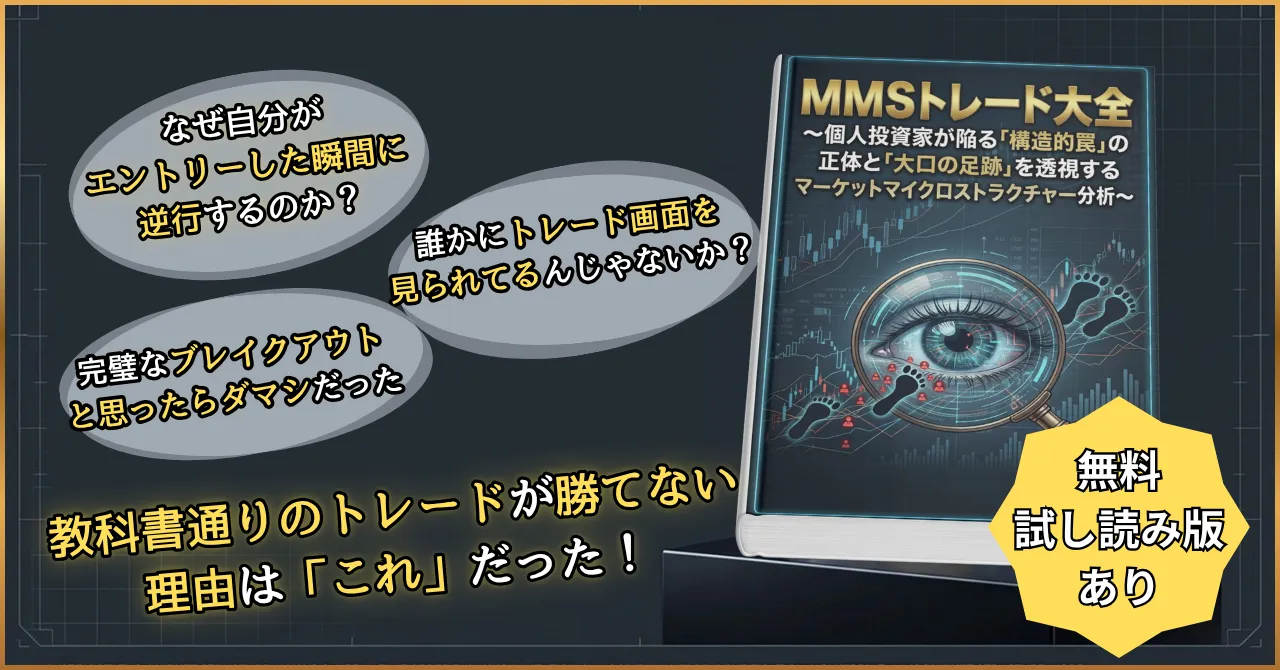
【Limited-time Public Preview Campaign!】 → MMS Trading Encyclopedia—Understanding the 'Structural Traps' that Individual Investors Fall into and Market Microstructure Analysis of the Footprints of the Big Players— (There is also a free trial version)

→The Secrets of MTF Multi-Timeframe Analysis (There is also a free trial version)