
【Forex Macro Complete Overview】Dollar-Yen "Mimura Shock" 156.64 Yen Plunge Deep Dive — The 7 Major Trends woven by Oil, U.S. Interest Rates, U.S. Stocks, and Gold, and the Daily Chart Indicators' Warnings
On the evening of September 28, 2026 (Monday), the dollar/yen (USD/JPY) showed volatile moves, ranging from the high 157s to briefly dropping to 156.647 yen.It fell sharply to 156.647 yenbefore showing rough price action.
The spark was a headline by Finance Minister Mr. Mimura: “From now on, I will continue to discuss FX at the level of the Finance Minister and myself.”
However, if one merely attributes this drop to a single causality of “Mr. Mimura’s remarks = yen buying,” one would misjudge the essence of the market.
Currently, the market is woven together by seven major currents,“oil, U.S. inflation, U.S. interest rates, global equities, USD/JPY currency diplomacy, China developments, and quarter-end flows”in a complex interconnection.
Along with objective signals from indicators shown on the charts, we will dissect the outlook of the global market and provide a complete set of criteria for judging tonight’s New York session.
Chapter 1: A global view of the “7 major currents” driving the world market
Step back from the single currency pair USD/JPY and take an overview of the seven vectors currently powering the market.
【Seven forces shaping the world market】

① Middle East and oil supply concerns (higher oil prices)
 President Trump’s rejection of Iran’s ceasefire plan prompts oil (Brent/WTI) to attempt higher levels again at the start of the week.
 Worries about prolonged closure of the Hormuz Strait fuel inflation.

② U.S. inflation concerns and expectations of additional Fed rate hikes
 Higher oil prices revive expectations of U.S. rate hikes.
 From speculation of higher rates and a stronger dollar, gold (a safe asset) falls more than 1%.

③ High U.S. long-term interest rates
 U.S. 10-year yield remains near the high 5% range.
 Vigilance on inflation and U.S. debt supply supports the dollar from underneath.

④ Risk appetite in U.S. equities (stability)
 Despite high oil prices and higher interest rates, the Dow remains around the 51,800 level, and U.S. stocks do not breakdown.
 Expectations for AI and corporate earnings break the “Middle East conflict = immediate full risk-off” chain.

⑤ USD/JPY policy in Japan and the U.S.—yen depreciation containment
 Mr. Trump’s yen depreciation concerns, Prime Minister Takai’s remarks on underestimation, and today’s remarks by Finance Minister Mimura.
 Both sides may have placed a strong “political lid” in the 158–159 yen range.

⑥ Slowdown in Chinese economy and U.S.-China tariff reductions
 China’s August industrial corporate profits slowed to +4.2%, and the Shanghai Composite fell 1.67%.
 Meanwhile, the U.S. and China agreed to reduce tariffs by $60 billion each, easing some global trade concerns..
⑦ Rebalancing flows at end of September
Institutional investors' position unwinds and real demand flows clash as quarter-end (September 30) approaches.
Thus, the market now faces a clash between “dollar-buying factors (oil, U.S. rates, and the Fed)” and “yen-buying factors (Japan-U.S. yen strength and Bank of Japan minutes).”
Chapter 2: Mimura’s remarks and the Bank of Japan minutes—why did it race down to 156.64 yen?
This evening, when Finance Minister Mimura stated, “From now on, I will continue to discuss FX at the level of the Finance Minister and myself,” the market plummeted from the high 157s to 156.647 yen.
The drop was not boosted solely by rhetoric. It was reinforced by the synergy with the “Bank of Japan July Monetary Policy Meeting Minutes” released earlier in the day.
【Key points of the BoJ July Minutes】
- Emphasis on anchoring core price inflation at 2%
- Necessity to adjust policy dynamically in response to economic and price conditions
- Mention of the possibility that the pace of rate hikes could be faster than market expectations
The market took in a double signal: “continuation of exchange-rate discussions by the Finance Ministry (warning of interference)”and“room for BoJ to accelerate the pace of additional rate hikes”.
Combined with the continued yen depreciation restraints from U.S.-Japan leadership talks over the past week, short-term players’ longs were all dumped as they judged buying above 158 yen to be stepping on a mine. This is the essence of the 156.64 yen drop.
Chapter 3: The truth of the Bearish signals that charts are showing
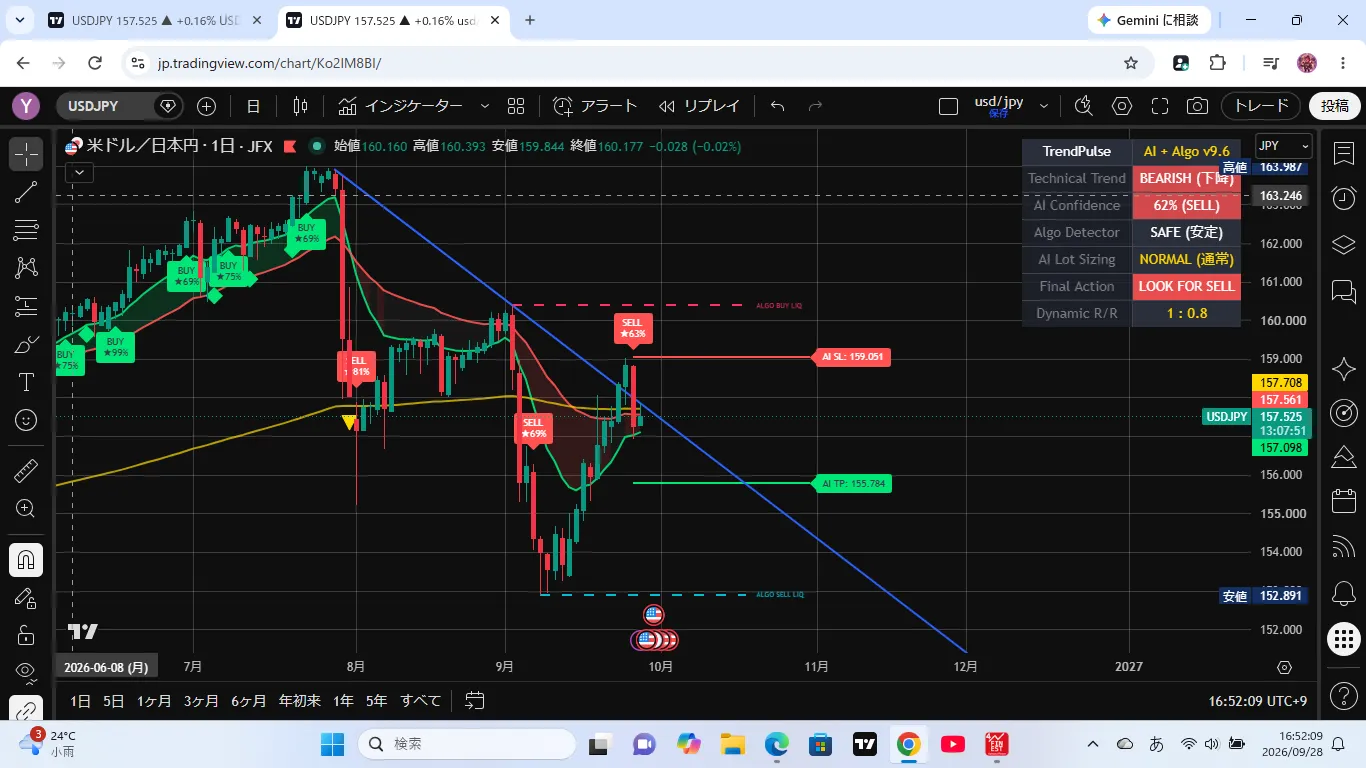
Looking at the attached daily chart (TradingView), the indicator cluster clearly displays a downward signal.
【Daily chart indicator analysis】
- Technical Trend: BEARISH (downtrend)
- AI Confidence: 62% (SELL)
- Algo Detector: SAFE (stable)-Final Action: LOOK FOR SELL (selling on rallies)-AI SL (stop loss): 159.051 yen-AI TP (take profit): 155.784 yen
Examining the chart structure shows that the blue downward trendline drawn from the July high briefly broke above to near 159 yen but then completely stalled and was pushed back inside the line (a failed breakout / false breakout) pattern is complete[cite: 3].
Furthermore, recently a “SELL ★63%” signal lit up, and the candlesticks have moved below the short-term moving averages (red and yellow lines)[cite: 3].
As the targets calculated by the indicators show “155.784 yen”[cite: 3], technically the structure has shifted toward a regime where downside selling is highly favored.
Chapter 4: The largest abnormal-signal to monitor tonight
The key to conquering tonight’s New York market is not price action of USD/JPY alone, but monitoring the distortions in correlation with external markets.
Tonight, important statements from U.S. officials include:
21:15 ?? Powell FRB Governor remarks
02:25 ?? Cook FRB Governor remarks
02:30 ?? Barkin, President of the Richmond Fed remarks
What to pay attention to as a decisive abnormal signal
【Bearish trend confirmation signals】
Oil (Brent) rising toward $100
U.S. 10-year yield staying in the 5% area
DXY rising
  Yet……
USD/JPY falling and clearly breaking below 156.50
Crosses such as EUR/JPY, GBP/JPY, and AUD/JPY also broadly weak
If this phenomenon occurs, it would mean that global dollar strength has been completely overridden by the policy risk of U.S.-Japan authorities causing an extreme yen appreciation. In this case, the indicator target of155.78 yen[cite: 3], and even a rapid move toward 155.00 yen would accelerate.
Conversely, if oil stays high and U.S. rates stay high and the cross yen recovers, keeping USD/JPY around 156.50 and moving toward the mid-157s, the support from U.S. rate differentials would still be in effect, suggesting a 156.50–158.00 yen range may continue.
Conclusion: Do not view USD/JPY in isolation; view it as the culmination of the world market
Today’s drop to 156.64 yen resulted from a crack caused by the clash between “dollar-buying factors (oil, U.S. rates, and the Fed)”and“yen-buying factors from U.S.-Japan policy containment and BoJ hawkish stance.”
Daily indicators suggest “LOOK FOR SELL (selling on rallies)” and warn of resistance in the upside[cite: 3].
However, tonight’s move in New York will be driven not only by Mimura’s remarks but also by the broader external environment.
Keep an eye on the linkage among “oil prices,” “U.S. long-term rates,” “U.S. stocks,” “gold,” and the “crosses of yen,” and calmly gauge the 156.50 support/attack level.
Compare external environment alignment with confirmed signals from indicators, and commit to disciplined trading free of emotion.
If you found this helpful at all, please follow and support us.
An update would be encouraging!
[GogoJungle Listing Page]