

What is FX's backtesting (historical testing)? The complete guide to methods, steps, and how to continue
Introduction
It is often said that “past validation is important.” However, where to start, what to record, and how far to go are often not explained as clearly as one would like.
This article is a guide that summarizes the overall picture of past validation in FX. The detailed methods are written in separate articles. Please read from the parts that interest you.
What you can learn from this article
- What past validation is and why you should do it
- The three ways of past validation and the suitability of each
- Six steps from preparation to review
- Tips for continuing
What is past validation
Past validation is,using past charts to test your trading rules and judgments. It is also called “backtesting.”
The term backtesting often refers to calculating the performance of automated trading programs (EAs) using historical data. The article here deals withpast validation of discretionary trading where you judge with your own eyes and decisions.
There are two main things you can do with past validation.
- Confirm your rules: If you trade according to your rules, quantify what the results would have been in the past market
- Practice judgment: Repeatedly decide “enter or pass” without using real money
Both take time in real markets. In live trading it may take days to wait for the same situation to recur. With past charts, you can see that situation dozens of times instantly.
The three ways to perform past validation
1. Scroll the chart by hand
Scroll the chart in MT5 and similar platforms to the left, then advance slowly to the right to make judgments.
- No tools required; you can start today
- Because the next bar remains on the right side of the screen,it's easy to see the answer
- Orders, P/L, and reasons are all recorded manually
2. Practice on a demo account
Trade the actual market with virtual money.
- Practice with real executions and spreads
- Since you wait for the market to move, the number of practice sessions is time-bound
- Cannot select specific past market conditions (e.g., days with major news) for practice
Strictly speaking, this isn’t past validation, but it is listed here as a training method.
3. Use a tool that replays past bars one by one
Replay past charts bar by bar and place orders in a virtual account.
- Can judge without looking ahead at future bars (depending on the tool)
- Can adjust playback speed to increase the number of repetitions in a short time
- Many tools automatically record results
- Setting up the tool can be time-consuming and may incur costs
There is no single “correct” method. What matters iswhether you predict future price moves without knowing them in advance andwhether records are kept.
What happens when you can see ahead is described in detail in this article.
▶ Why seeing ahead makes practice ineffective — Three situations where past validation is biased by hindsight
https://www.gogojungle.co.jp/finance/navi/articles/126818
Six steps of past validation
Step 1: Put the rules into words
First, write down the rule you want to test. If you keep vague phrases like “buy on pullbacks,” your judgments will vary by situation and you won’t be able to tally them later.
- In what market conditions (e.g., when higher timeframe is trending up)
- Where to enter
- Where to place stop-loss
- Where to take profit
Write these four things in words that others can read and make the same judgments.
Step 2: Prepare historical data
If you are doing past validation in MT5, load historical data (history) for the currency pair you want to practice.
If you want to inspect in detail, 1-minute data is required. Open a 1-minute chart and press the keyboardHomekey to go back in time. MT5 stores data separately for each timeframe, so pressingHomeon a hourly chart will not increase the 1-minute data.
Step 3: Decide without looking ahead
Progress the chart slowly and decide “enter or pass.” When progressing manually,record your decision before moving to the next barto prevent hindsight bias.
Step 4: Record for each trial
At minimum, record the following items.
- Date/time, currency pair, timeframe
- Buy or sell
- Reason for entry
- Position of stop-loss and take-profit (decided before entering)
- Result (pips or P/L)
- Reason for exiting
- Whether the rule was followed (Yes/No)
The reason for entry is writtenbefore knowing the resultto avoid explaining after the fact to fit the outcome.
Step 5: Review after a sufficient number of trials
A few results aren’t enough; you’ll be swayed by chance. After accumulating a certain number of trials, look at the following:
- Are there differences in reasons for winning vs. losing?
- Is there a difference in profit/loss between trials that followed the rule (Yes) and those that violated it (No)?
- Was the stop-loss position appropriate in hindsight?
Step 6: Correct one rule at a time and try again
When you tweak,change only one aspect at a time. If you change many things at once, you won’t know which change was effective.
After adjusting, go back to Step 3 and try again in the same way.
Tips to keep going
Past validation is not something you finish in one go. It’s important to shape it so you can continue.
- Set a fixed time per session: e.g., 20 minutes a day. It’s easier to keep up with a little each day than longer sessions
- Make it possible to stop midway: record where you left off, so you can resume from there next day
- Reduce the effort of recording: transcribing is burdensome; heavy recording can be more burdensome than practice
- Focus on actions rather than outcomes: prioritize whether you entered according to the rules rather than winning or losing
Reduce effort with tools
The steps 3 “decide without looking ahead” and 4 “record” are time-consuming when done manually.
The MT5 indicator “FX Past Validation Trainer” is a practice tool that replays past charts bar by bar and allows placing orders and recording in a simulated account.
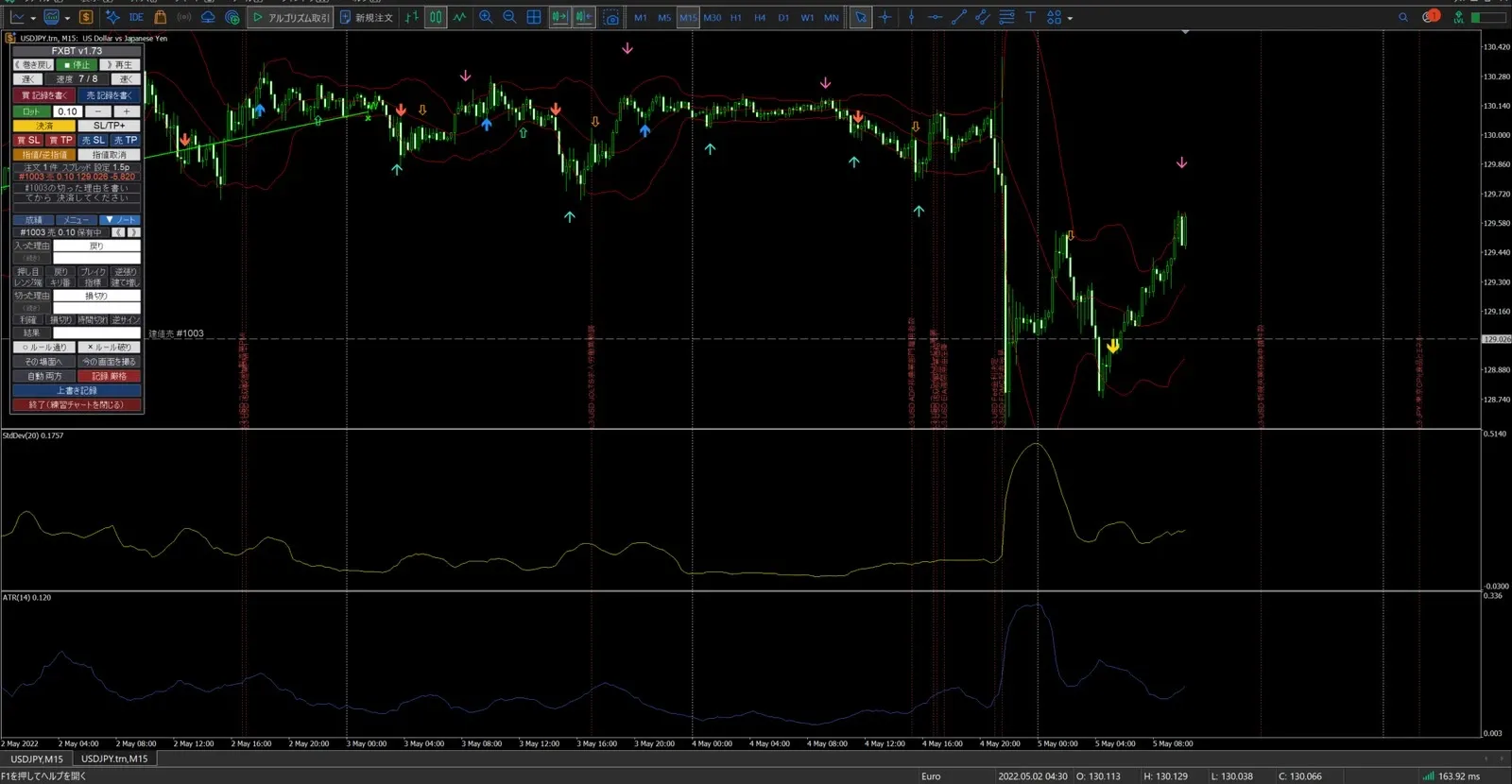
- Future bars do not exist in data, so you cannot see them by scrolling
- Stop-loss and take-profit are set by dragging chart lines. The profit/loss ratio (RR) and estimated loss appear beside the lines
- Reasons for entry and exit, and Yes/No decisions are saved to a notebook for each trial
- You can save mid-way and resume the next day
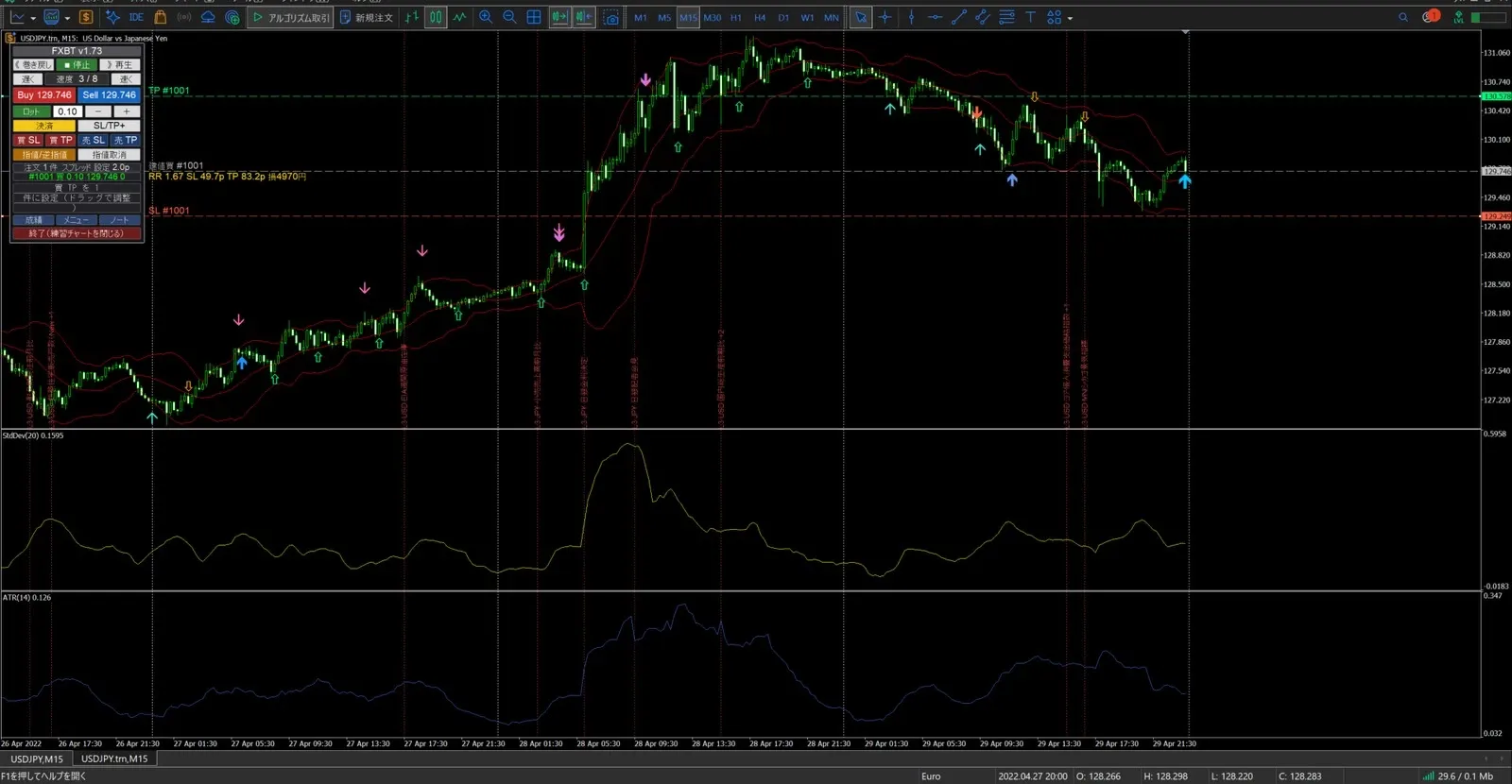
There are things it cannot do. Fees and swaps are not included in calculations. It also does not reproduce price movements finer than the minimum bar you set (default is 1 minute). The rule creation in Step 1 and the review in Steps 5–6 are not done by the tool but by you.
The steps to practice with tools in MT5 are summarized in another article.
▶ How to perform past validation with MT5 when you can’t see ahead — The pitfalls of manual scrolling and practicing with single-bar replay
https://www.gogojungle.co.jp/finance/navi/articles/126682
Summary
- Past validation involves confirming rules on historical charts and practicing judgments
- The important points are whether you decide without knowing the future and whether records are kept
- Write the rules in words → Prepare data → Decide without looking ahead → Record → Review → Change only one aspect at a time, and repeat
About practice tools
The practice described in this article can be done with the MT5 indicator “FX Past Validation Trainer.” It’s a training tool that replays past charts bar by bar, and allows orders, recording, and review in a simulated account.
There is a free version.All features, currency pairs, and timeframes can be practiced up to 30 trades (cumulative). There is no expiration. You can check first whether it runs on your MT5 and whether your usual indicators work.
▶ Free version (Product ID 86772)https://www.gogojungle.co.jp/tools/indicators/86772
If you want to practice without worrying about the number of trades, see the paid version. The trade notes and saved validations written in the free version can be opened in the paid version as-is.
▶ Paid version (Product ID 86765)https://www.gogojungle.co.jp/tools/indicators/86765
Caution
- This tool is for practice purposes. It does not guarantee profits. It does not execute real orders.
- This article introduces practice methods and does not promote any specific trading or strategies.