
Reasons Why Practice Is Not Useful When You Can See the End — Three Scenarios Where Hindsight Enters into Past Verification
Introduction
In backtesting, the results may look good, but in actual trading they don’t always turn out the same. Have you ever experienced that?
There are several reasons, but one that is easy to overlook is“hindsight”Hindsight is the mental tendency to feel that you “knew it from the start” after knowing the outcome.
In past charts, the results are already there. Depending on how you do it, those results can seep into your practice.
What you will learn in this article
- Three situations where hindsight seeps into backtesting
- Ways to reduce hindsight when testing by hand
- The idea of practicing on charts where the next move is “not present”
What’s difficult when hindsight slips in
The purpose of backtesting is to confirm how you would judge in this moment.
However, if you know the answer even a little, your judgment is pulled toward that answer. Although you may think you’re thinking for yourself, you’re actually deciding after seeing the answer.
As a result, your test results appear better than your actual ability. If you enter live trading trusting those inflated results, you’re likely to feel, “This isn’t how it should be.”
Hindsight slips in even when you’re careful. Knowing where it comes from is the first countermeasure.
Scene 1: The next move is visible on the right side of the screen
When you test by hand, you rewind the chart to the left and move gradually to the right.
At this time, the next move is not erased. It’s on the right side of the screen. If you scroll a little too far or change the chart’s scale, the subsequent price movement becomes visible.
If you look at it even for a moment, you can’t forget it. When you feel, “This looks like it will rise,” you may not be able to tell whether that feeling is your own judgment or a memory of the motion you just saw.
Scene 2: The formed bars are shown on the higher timeframe
For example, you practice on a 15-minute chart while checking the trend on a 4-hour chart.
When you test by hand, the 4-hour chart showsthe bars that are formed within the day, drawn in their final shapeEven though it’s only 10 o’clock on the 15-minute chart, looking at the 4-hour chart reveals the high and low up to 12 o’clock already.
Looking at the higher timeframe is important. However, the higher-timeframe view you see by hand tends to mix in the answer from ahead.
The same can be said for bars that are still forming. In past charts, you only see bars that have completed. In real markets, bars form as prices move up and down. Even in a scene where you could have entered if you knew a bullish close would happen, you’ll likely hesitate while the bar is still forming. You can’t practice that hesitation.
Scene 3: Writing the record after knowing the result
Sometimes you conduct backtests in batches and then transcribe them into a table later.
At this time, you write the reasons afterknowing the resultThe outcome makes you want to write that the “justified reasons” supported the winning trades and that you “entered despite poor justification” for the losing trades.
Notes written this way cannot be used for reflection. They are not truly what you were thinking at the moment but explanations aligned with the outcome.
The same goes for practicing on familiar markets. If you remember the price moves from a day with big swings, you’ll have the answer in your head even before you look at the chart.
Ways to reduce hindsight when testing by hand
If you want to proceed without tools, decide the following to reduce hindsight:
- Write before you proceed.Before moving to the next bar, write in one line your reason for “buy/sell/hold.” Then proceed
- Also write the stop loss and take profit in advance.If you decide to enter, write the stop loss and take profit prices first. Writing after the fact does not provide justification
- Only look at confirmed higher-timeframe bars.Only consider bars that closed before the current time. Do not look at bars that have not closed yet
- Do not count scenes you looked at.Scenes where you could already see ahead are skipped from the results
- Avoid markets you remember.If you remember price movements, don’t use them as practice material
However, all of these rely on willpower. When you’re tired, you may proceed before writing. If you continue hundreds or thousands of times, not every day will allow you to stick to them naturally.
Practice on charts where the next move is absent
If it’s hard to prevent hindsight with willpower alone,practice in a state where the next bar itself is absentand use that for training.
The MT5 indicator “FX Backtest Trainer” creates a separate instrument for practice and loads past bars one by one there. Bars that have not yet been loaded are not hidden; they do not exist as data.
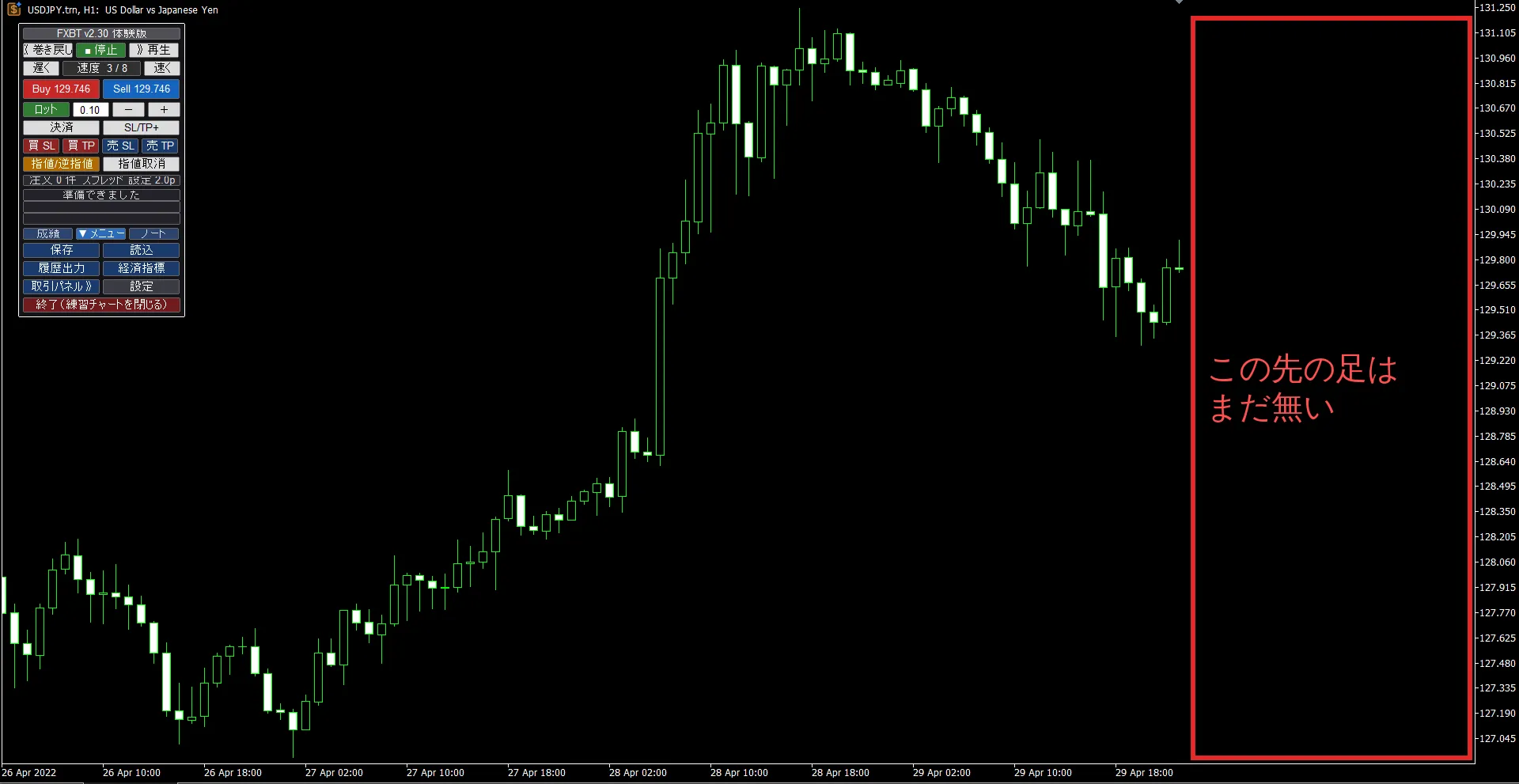
There is nothing on the rightmost end yet. Even if you scroll, nothing will appear ahead.
The three scenes above change as follows when using this method.
- Scene 1 (right side of the screen)Because there is no next bar, scrolling forward won’t reveal it
- Scene 2 (higher timeframe)The higher timeframe is also composed of bars up to the moment you are practicing. The last bar of the 4-hour chart is drawn up to that moment. When played at a slower speed, you can see the bar forming
- Scene 3 (recording)In the trade note, you can write the reason before placing the order. If you enable the “strict” setting, you cannot place orders or close positions until you write the reason
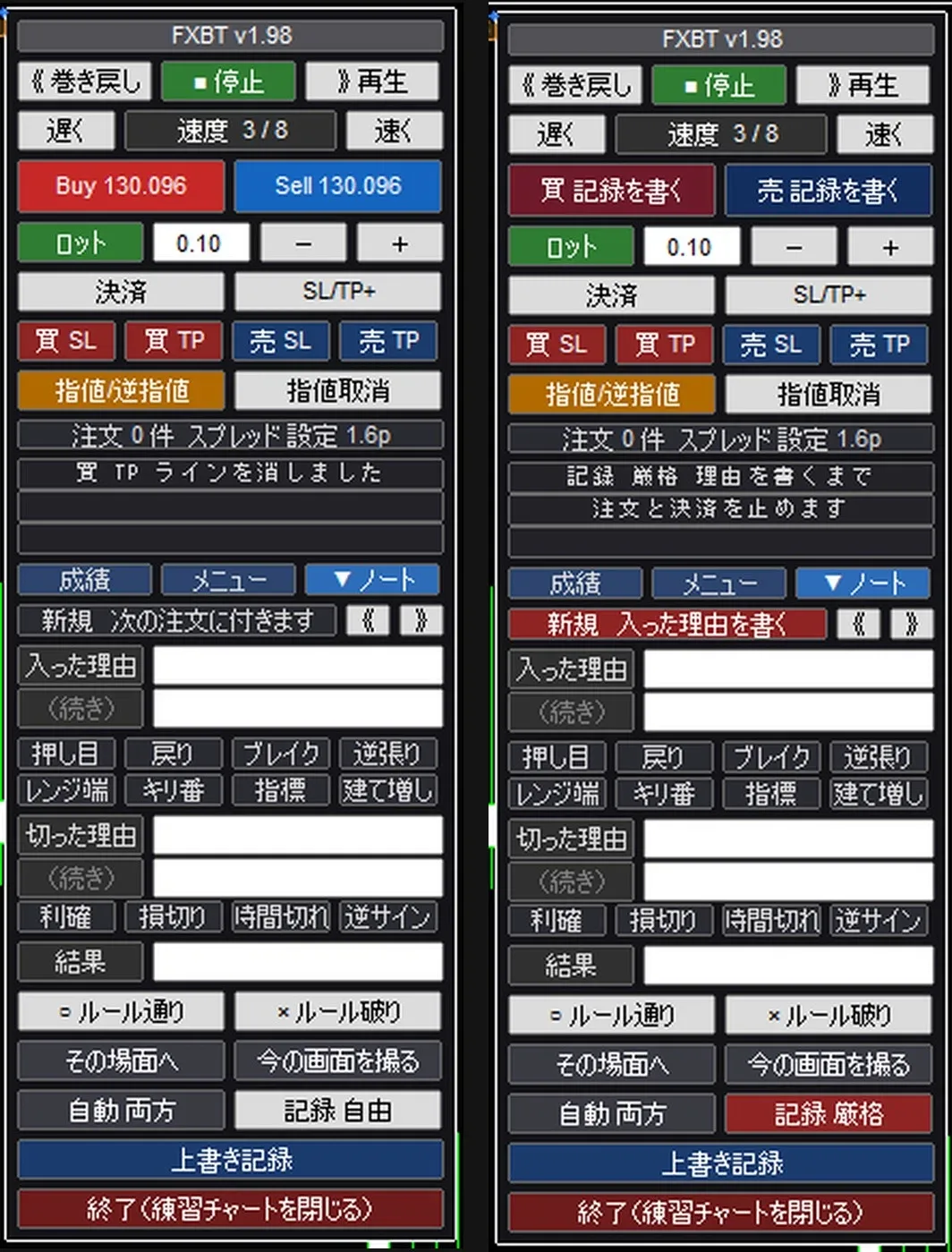
The left is the usual setting, the right is the “strict” setting. In strict mode, the order button changes to “Write record” until you write the reason.
However, this tool also has limitations. Fees and swaps are not included in calculations. It does not reproduce price movements finer than the minimum bar you set (default is 1 minute). It cannot prevent you from seeing familiar markets; that is a choice you must make yourself.
Conclusion
- In backtesting, hindsight sneaks in from three places: the right-side of the screen, the higher timeframe, and later-recorded notes
- If testing by hand, decide in advance to “write before advancing,” “only view confirmed higher-timeframe bars,” and “don’t count scenes you looked at”
- Practicing on charts where the next bar is absent reduces hindsight without relying on willpower
About the practice tools
The practice described in this article can be done with the MT5 indicator “FX Backtest Trainer.” It plays back past charts one by one and provides practice with simulated orders, recording, and review in a demo account.
There is a free version.With the free version, you can practice up to 30 settlements (in total) for all features, currency pairs, and periods. There is no expiration. You can check beforehand whether it runs on your MT5 or whether your usual indicators work.
▶ Free version (Product ID 86772)https://www.gogojungle.co.jp/tools/indicators/86772
If you want unlimited practice, consider the full version. Trade notes and saved backtests created with the free version can be opened in the full version as-is.
▶ Full version (Product ID 86765)https://www.gogojungle.co.jp/tools/indicators/86765
Notes
- This tool is a tool for practice. It does not guarantee profits. It does not execute real orders.
- This article introduces a practice method. It is not recommending any particular buy/sell approach or strategy.