
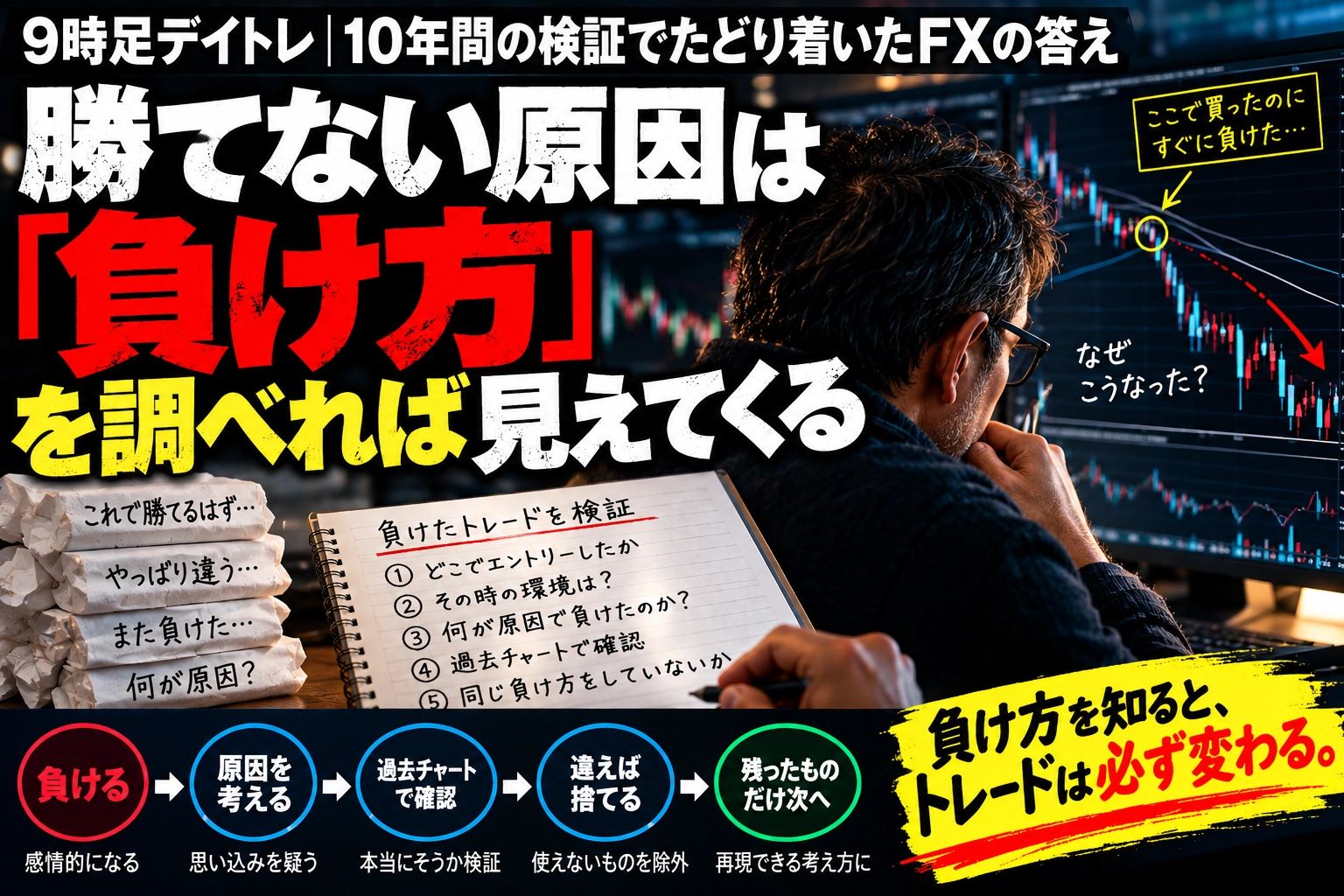
The reason you can't win becomes clear if you analyze how you lose
Good morning.An-chandesu.
When you lose in FX, many people search for the next "method to win."
Look for a new technique.
Change the indicators.
Change the settings.
Study another trader's method on YouTube or SNS.
I was the same.
However, after continuing to verify for ten years, my thinking changed.
If you want to know the cause of not winning, it's better to investigate how you lost first rather than searching for the next win method.
Because among the losing trades there is material for what to verify next.
When you lose, examine the "why" one by one
For example, you bought thinking it was rising, but right after, it fell and you hit a stop loss.
If it were me before,
"I misread the direction"
would be the end of it.
But that alone tells you nothing.
Was the direction truly wrong?
Was the entry location bad?
Was the entry too early?
Did you chase after a big rise?
Or did you lose according to the rules you set?
The same "loss" can have different causes.
So I started reviewing losing charts and looking for differences from winning ones.
Finding a cause is not the end
What matters here is
"Perhaps this is the cause"
and not just ending there.
Once you find one plausible cause, turn it into a hypothesis.
Then inspect the past charts under the same conditions.
Do you really tend to lose under that condition?
Would removing that condition improve the result?
Does the same thing happen in other periods?
Check repeatedly.
Then sometimes what you thought was the cause turns out to be irrelevant.
In that case, discard it.
And pose another hypothesis.
Lose
↓
Think about the cause
↓
Verify on past charts
↓
If different, discard
↓
Further verify the remaining ones
I have repeated this.
Winning a few times does not become the "answer"
While verifying,
there are moments when you think
"This is it."
If the newly considered condition works for several consecutive cases, you feel like you found the answer.
I have experienced this many times.
However, when you widen the verification period, it stops working.
As market conditions change, the results collapse.
This has happened many times.
So I began to think,
to separate "works" from "reproducible"
I no longer rely on a single successful instance as a rule.
I test by changing conditions and timing, and only keep what remains necessary.
I repeated this process.
Not aiming to eliminate all losses
This is also important.
The purpose of investigating losing causes is not to eliminate losses to zero.It's impossible to capture every price movement with any method.
There are times when you lose even if you trade according to the rules.
In that case, you must accept that loss.
The problem is
whether the loss comes from a problem with the rules themselves or as a result of following the rules.
This distinction is important.
If it's the former, you verify it.
If it's the latter, you don't change the rule just because you lost.
If you don't distinguish this, you'll keep changing your method every time you lose.
Then you can never verify under the same conditions.
Yesterday's loss becomes a verification material
Losing days do not feel good.
I also thought
"Why did I enter here?"
"I should have waited a bit longer."
I have thought that many times.
However, if you end it there, the loss is just a loss.
Keep the chart and
why you lost.
Are you not repeating the same loss?
Is it truly the part that should be improved?
If you investigate that far, the losing trade becomes verification material.
Therefore for me,
yesterday's loss is tomorrow's verification material.
What I have been doing for ten years is not special future forecasting.
Form a hypothesis.
Verify.
If different, discard.
Further verify what remains.
That was the repeating process.
And the longer I continued, the more I prioritized something else over "finding a winning shape."
When you see the same situation, can you judge with the same criteria every time?
Even if past results are good, if your entry and profit-taking judgments change with your daily feelings, you cannot repeat the same trades.
What I pursued through ten years of verification until the end was not a form with a high win rate,but a reproducible standard of judgment.