

Why do people get angry when they are advised?
"Amateurs, shut up!"
"What’s this Fibonacci nonsense!"
"Idiot!"
Scary.
Terrifying.
This was what I first heard when I watched a live FX stream on YouTube,
the very first words that entered my ears.
At the time, I had just started FX.
I didn’t know my left from my right yet.
For the time being,
Isn’t there an easy way to win?
With that in mind, I was browsing YouTube.
The search terms were, of course,
"FX how to win"
That’s what I typed.
Thinking back now, that was very straightforward of me.
As I looked at the screen, one thumbnail caught my eye.
"A pro teaches you how to win in the market"
This is it!
This was exactly what I’d been looking for.
A pro would teach me how to win in the market.
How kind.
Without any doubt, I opened the stream.
And the first thing I heard was,
"Amateurs, shut up!"
That.
I had no idea what was going on.
I didn’t even know who he was angry at.
The only thing I did understand was,
he was furious.
That much was clear.
"Is FX really such a scary world?"
I suddenly felt a wave of anxiety.
What could make someone this angry?
I didn’t know the rules of the market,
or even the basic etiquette of the FX world.
Maybe,
it’s a world where you get yelled at if you say something dumb.
Back then, I seriously thought that.
The streamer would occasionally shriek and insult the viewers.
And in quite a loud voice.
He would suddenly scream, making me jump each time.
Judging by the voice, he was around his 40s.
Kansai accent.
And a deep voice.
Which made it even scarier.
Even so, I didn’t close the stream.
I was supposed to be there to learn how to win at FX,
but before I knew it, my interest had shifted elsewhere.
Why is this man so angry?
I was supposed to study the markets,
yet before I realized it,
I was observing an angry middle-aged man.
Let’s call him Mr. D.
After watching for a while, I finally started to get the picture.
Apparently, Mr. D
had received advice from a viewer.
And it seems he really didn’t like it.
Well, of course.
Giving advice to a pro?
That’s what I thought.
After all, the thumbnail said,
"A pro teaches you how to win in the market"
That’s what it said.
He was a pro.
And a viewer advised that pro.
Isn’t that rude?
That’s how it looked to me then.
Here’s how it went.
Mr. D was about to go long.
But it was at a very high level.
In other words,
the very top.
At that moment, a viewer commented.
"Buying from here is dangerous."
"It’s going to drop about halfway from here."
"You should wait for the Fibonacci 50%."
Something along those lines.
Mr. D was enraged.
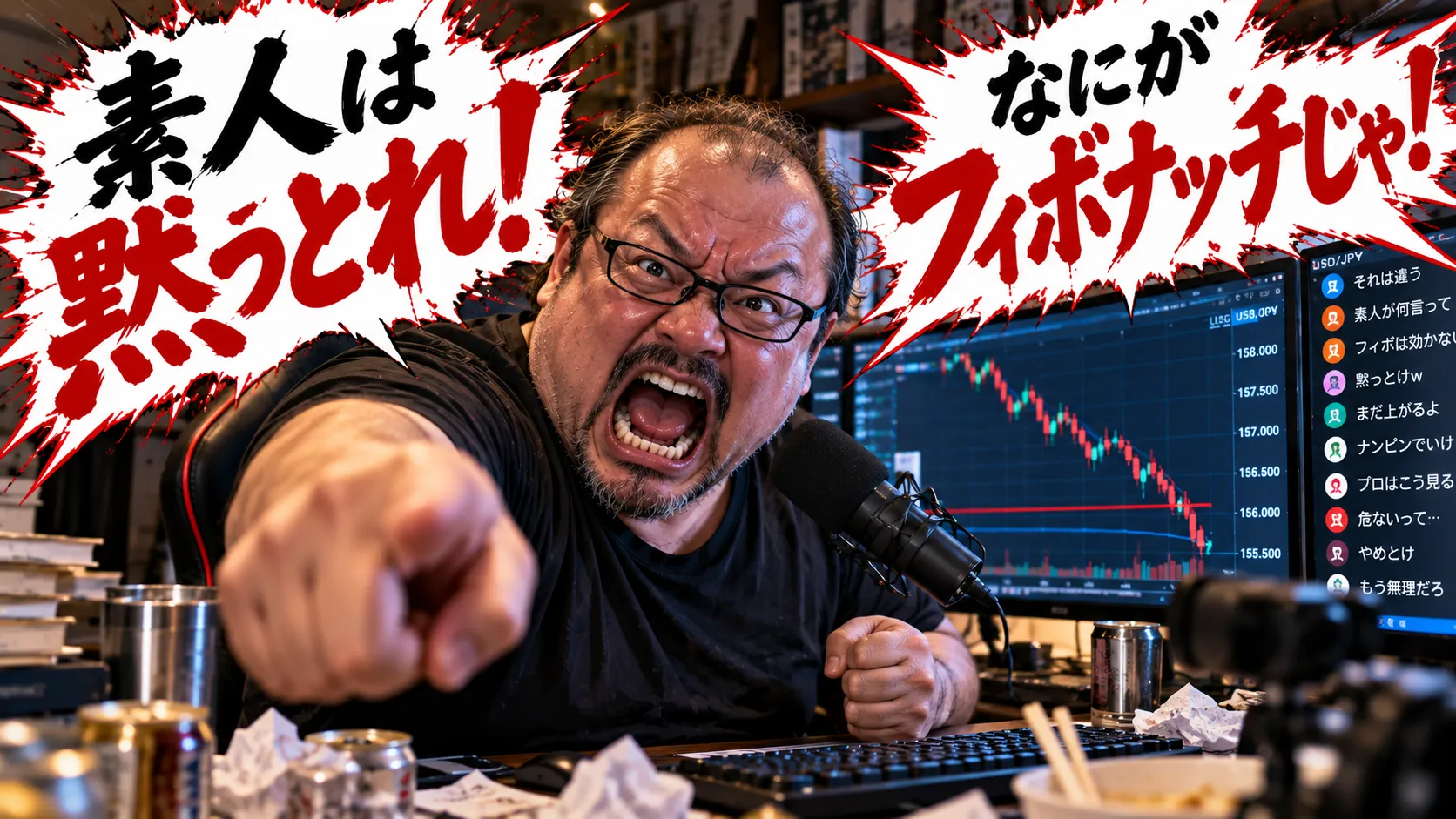
"Amateurs, shut up!"
"What’s this Fibonacci nonsense!"
"Idiot!"
I see.
I finally started to understand.
Mr. D
"It’s going up from here"
That’s what he thought.
Then a viewer came along and said,
"It’ll drop more."
That’s what they told him.
Moreover,
"Wait for the Fibonacci 50%,"
they even specified a concrete level.
Mr. D is a pro.
At least, that’s what the thumbnail said.
And the viewer directly denied
the pro’s judgment head-on.
Then Mr. D bought.
Ping!
An electronic sound rang.
Apparently that was the sound of his buy order being executed.
But,
right after he bought, the price plunged.
It fell at a tremendous speed.
I didn’t understand it at the time,
but it seems Mr. D was using very high leverage with overseas FX.
Even a small move against him
would make the losses grow large.
Let alone,
a sudden drop right after buying at the very top.
Mr. D’s voice got even louder.
"Hey! You, XX!"
"Send me your trade history by email right now!"
Apparently, he was calling out that viewer who had given advice earlier by name.
"Bet you can’t send it anyway!"
"You amateur!"
Scary.
He’s still angry.
Now he’s demanding that they submit their trade history.
We were supposed to be talking about Fibonacci,
but somehow it turned into trade history.
Meanwhile,
the price kept dropping.
Mr. D’s unrealized loss ballooned before my eyes.
And yet,
he didn’t seem concerned.
It seemed he was more concerned with
the viewer who had advised him than with the chart.
The market kept moving further in the opposite direction.
Even so,
Mr. D was engrossed in berating the viewer.
I thought,
In the world of FX,
do you have to prove your track record just to give advice?
"Don’t act high and mighty when you can’t even win!"
"Idiot!"
The insults continued.
All the while, the price kept falling.
Then it happened.
The comments section suddenly exploded.
"Serves you right!"
"Good game!"
"That’s a pro for you!"
"You’re the one who should retire!"
"Zero cut! Zero cut! www"
What?
What happened?
Apparently,
while Mr. D was berating the viewer,
his position got zero-cut.
While he was yelling, "Send me your trade history!",
his own trade had ended.
I looked at the chart.
And I realized.
The place where Mr. D got zero-cut.
That was—
the Fibonacci 50%.
……
I did a double take at the screen.
Just a moment ago,
he was shouting, "What’s this Fibonacci nonsense!"
And right at the Fibonacci 50%,
he got zero-cut perfectly.
Scary.
But,
kind of funny.
Back then,
I barely knew anything about Fibonacci.
Even so, I understood one thing.
That viewer was right.
Mr. D suddenly went quiet.
He’d been shouting so much,
but now he said nothing.
Only the comments kept flowing.
"Zero-cut www"
"50% hit!"
"Good game!"
Mr. D was silent.
Scary.
Now it was
too quiet. Scary.
A few minutes passed.
Suddenly, Mr. D spoke.
"...From here, it’s a sell."
Huh?
Weren’t you just buying?
I was confused.
But the viewers reacted even faster.
"It’s going to rebound from here!"
"Don’t sell!"
"It’s up next!"
"Selling from here is dangerous!"
Then Mr. D
perked up again.
"Amateurs, shut up!"
He was back.
And in high spirits.
"Can’t you tell from the momentum of this drop?!"
"Hedge funds are involved!"
"Anyone who resists here is an amateur!"
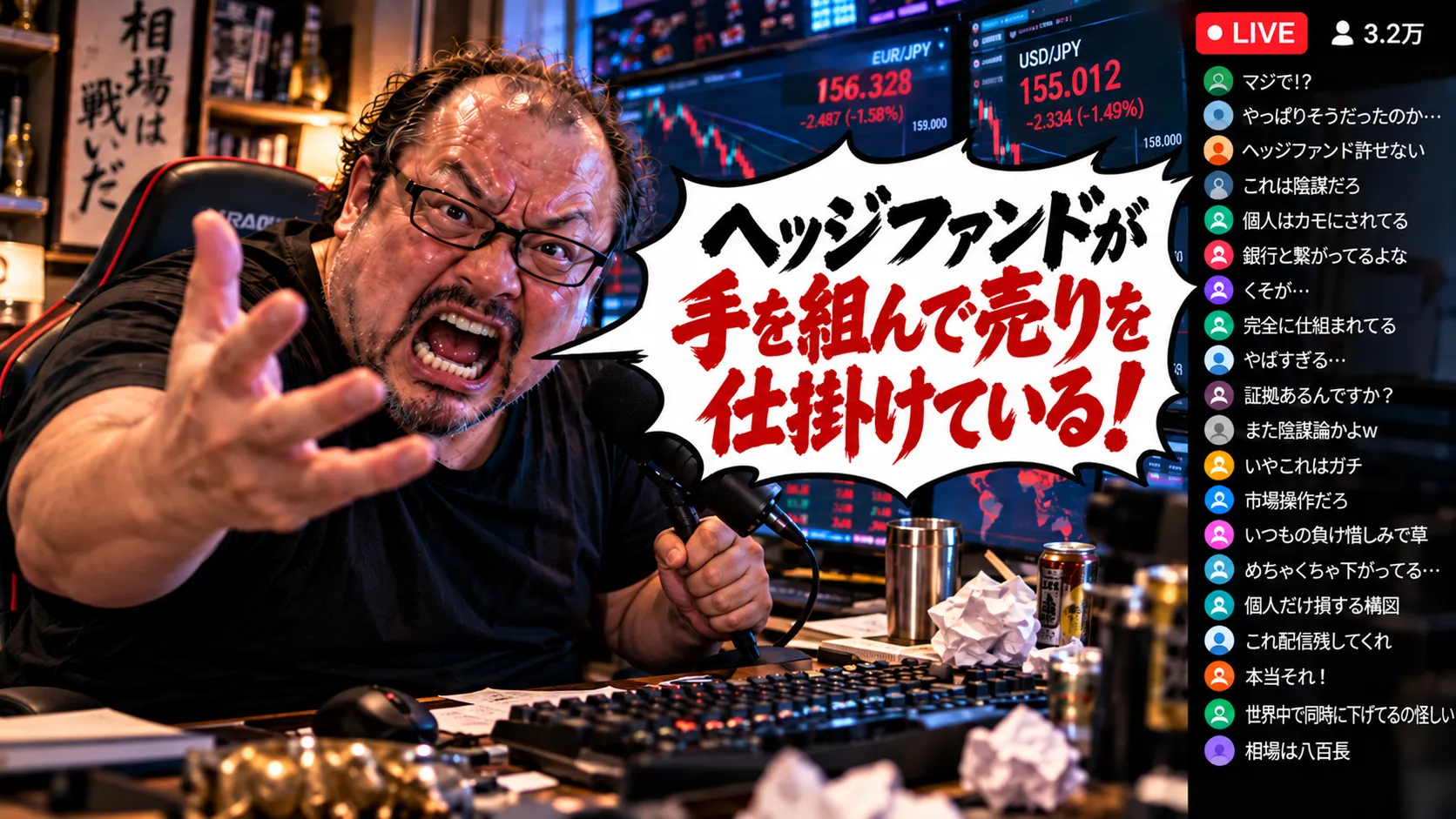
Apparently, hedge funds were involved in this drop.
In that short time,
how did he even figure out hedge funds were involved?
I had no idea back then.
Anyway,
pros are amazing.
So I thought.
By the way,
I still don’t know.
Ping!
A clean electronic sound rang.
Mr. D went short.
He entered while the viewers strongly objected.
Of course,
with ultra-high leverage.
From there, Mr. D
explained hedge funds in detail.
According to him,
right now, hedge funds around the world were loading up on shorts.
Moreover,
they were selling every currency.
In short,
hedge funds had joined forces
and were selling like crazy.
As I listened, I suddenly remembered.
I’d heard this before.
It’s the big traders who move the market.
Big traders
move the market with massive capital
and reap enormous profits.
I’d read something like that somewhere.
"I see!"
"So this is what that meant!"
I was impressed.
Hedge funds around the world were selling all at once.
And from just looking at the chart,
Mr. D sensed that.
Pros really are different.
To me it looked like just a sharp drop.
But to Mr. D,
he could see the hedge funds on the other side.
"Umm... umm..."
I heard a groaning sound.
Mr. D, who had just been loudly lecturing about hedge funds,
suddenly went quiet.
And after a while—
"...So it’s up after all..."
In a
feeble voice, Mr. D said.
Huh?
Up?
Weren’t
hedge funds around the world selling?
I looked at the screen.
Price had rebounded.
And
with quite some force.
Apparently this time,
his short position was in trouble.
The comments section exploded again.
"Rip!"
"You’re the amateur! Get lost!"
"Round-trip slap ww"
Comments streamed by at incredible speed.
Zero-cut on the long.
Then immediately a short.
And now the market rebounded.
A complete round-trip slap.
Mr. D was silent for a while.
Then it happened.
He suddenly shouted,
"This is the hedge funds taking profit!"
He was back.
You’d never think he was the same person
"...So it’s up after all..."
who had just said, in a thin voice,
Apparently, in Mr. D’s mind,
hedge funds around the world sold heavily,
and then took profits all at once,
causing the market to rebound.
I see.
So that’s it.
I was impressed.
If it goes down, it’s hedge funds selling.
If it goes up, it’s hedge funds taking profits.
With this,
you can explain it either way.
That’s a pro for you.
It’s a fire pillar!
A fire pillar!
The price kept climbing.
As if the earlier drop had been a lie,
it surged back strongly.
"So it’s up after all..."
Mr. D said, sounding a bit reinvigorated.
"So my direction was right."
I thought,
No.
You were selling just now.
And,
you said hedge funds around the world were selling.
Then it went up right after.
Even so,
apparently that still counts as "the direction was right."
The market is deep.
At least,
I couldn’t understand it back then.
Ping!
The electronic sound again.
"It’s a buy after all. Up we go."
And then, right away, again—
Ping!
?
What just happened?
I
no longer knew.
Apparently, Mr. D
had just cut his short position himself.
Or rather,
he closed it himself right before a zero-cut.
And the second
"Ping!"
This time,
he re-entered long.
Buy.
Sell.
And then,
buy again.
In a matter of tens of minutes,
his market view had been reborn multiple times.
By the way,
his account balance then was
588 yen.
I thought,
Does it even make sense to enter now?
But Mr. D
apparently still intended to fight.
Looking back now,
what made Mr. D angry
might not have been the advice itself.
It was because someone touched
the part of him that suspected he might be wrong.
And worse, the market
moved just as that person had said.
People don’t always get angry
when their opinions are denied.
But,
when someone pokes at a place you yourself feel uneasy about,
those words hit hard.
And,
the more accurate that criticism is,
the harder it is to admit.
So Mr. D
became more obsessed with silencing the viewer who advised him
than with watching the market.
At least,
that’s how it looked to me that day.
Though,
back then I wasn’t thinking that far.
The only thing
I understood was this:
The world of FX
is scary after all.
And Mr. D
was still fighting with 588 yen in funds and a lot size of 0.03.
Afterword
When someone points out your mistake, it can make you angry.
It’s hard to accept it honestly.
And I think this is also
one reason why people can’t cut their losses.
When someone says,
"That’s wrong,"
it’s hard enough to accept.
Yet on top of that,
you have to, yourself,
admit, "My judgment was wrong."
That’s even harder.
"It’s going up from here!"
"It’ll definitely go down!"
Thinking that, you entered with your own money.
Right after that it moved the other way,
and it’s not easy
to just say,
"Yes, I was wrong."
So,
"If I wait a bit, it’ll come back,"
"It’ll reverse from here,"
"Big players are pushing it,"
"This is a temporary move,"
and so on,
you start looking for reasons that can make your judgment ‘right.’
And before you know it,
instead of watching the market,
you’re watching it to deny your own mistake.
This way,
you’ll keep making the same mistake.
So what should we do?
I think
it’s important to decide your criteria before taking a position,
is what matters.
Under what scenario will you enter?
What’s the basis for the entry?
And,
what breakdown will make you revoke that judgment?
Decide in advance.
Don’t look for convenient reasons
after you’re holding a losing position.
At Resilience FX,
instead of relying only on feel,
we summarize frameworks to build scenarios, confirm reasons, and have your own decision criteria,
so you can decide for yourself.
In the market, what’s needed
is not to always be right.
It’s to admit when you’re wrong and move on to the next decision.
If you’re interested,
please see the Resilience FX product page.
▶ Here is the Resilience FX product page
https://www.gogojungle.co.jp/tools/ebooks/86120?utm_source=share