
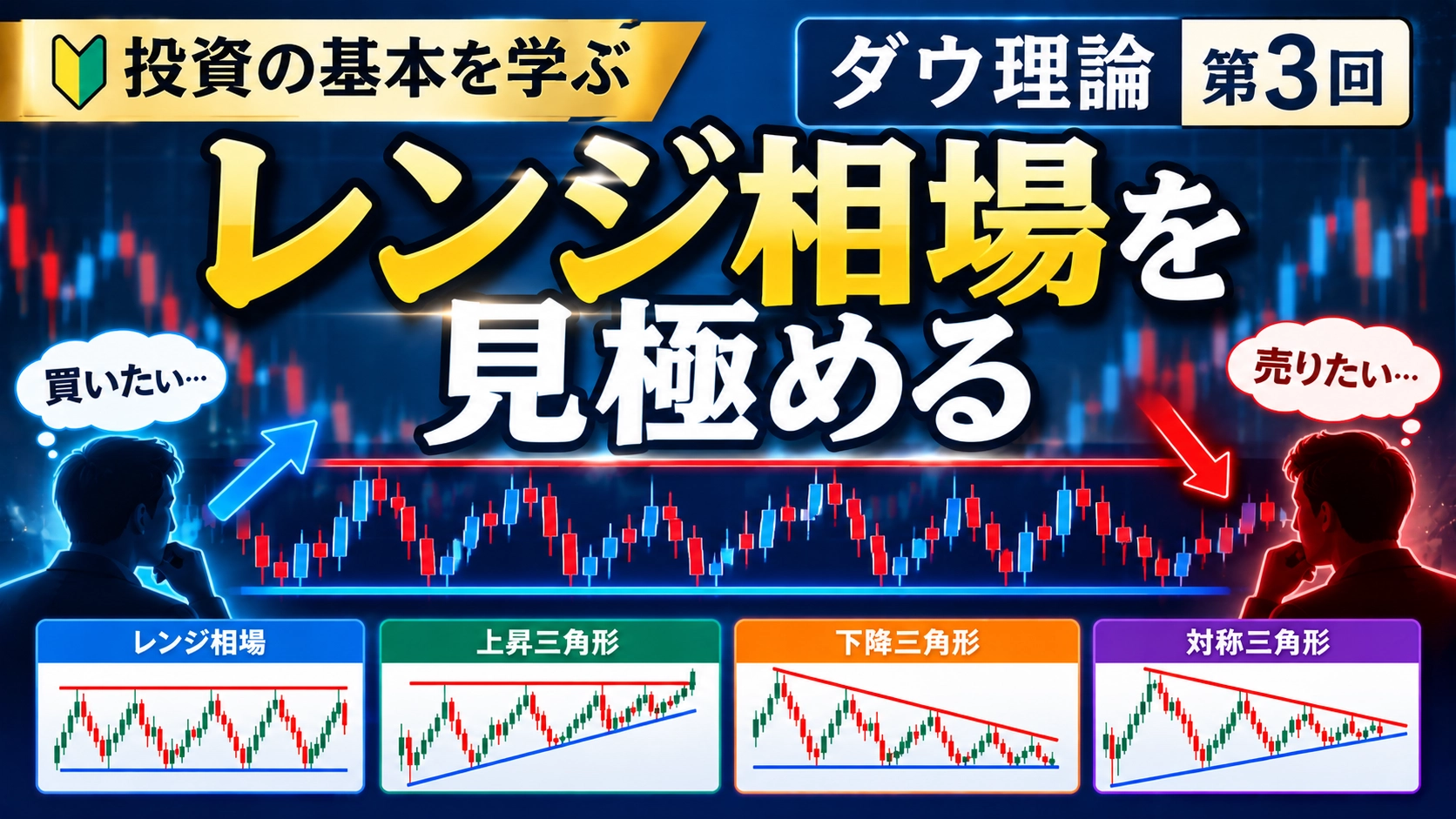
Learn the Basics of Investing Dow Theory Session 3
Identify Range-Bound Markets!
Do not force entries; stick to your own rules
Last time, we explained the signs of trend reversals.
This time, we will look at“range-bound markets”where the trend is not clear.
When identifying a range-bound market, firstwatch the movements of highs and lows.
In an uptrend, highs and lows rise.
In a downtrend, highs and lows fall.
However, when that movement stops,
lows also fail to be updated.
If it reaches a state like this, the market may be entering a range.
Range markets or consolidation do not only involve highs and lows moving within a nearly fixed range; there are also patterns where highs or lows gradually rise or fall while price action converges.
Representative forms include the following.
- Range market (sideways movement)
- 1. Rising triangle (triangle consolidation)
- 2. Descending triangle (triangle consolidation)
- 3. Symmetrical triangle (triangle consolidation)
The “range market” is a pattern where highs and lows repeatedly move within approximately a fixed range.
The “rising triangle” is a pattern where highs remain roughly constant while lows gradually rise.
The “descending triangle” is a pattern where lows remain roughly constant while highs gradually fall.
The “symmetrical triangle” is a pattern where highs fall while lows rise, and the price range gradually narrows.
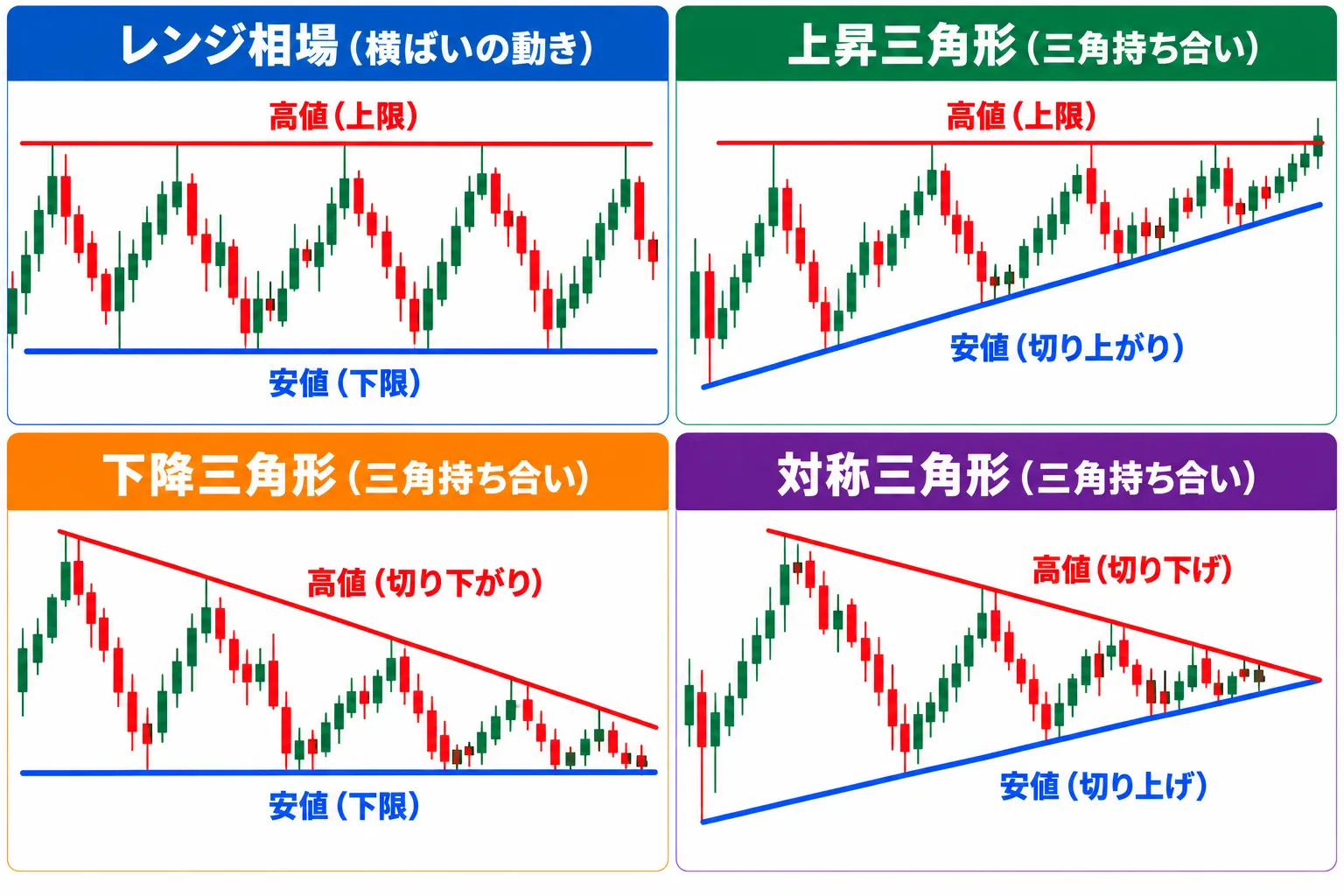
In this way, markets can be consolidating in various forms not only when price is flat, but also due to the movements of highs and lows taking different shapes.
It is important to recognize these changes quickly.