

I sold because of the price drop, but the profit disappeared—want to reassess the "basis for continuing to sell" with gold
I Sold on a Break of the Low, Yet the Profit Disappears—Reevaluating the “Reason to Continue Selling” in Gold
Even if a downtrend persists, it is not necessarily okay to continue holding a short position entered on a breakdown.
What to consider from the gold chart photographed on September 24 is this difference.
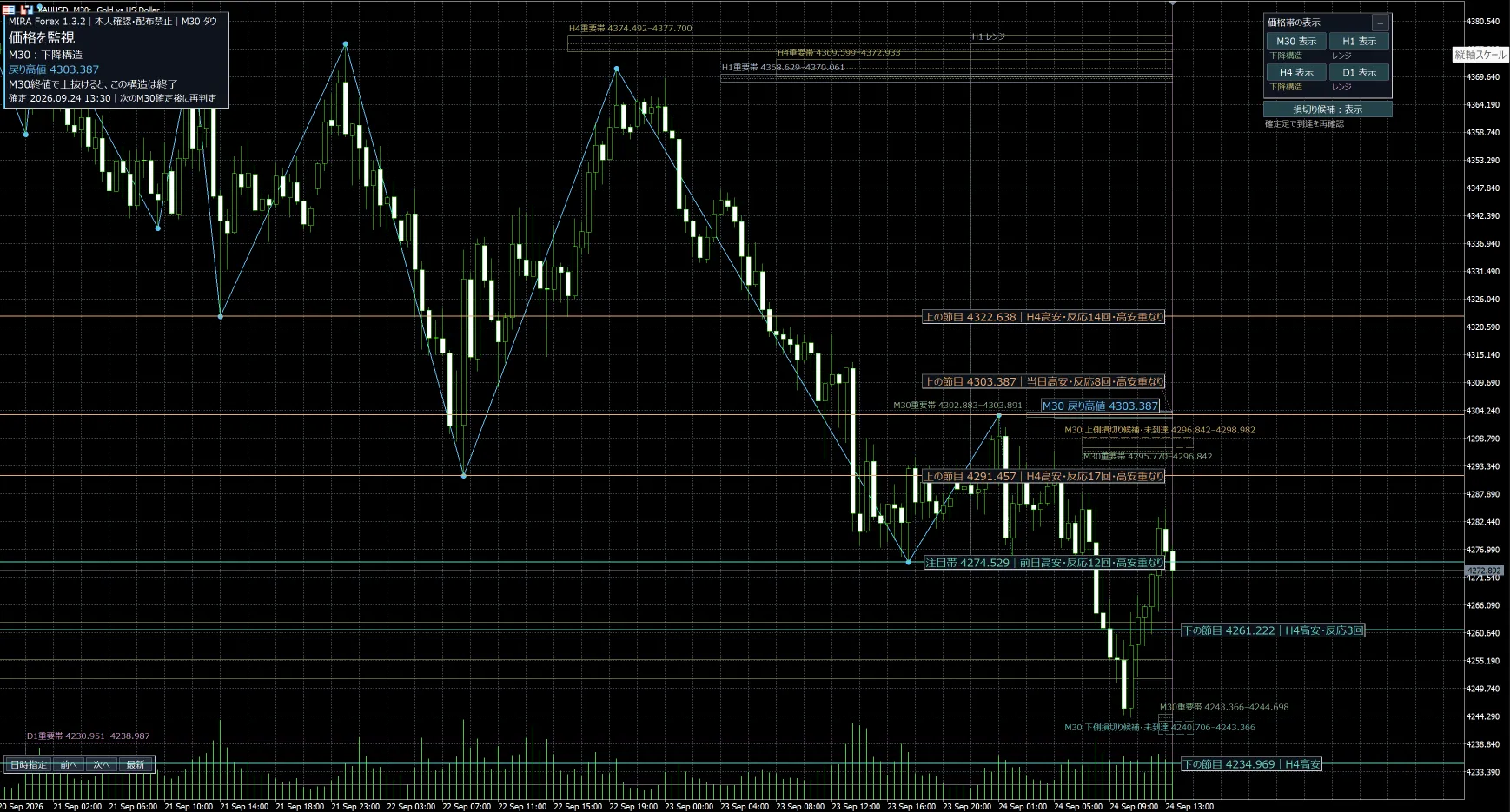
“I sold because I broke the low. It was in the red at first. But it retraced a lot.”
In such moments, before concluding “the downtrend is still in effect and it’s fine,” there are things to confirm.
Is the premise under which you sold still valid?
This time, the characteristic is “after the break, it extended, then returned to the original price range”
On the current 30-minute chart, after slipping below around 4274.529, it fell to the early 4240s, then rebounded and at the time of the shoot had returned to around 4279.
In other words, not only did it make a new low, but it also retraced back to roughly the area near 4274 that had been broken.
It is not appropriate to conclude here that “the break of the low was a false signal, so selling was unnecessary.” After the break, there was actual downward price movement.
What to consider is not only whether the entry was correct, but also whether the price relationship that underpinned the sale has not been broken.
This is the perspective to connect this price action to trading decisions this time.
What changed with the rebound is not just the price
For example, suppose the reason for selling the break of around 4274 was the following:
Because the low was broken, I expect further downward movement. Even if it retraces, the area around 4274 broken to the downside will cap the upside.
This is the technical analysis idea that the broken support band becomes resistance in the subsequent rally; however, it does not always change into that role.CME Group
If you sold based on that premise, you cannot ignore the move to recover around 4274.
The fact that “it broke lower” remains unchanged. However, the expectation that “it will be capped by that price range when it retraces” is now questionable.
The fact that it went down once does not prove that selling remains advantageous afterward.
What you want to confirm with the rebound is not only “how many dollars it retraced,” but also whether the price relationship that underpinned the short sale has not broken down.
Also, this image does not allow identifying the buyers or the cause of the rebound. Even without adding explanations like “big players bought,” it provides material to reevaluate the premise of selling.
The pitfall of “It hasn’t exceeded 4303, so it’s OK”
In this chart, the 30-minute chart’s retrace high is shown as 4303.387. Under the chart’s conditions, if the 30-minute close clears this price to the upside, the current downtrend structure ends.
The price at the time of the photo is still below that.
However,“Not yet reached the ending condition of the downtrend structure” and “there is a reason to hold short-term shorts” are not the same thing.
Trends are understood as sequences of highs and lows. Also, large trends and short-term price movements within them can be considered separately. It is not contradictory for a short-term rebound to progress while a down structure remains.
In this case, around 4303 is a price to reevaluate the 30-minute downtrend structure. Around 4274 is a price to reevaluate the short-term breakdown sale based on the previous hypothesis.
If you sold short expecting a short-term break, but then it reverses and you change your holding rationale by saying “4303 is down-structure,” you are effectively shifting the time horizon of your judgment during the trade.
A long position would be treated differently if you originally expected a wide price range retrace and sized your trade accordingly.
The problem isthat you entered with a plan for short-term trading but switch to a longer time frame to accommodate gains in unrealized losses.
What to change the next time the same situation occurs
What I want to change is not the intuitive feel of “I’ll exit when it looks like a rebound,” but to decide before selling the conditions to continue selling and the conditions to reevaluate. Fidelity’s investment education also suggests considering holding periods and exit conditions before trading.
Using the around-4274 area as an example, I will split the decision. The following is not a validated trading rule, but an example of scenario construction.
If you have already sold on the break
Set in advance conditions like “if the price that broke lower moves back above the closing price of the applicable timeframe, reduce or exit the short position.”
If that condition is met, do not create an exception by saying “the downtrend still exists.”
Also, if a separately set stop-loss condition is reached first, do not postpone exit based on a closing price check.
If you are considering selling on a rebound
Right after the 4274 area recovers, instead of saying “it’s a down market, so sell,” check whether it can again move below that level and then recover above it.
If this movement is observed, it becomes new evidence for selling that the band is suppressing upside. If not observed, skip selling based on that premise.
Not because it broke lower there before, but because it still suppresses upside now.
That is the difference in judgment.
If it can be supported on the upside even after recovery
In this case, temporarily remove the hypothesis that the broken band will cap upside.
However, that alone does not prove the buying advantage.
The decision to forego selling and the decision to execute a buy are separate.
Buying requires a buying condition and a stop-loss design. Simply switching to buying because there is doubt about selling does not resolve the lack of justification for the trading direction.
Also, you do not need to treat 4274.529 as an exact boundary to the decimal. Support and resistance are treated as price ranges; the width of the band and the bars used to confirm them should be decided before trading.
With this view, I did not hit the bottom
This explanation is not about predicting the rebound from the early 4240s; it started there, but it was not predicted in advance.
If you decide to judge after confirming the recovery around 4274, the initial impulse of the rebound has already passed. Increasing confirmations only delays judgment, which is the cost.
The purpose of this view is not to hit the bottom, but tonot cling to the old selling rationale after the price action has changed.
Whether this condition improves profitability or which timeframe or price-band width is appropriate requires separate validation. It cannot be concluded from this single example that a universal rule appears for gold.
Not “It will go down further,” but “What continues to be sold while it lasts”
What I want to carry forward here is not the conclusion that you must not sell on a breakdown.
Separate the fact that there was a reason to sell from the fact that there remains a reason to continue selling.
To do that, distinguish between the price that indicates the market direction and the price to review your own trading.
※This article explains a decision method using the chart at the time of capture. The confidence in the stage interpretation is moderate, and the success rate and expected value of the described conditions are not validated. It does not recommend trading at a specific price or guarantee profits.