
When the wind blows, the cooper shops profit ~ AI rally drives up government bond yields
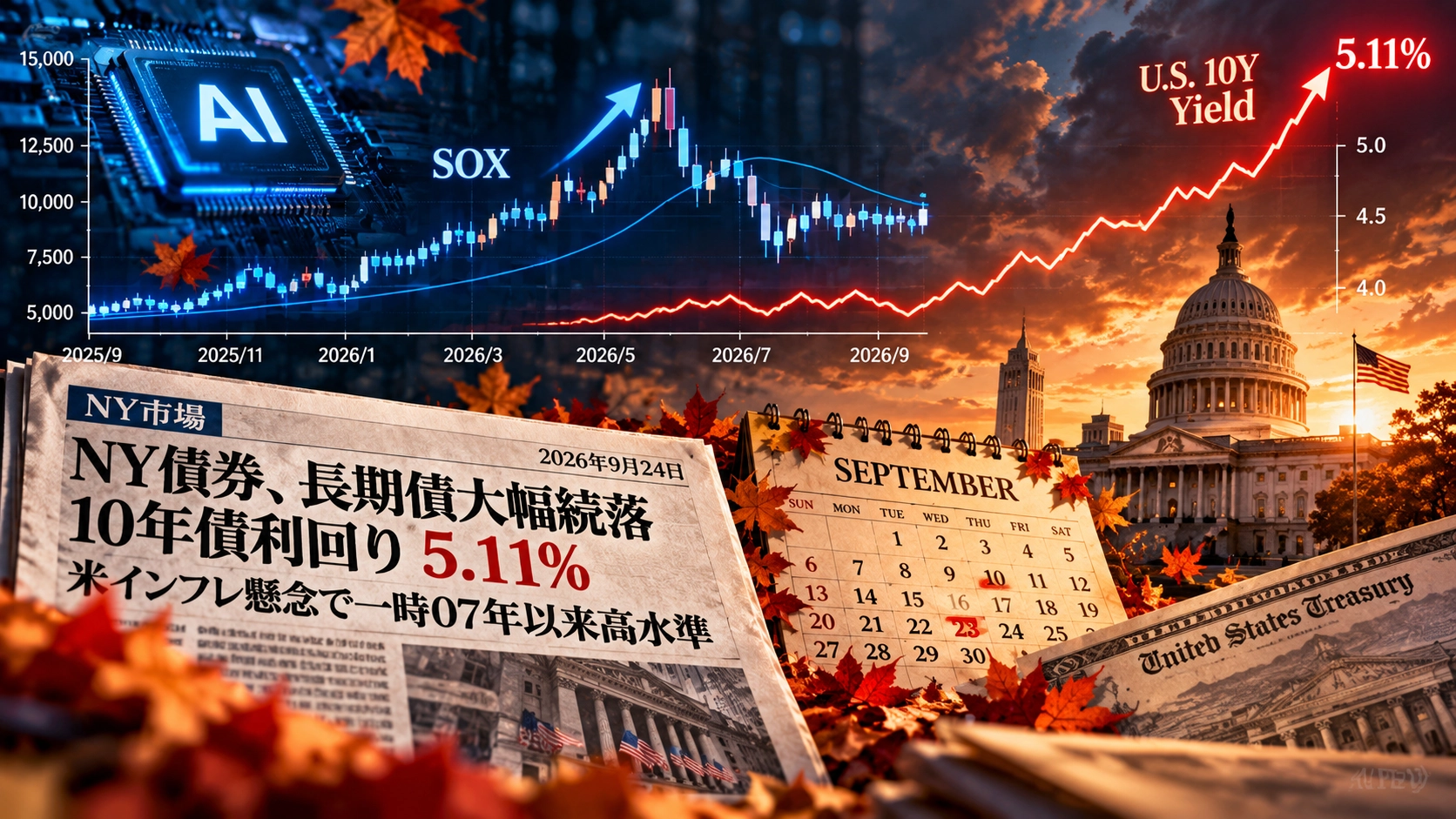
“In the New York bond market on the 23rd, the long-term bond market fell sharply again. The 10-year government bond yield, whose 4.625% is the benchmark coupon, finished at 5.11% (prices down), up 0.15 percentage points from the previous day. The anticipation of additional rate hikes by the Federal Reserve (Fed) strengthened, leading to bond selling. It had briefly reached 5.13%, the highest since mid-July 2007. The concerns about supply and demand at the 5-year bond auction on the same day also weighed heavily.”
Long-term bonds in NY fall sharply, 10-year yield at 5.11% on inflation concerns in the U.S.; highest since 2007 - Nikkei
The U.S. 10-year Treasury yield rose to its highest level in 19 years since mid-July 2007. This marked the highest level since the world changed utterly after the Lehman Brothers collapse.
Following these movements in the U.S. Treasury market, in Tokyo on the 24th after the Silver Week,
“In the domestic bond market, the yield on the newly issued 10-year government bond, a benchmark for long-term interest rates, temporarily rose to 3.055% (bond prices fell), a 30-year high not seen since August 1996.”
“On the morning of the 24th, the Osaka Exchange activated a ‘Dynamic Circuit Breaker (immediate eligible price range system)’ temporarily halting trading in long-term government bond futures.”
Long-term yields rise to 3.055% briefly as U.S. bond selling spreads - Nikkei
This is the situation.
“On the 23rd,S&P Global announced that in September the U.S. PMI (Purchasing Managers’ Index, flash) stood at 57.0 for manufacturing, higher than market expectations (53.5) compiled by Dow Jones Newswires, marking the highest in four years and four months. The services PMI was 58.7, well above expectations (55.7), the highest in four years and eleven months.”
Long-term bonds in NY fall sharply, 10-year yield at 5.11% on inflation concerns in the U.S.; highest since 2007 - Nikkei
It is said that the reason for the rapid rise in the U.S. 10-year yield was that PMI surpassed market expectations, inflation concerns widened, and the probability of Fed rate hikes increased.
“According to FedWatch, which predicts U.S. monetary policy from movements in U.S. short-term interest rate futures, the probability of a 0.25% rate hike at the October FOMC is 68% as of the evening of the 23rd, up from 55% the previous day.”
Long-term bonds in NY fall sharply, 10-year yield at 5.11% on inflation concerns in the U.S.; highest since 2007 - Nikkei
What is notable is what is mentioned at the end of the article as an aside
“The yield on the 2-year note, which is more sensitive to monetary policy, ended at 4.90%, up 0.14 percentage points from the previous day. It briefly rose to 4.94%, the highest since the end of May 2024.”
This is where it stands.
U.S. Treasury yields have risen above 5% for the 5-year and longer maturities, and the 2-year yield is approaching 5%, causing the yield curve to bear-flatten (short-term yields rise, flattening the yield curve).
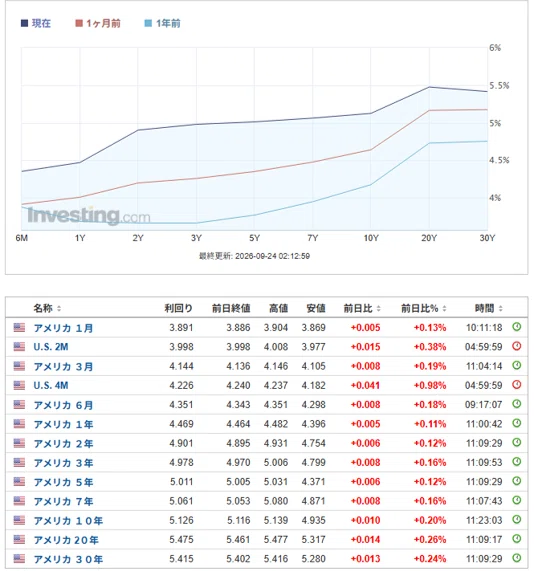
That the U.S. Treasury yield curve is bear-flattening in the 5% range means you can earn about 5% without taking duration risk, credit risk, or liquidity risk.
This implies that even if expected returns on risky assets do not change, demand for risky assets will gradually decline.
The main players in global financial markets’ funds are institutional investors such as pension funds. This pension capital is estimated to be about USD 63 trillion across the OECD, of which DB (defined benefit) funds are about USD 20 trillion, and U.S. DB funds are over USD 12 trillion; thus the need for risky assets naturally declines (excluding GPIF).
The question is whether the rise in U.S. bond yields is due only to structural concerns like inflation risk and rate hike expectations that people talk about.
While the U.S. economy is strong, rising crude oil prices and fiscal concerns continue to exert upward pressure on interest rates. However, this year’s rapid rise in U.S. yields is likely influenced by a special factor, the “September Effect.”