
Last Look ── After placing the order, there is a moment for the other party to decide whether to accept it
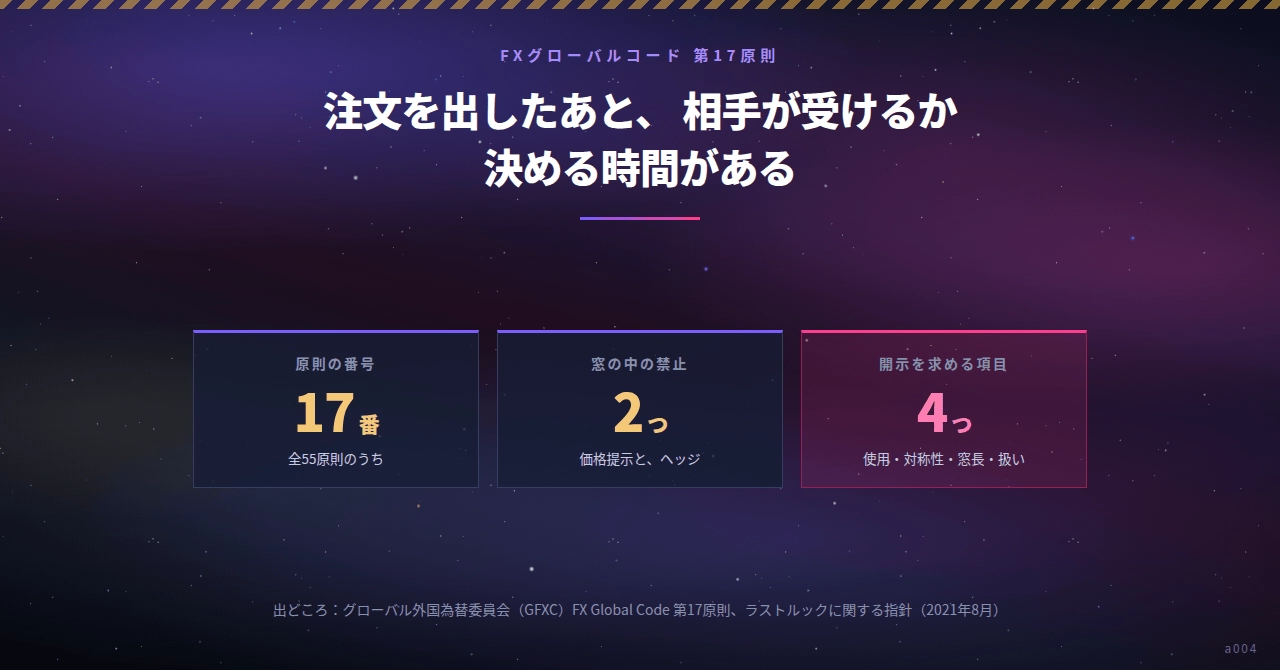
Principle number 17th Out of the 55 principles | Prohibition inside the window 2items Price representation and hedging | Items requiring disclosure 4items Use, symmetry, window length, handling |
After sending an order in electronic trading, it may be filled immediately or placed on hold. This is because the receiving party has time to decide one final time whether to accept or reject.Last Lookis what it’s called.
This article reads the mechanism from the FX Global Code, a set of global guidance created by central banks and market participants around the world, the Global Foreign Exchange Committee (GFXC). Before delving into Japan’s over-the-counter FX market, let’s first note how far international alignment has progressed.
In electronic trading, there is a time window in which the party receiving the order decides at the end whether to accept or reject. The FX Global Code prohibits using customer order information within that window for trading, and requires disclosure about the length of the window.
The FX Global Code is a voluntary, principle-based framework created jointly by central banks and market participants across 20 jurisdictions. It does not impose legal obligations; instead, participants commit to it by issuing a declaration of commitment. The current version is the December 2024 edition, with 55 principles.
The text of Principle 17 begins like this.
The code narrows what may be done within this window to two checks.
| Check | Purpose (Code organization) | What is observed |
|---|---|---|
| Validity | Ensure that the content of the trade request is administratively appropriate and that credit limits are sufficient | Quantity, currency, settlement date, credit |
| Price | Ensure that the price at which the trade request is made is consistent with what can be quoted to the customer now | Difference between the price at request and the current price |
This is where the price check’ssymmetrymatters. The guidance published by GFXC in August 2021 describes a symmetric price check as “placing the same tolerance around the current price, and treating that tolerance the same whether it favors liquidity providers or is favorable to customers.”
An asymmetric setting creates a tendency for fills when prices move in the provider’s favor and rejections when tolerance moves beyond the provider’s favorable direction. Even with the same tolerance, applying it to only one side skews the outcome.
The central issue in debates around last look was what could be done inside the window. In a December 2017 revision, the code added the following sentence to Principle 17.
There is a single exception to this ban. It is called cover-and-deal. Three conditions are required for it: mutual explicit understanding that the market participant will first take the opposite side and fill the customer order without taking on market risk; all quantities traded during that period are delivered to the customer; and this understanding is properly documented.
In the July 2021 triannual review, instead of rewriting Principle 17 itself, specific examples were added. If information from a trading request is used inside the window, all quantities traded during that period must be delivered to the customer. An example is a scenario where a 50 million euro request is filled to 45 million and the remainder is rejected, which would be outside what the code requires.
The exact window length in milliseconds and the exact rejection rate as a percentage are not published as representative industry-wide figures in the source material found. GFXC seeks disclosure at the level of the liquidity provider, not aggregated statistics.
A major public pension fund notes in its disclosures that evaluation periods are usually measured in milliseconds, rejection rates vary substantially by counterparty, and symmetric threshold implementations were only partially adoptable.Different per counterpartyThis is the only point that can be confirmed from primary sources.
In other words, this area is more accessible for a practitioner to compare their own account figures than to know the market average.Focus on counting your own account’s numbersThe window length itself lies beyond outward visibility, but the time from sending to a filled notification can be measured per order on the account side. Analyzing the distribution and the times at which rejections occur provides clues about how your orders are treated.
To summarize what has been covered: international norms permit last look, but restrict use of information inside the window, require symmetry and disclosure of window length. The disclosure demand impliesyou can read the disclosuresTo what extent the rejection and hold terms are described in your account terms and trading disclosures. That itself becomes one piece of material for assessment.