
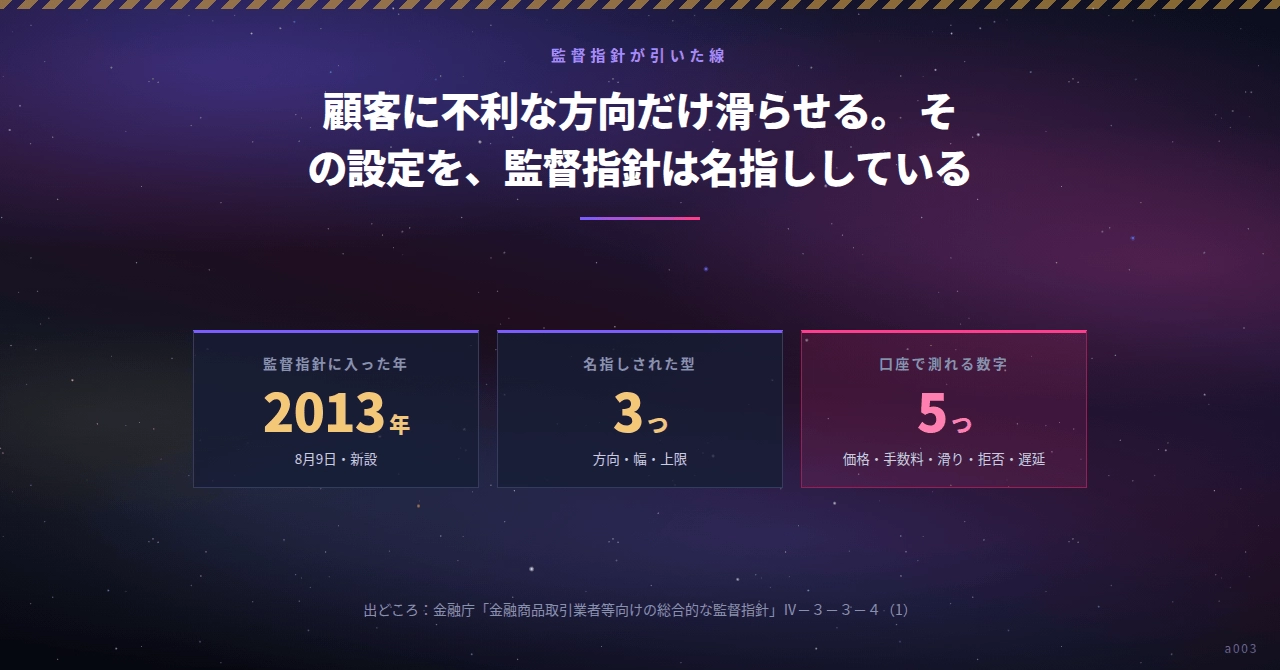
There are rules for "slippery" things — the supervisory guidelines deem settings that only slip in the disadvantageous direction for customers to be inappropriate.
Year entered into supervisory guidelines 2013 year August 9 – New | Typed designated 3 types Direction, magnitude, cap | Measurable numbers 5 items Price, fees, slippage, rejection, delay |
The contracted price may deviate from the price at which the order was placed. This deviation is called slippage (slippage). If the market moves quickly, deviation itself is natural.
What becomes problematic isthe direction. Whether the deviation favors or disfavors the client, does it appear in the same way on both sides? The Japanese supervisory guidelines draw a line here.
The Japanese supervisory guidelines name three types that are deemed improper because they cause slippage only in a direction harmful to clients. Therefore, slippage is something that can be measured and verified.
In the Financial Services Agency’s \"Comprehensive Supervisory Guidelines for Financial Instruments Firms\", there is a note IV-3-3-4(1) on \"Precautions regarding the treatment of slippage in currency-related OTC derivative transactions.\" This item was newly added on the August 9, 2013 revision.
The asymmetrical treatments that are disadvantageous to clients listed there are the following three.
These three become the blueprint for measurement. If you rearrange them, you get this.
| Supervisory guideline type | What is asymmetrical | What is measured in accounts |
|---|---|---|
| A | Direction. Slippage on the favorable side is also pushed toward the unfavorable side | Sign-coded distribution of slippage. Shape of the left and right tails |
| B | Magnitude. Broaden the acceptable range on the unfavorable side | Distribution of the absolute value of slippage. 95th percentiles on both sides |
| C | Amount. Increase the upper limit for execution only on the unfavorable side | Execution rate by quantity. Quantities that were rejected |
The supervisory guidelines even set a higher standard for cases with symmetric treatments. They address whether the fact of slippage and its causes, whether slippage can work for or against the client, and how the broker should handle it if it occurs, with prior, adequate explanations. In other wordsExplanations should come firstis how it is organized.
Conversely, how slippage is written in contract terms or trading manuals is material you can read before choosing a account. The level of detail in the wording itself becomes information.
During this revision, in public comments there was a suggestion like, “If execution can be refused, isn’t the same thing possible?” The Financial Services Agency’s response is as follows.
There is also language in self-regulatory rules. The Japanese Financial Futures Association’s “Regulations on Handling of Financial Futures Trading Activities” Article 25-2 requires members engaged in OTC foreign exchange margin trading to predefine standards for the execution of customer orders. These standards include order reception, order execution order, the execution price, and handling of holds or cancellations.
The same axis appears in international codes of conduct. The Global Foreign Exchange Committee (GFXC), formed by central banks and market participants, in its August 2021 guidance divides price checks into symmetric and asymmetric.
SymmetricMeans placing the same allowable range around the current price and treating the same on both the side that provides liquidity and on the client side.AsymmetricMeans when prices move in the direction favorable to the liquidity provider, executions pass, but when moves exceed the range unfavorably to the provider, they are rejected.
GFXC’s guidance lists four items that liquidity providers should disclose: whether to use a last look, whether price checks are symmetric or asymmetric,the maximum and minimum window lengths, and how to handle cover and deal. The fact that window length is included in disclosure is a notable advance of this guidance.
Although the wording differs, they look at the same core as Japan’s guidelines’ A and B.Are you treating the favorable and unfavorable sides the same?This is the axis.
One thing, honestly stated: there is no readily accessible primary material that publishes a representative industry value for window length or rejection rate. GFXC seeks individual disclosures by liquidity providers; publication of aggregated standard values is a different matter. Numbers circulating as industry averages often originate from analysis service materials.
Therefore this article also shifts towardcounting in your own accountregardless of industry averages; in practice, your own funds pass through your own account alone. The numbers for that account can be obtained today by round-tripping the minimum quantity.