
The in-store FX trading guide says "the broker is the counterparty" ── Read as A-book and B-book in public documents
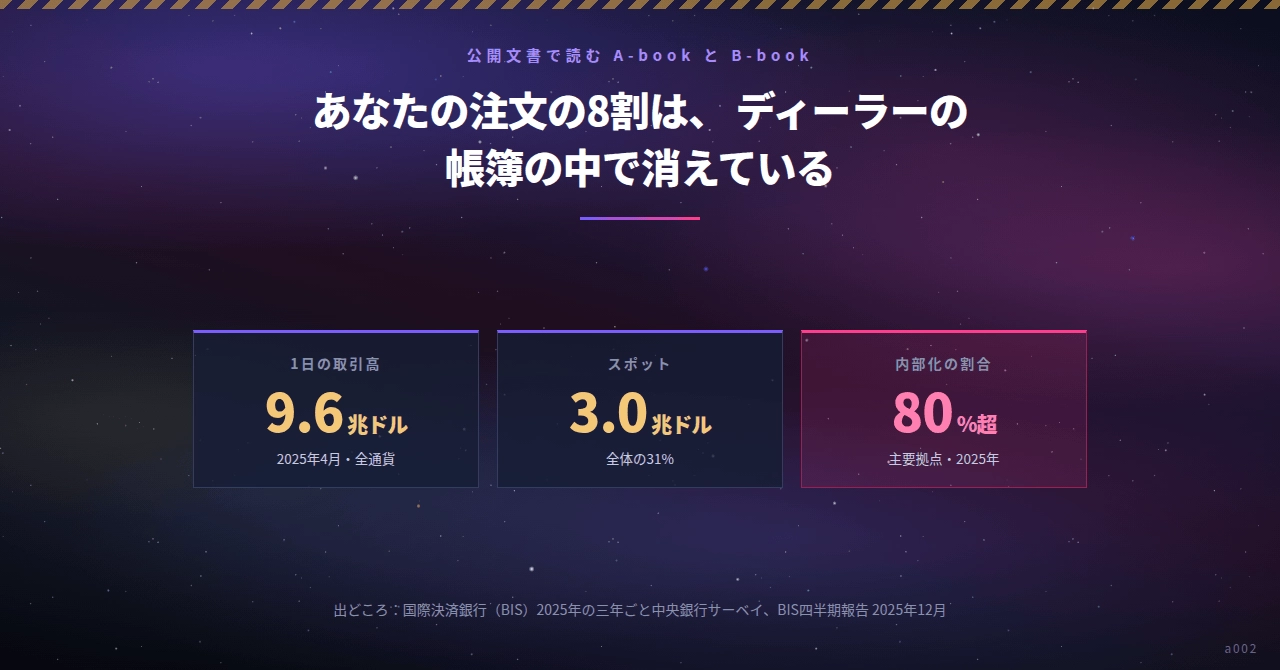
Daily trading volume 9.6trillion dollars April 2025 – all currencies | of which, spot 3.0trillion dollars 31% of the total | Internalization rate 80%+, Major centers – 2025 |
There are terms like “A-book” and “B-book.” It is common in advertising language, but in publicly available documents it is written with different words.Internalization.
This article deals with the topic before aiming at the internal side of the brokers. We read what is written in documents published by the Bank for International Settlements (BIS) and Japan’s Financial Services Agency. Based on that, we clarify what readers can measure with their own hands.
Over-the-counter FX is a bilateral trade where the broker is the counterparty. Whether orders are sent outward or hedged on the broker’s own books is described in public documents as internalization, which exceeds 80% at major centers.
The retail FX trading manual (for trading FX outside of an exchange, where the broker trades directly with the client) states that the broker is the counterparty to the client. This mechanism differs from the setup where an order board at an exchange facilitates meetings with other participants.
U.S. regulations require brokers to give clients a written statement that says, essentially, your counterparty is the broker and this presents a conflict of interest. The mechanism itself includes conflicts of interest.
The FSA’s June 2018 report by the Expert Council on dealing with settlement risk in over-the-counter FX states that retail FX brokers bear the risk that clients might incur losses exceeding their margin due to price movements, acting as the counterparty to the client.
BIS defines internalization as follows.A mechanism where opposite customer flows arriving at different times are immediately hedged in the interbank market by the broker, who instead matches them on his own books. Brokers hold inventory for a very short time; BIS sometimes notes it as a few minutes.
The share has been rising over the past decade.
| Point in time | Internalization rate (spot) | Source |
|---|---|---|
| 2016 | 63% (weighted average of all) | BIS Quarterly Review December 2016 |
| 2022 | Around 75–80% at major centers | BIS Quarterly Review December 2022 |
| 2025 | Over 80% at major centers(G10 higher still) | BIS Quarterly Review December 2025 |
In BIS’s 2025 description, brokers handle more than 80% of client trades within their own liquidity pools. Some major brokers reportedly reach 90%. However, BIS itself cautions that “internalization” can be interpreted in several ways, making it difficult to measure the true market share.
As of April 1, 2025, the daily OTC FX trading volume was $9.6 trillion, up 28% from $7.5 trillion three years earlier. Of this, spot accounted for $3.0 trillion, or 31% of the total. The share of electronic trading was 59%, roughly the same as in 2022.
A similar structure appears in Japan’s retail FX operators in public documents. The FSA’s 2018 report notes that there are wide differences in the upper limits set by brokers for uncovered positions that they hold themselves instead of hedging, with some brokers having limits exceeding 100 billion yen.
The same report also notes that major brokers commonly use prime brokers (PBs) to reduce the cost of managing hedged trades, and that many PBs are global systemically important financial institutions (G-SIFIs). If a small set of PBs dominate hedging, problems at that PB could affect the whole market.
The report also suggests updating stress testing for OTC FX brokers from once a year to daily, which led to self-regulatory rules that began January 2020, applying seven scenarios using data back to 1985 on every business day.
The above covers what can be read from public documents.Details of individual orders fall outside this range.So, instead of guessing, we measure what can be measured.
The impact of internalization extends beyond the broker’s books. BIS’s 2025 analysis states that in markets with high internalization, client purchases and sales have less price pressure, and quotes tend to stabilize; however, information conveyed by trades to the market is reduced.
The hot-potato trading (inventory being passed around among banks in interbank markets) decreases as internalization advances. The more a broker can offset on its own, the less volume exits to external markets.
By currency, the daily transactions as of April 1, 2025 involving USD total 8.56 trillion (about 89%), EUR 2.77 trillion (28.9%), and JPY 1.61 trillion (16.8%). Since both sides of a trade are counted, the sum exceeds 200%. Spot has risen 42% from three years ago, outpacing overall growth of 28%.