
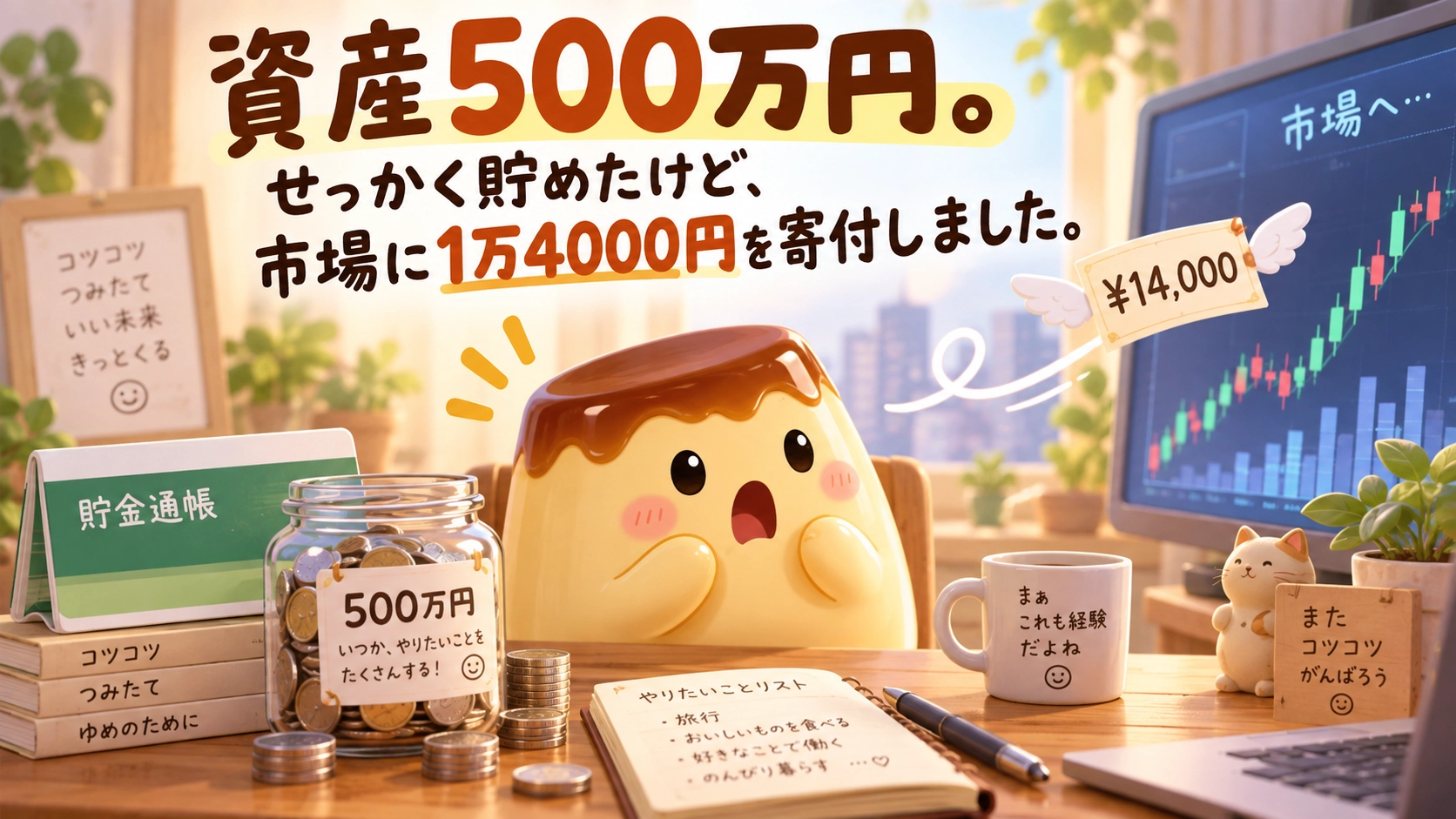
My real experience saving 5,000,000 yen and stocks. I saved up, but I donated 14,000 yen to the market.
My two days of work at the time never returned after going to the market.
I bought Nissan Motor Co. stock and took a loss of 14,000 yen.
I worried, and I sold it.
If possible, I’d like to request a call-out to the market for the lost child.
“Prince Warrior-sama’s 14,000 yen. Your companion is waiting in the original account.”
That’s me. It’s my companion.
I thought it would come back larger, but even the person himself didn’t come back.
I don’t want it to increase anymore. Please have everyone come back as they are.
…There’s no place where such a broadcast can be made, so I’m writing it here.
Hello, this is Prince Warrior.
This time is about my actual story from when I had 5 million yen in assets.
For those who think I’ve wonderfully increased it.
Sorry. First, it will decrease.
I wrote “donation,” but it wasn’t a real donation. It’s a story of losses in stocks.
There was no goodwill.
There was a will to increase.
As a donor, I was quite bad at giving up.
How did you accumulate 5 million yen?
Now, before the donation.
Where did that money come from?
Up to about 5 million yen, I basically earned it and saved it.
It wasn’t the 5 million yen I increased via stock.
What you’d call “deposit power” these days.
Back then, I wasn’t conscious of FIRE.
There were no plans for early retirement or big asset goals.
“So you designed a path to freedom from your youth, right?”
That isn’t true.
Don’t bring a blueprint later. I’m seeing my younger self for the first time.
My salary wasn’t particularly high.
Even including bonuses, I saved about 100,000 yen per month.
Looking back now, I kept quite a bit.
However, I don’t feel I was definitely persevering with extreme frugality.
If I lived normally, I would have saved as a result.
Then what was that “normal” life like?
I wasn’t particularly good at saving money; I was poor at spending.
I think I was bad at wasting money.
That’s what I feel when I look back now.
That doesn’t mean I didn’t endure anything.
Even just meeting and talking with friends was enjoyable.
It was fun without spending a lot of money.
When asked, “How much should I spend today to be satisfied?” I’m already satisfied just talking with friends.
My wallet didn’t do anything. I was just there on the scene.
It wasn’t that I was good at saving money; I could enjoy myself even without spending much.
On the other hand, I traveled quite a bit.
I didn’t just grow my bankbook while keeping myself in a closet.
I also went out.
If only the bankbook enjoys life, that would be a problem.
I use enjoyable things.
If I save money just to save, I wouldn’t keep going.
If stress accumulates with money, that’s a problem.
I travel. But I don’t increase fixed costs.
Meanwhile, I thought about monthly expenses in my own way.
For example, insurance.
Private insurance was basically on a term basis.
There are public medical insurance high-cost medical care systems, and company insurance coverage.
Including those, I considered how much I actually needed.
At that time, I decided I wouldn’t have to pay excessively high premiums for my situation.
Of course, high-cost medical care systems don’t cover all medical expenses.
There are costs that aren’t covered, such as meals and surcharges for bed differences.
Necessary protections vary with family and living circumstances.
Term insurance isn’t a universal answer for everyone.
Regarding cars, my order was “save money first, then buy.”
I thought paying interest would be a waste.
Rather than adding loan payments to monthly plans, I wanted to have the money to buy it upfront.
Even before buying a car, I didn’t want to rely on next month’s salary.
It’s awkward to put plans in place before starting work.
It’s not that buying with cash is absolutely the only right way, but that was my thinking at the time.
Use where you need to. Tighten where you should.
Travel. Hang out with friends.
But don’t let monthly spending rise without limit.
Rather than depriving yourself of everything to save, decide where to spend.
That’s probably how I built up 5 million yen.
Even now, this sense hasn’t changed much.
If I were to tell someone who wants to save now, I’d say: before cutting out enjoyable plans, look at the money that automatically goes out every month.
Not by cutting necessary expenses, but by reconsidering,
“Do I really need this amount for my current self?”
You might find that you’re approving withdrawals smoothly, even though you pause in other areas.
Please pause at the reception for those as well.
Income, family composition, and living conditions are all different.
This does not guarantee everyone can save the same amount.
10万円 per month was my record at the time; it’s not an assignment for everyone.
The saved money later became seed money to buy stocks.
Talk with friends, go on trips.
Keep monthly payments from getting too large, and save what you earn.
With that lifestyle, I saved about 5 million yen.
It wasn’t money set aside from the start for investing.
But in hindsight, this saving became the seed money to start stocks.
The process of preparing the seed was steady. When someone with capital comes along, inspiration strikes.
Meeting investing
What sparked me to start investing was
“Shall I give investing a try?”
…That’s all.
There’s no influential book or mentor here that would bring grandeur to the story.
Mentor: “Finally, the moment has come.”
Something like that.
There isn’t. Please return, mentor.
I opened an account with SBI Securities and tried buying stocks.
“Oh, I can buy with this.”
It felt like that.
As a first statement as an investor, it was quite simple.
Before predicting the world economy, I confirmed I could purchase.
That’s where it starts.
“What stock did you buy first?”
I forgot.
Isn’t that the important part?
Yes.
In a book on investing, this would be the place to draw a line further.
It’s blank. You can draw anywhere you like.
I can’t come up with a later grand justification.
I remember two stocks that made a big profit and two that made big losses.
I wish I had kept a commemorative photo for the first stock.
One of the early trades I clearly remember is Nissan Motor Co.
I forgot why I chose it.
But I remember losing about 14,000 yen in one day.
I forget the first stock, but I remember the amount I lost.
My memory saves the deficit well.
That part is laminated.
It wasn’t 14,000 yen but two days’ worth of work.
It went into a loss, and after much worry, I sold it a day later.
“You cut losses accurately, didn’t you?”
If praised for that, I’m tempted to accept it.
But no. Let’s be honest.
All I have left is this:.
“Two days of work disappeared.”
This is a story from more than 20 years ago, when deflation was still spoken of.
My salary was not that high then.
So 14,000 yen felt heavier than it does now.
It felt like about two days of work disappeared.
This isn’t a precise calculation of daily wages.
That shock at that time.
What appeared on the screen is the amount.
But I also have a sense of having worked for it.
There’s my time in it before it becomes money.
That amount is decreasing.
Wait a moment.
That two days, I did work.
If money disappears, shouldn’t the attendance at work be canceled as well?
It shouldn’t, right?
This system is precisely processed against the parts that are disadvantageous to me.
Could you at least restore one day’s worth?
Even if I spend time with friends or travel, money goes out.
But just as saying, “the balance decreased,” inside me it wasn’t the same.
This one I’m trying to increase by buying.
Then it decreased.
To the person who thought, “I bought it,” next came, “It decreases.”
The same person.
The money I saved and the money I held stocks in
Just because I saved money doesn’t mean I became indifferent to decreases.
Rather, because I saved through work,
“That’s mine.”
Even if I tell the market, nothing can be done.
Now I could summarize, “I learned a lot.”
But at that time, the two days of work disappearing hurt.
It’s not necessary to suddenly turn into grand reflections.
First, “Oh no, it decreased.” For me, that was.
The me who wanted to increase money and the me who saw it decrease lived in the same account.
If I were to put that difference into words now, it would be like this.
Me before buying: “Shall I try investing?”
Me after losses: “The story is different.”
Even though they’re in the same account, we lack proper coordination.
I want to start from the story of 5 million yen here.
If you write only the number 5 million yen, it can be short.
But if you try to tell about that time, savings alone won’t end the story.
There were also time with friends and travel.
There were lives where I thought about insurance and car payments in my own way.
There are stocks I bought but forgot the reason.
And there’s that unforgettable 14,000 yen.
When I was saving,
“Use where you should. Tighten where you should.”
I did that.
However, in stocks, money can decrease even if you don’t use it.
What didn’t come out when saving now appeared.
Looking back now, I feel the way I deal with money cannot be understood solely by the increase in balance.
What I spent money on that I could accept, and what kind of decrease I disliked.
There is a self that cannot be seen in numbers alone.
Rather than distributing the answer that “you can save 5 million yen by doing this,” I’d like to leave this kind of story behind.
If I only list what went well, the me who sold quickly that day would disappear.
Whether you do OCC or individual stocks, investing requires capital.
In my case, that seed was the 5 million yen.
And how I made that seed.
Use where you should and suppress fixed costs that don’t lead to satisfaction.
I’d be happy if my way of spending money could be a reference for someone.
Next, I’ll also write an article from when I had 10 million yen.
Will my relationship with money change as the amount increases?
Or will the balance just grow while I remain the same?
I also plan to properly feature the me from that time.
So, where will this person go?
Even I didn’t know at that time.
By the way, regarding the 14,000 yen I called out at the beginning.
I’m not angry. You know the account, right?
The mentor has left, but you all should come back.
By the way, I’m not an FP (financial planner).
However, I’ve worked with taxes and pensions at the city hall and have thought about money for a long time myself.
After retirement,
“How should I organize money and life?”
I’d like to try helping organize discussions about that based on my experiences.
If there are people who want to consult at that time, please leave a comment.
Of course, it’s paid (laughs).
If I become busy for free, I’ll take a FIRE and rejoin the workforce.
Thank you for reading to the end.
If you’d like to see more of this person’s story, I’d be glad if you could like or follow.
Even in the era of 10 million yen, I’ll deliver not only the balance but the person himself as well.
※This article contains general information and the author’s own views, and does not recommend buying or selling specific stocks or financial products. Investments carry price fluctuation and the possibility of loss. Please check the latest information and proceed based on your own judgment and responsibility.