
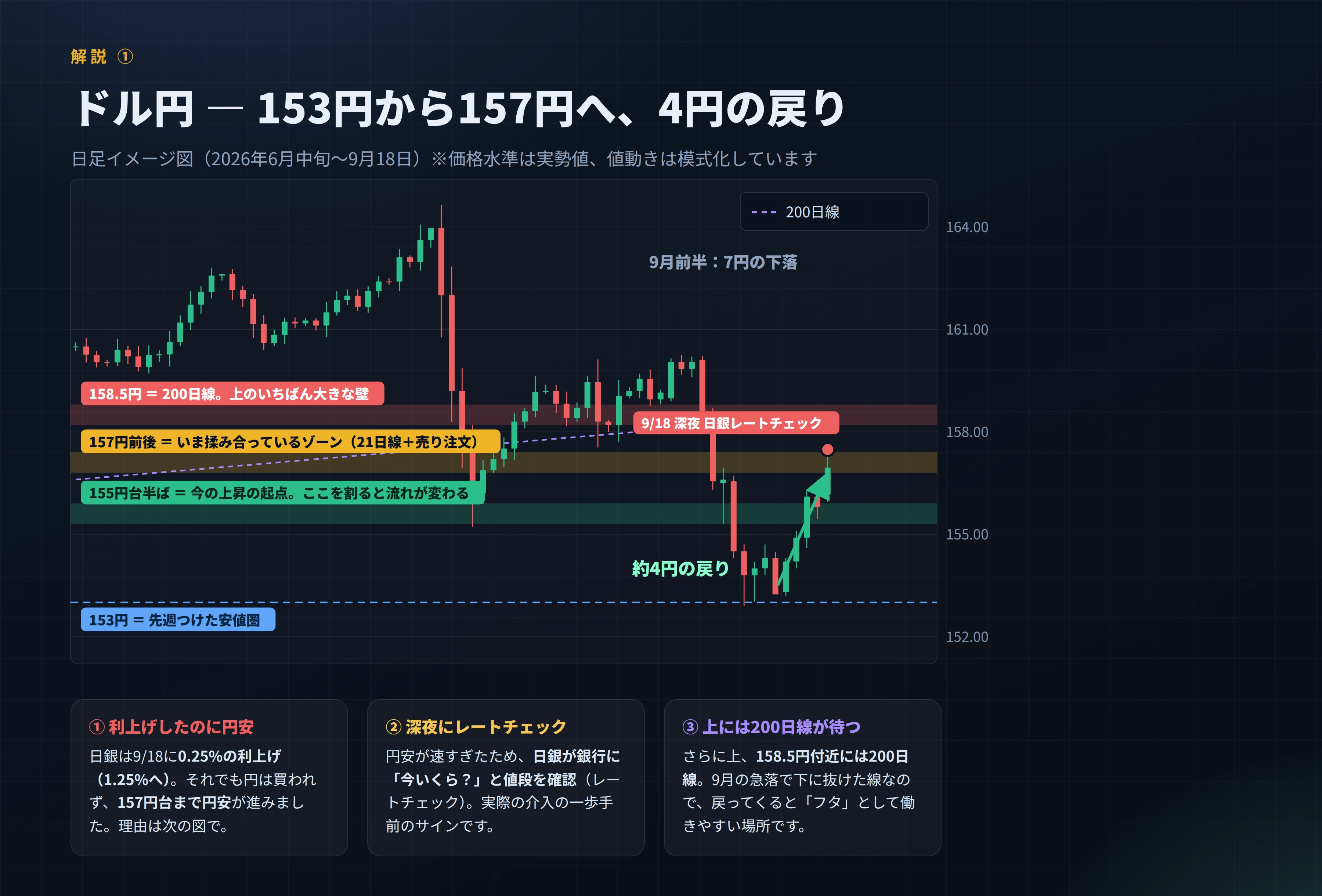
Even though the Bank of Japan raised rates, the yen was sold. And in the late night, the Bank of Japan moved with a "rate check."
The BOJ raised rates, yet the yen fell.
And in the middle of the night, the BOJ moved on a “rate check.”
In last week’s commentary I said that “a rate hike does not necessarily mean a stronger yen,” and
that is exactly the result we see.
What happened this week (9/14–9/18)
Daily flow
9/14 (Mon) Slowly rebounded from the 153 level
9/15 (Tue) Up to the 154 level
9/16 (Wed) FOMC (US) raises 0.25% → to the 156 level
9/17 (Thu) briefly pushed to mid-155s
9/18 (Fri) BOJ raises 0.25% (to 1.25%)
→ Yet yen depreciation continued, to the 157 level
→ Late at night, the BOJ conducted a rate check
153 yen → 157 yen range = about 4 yen rebound
Two central bank decisions
【9/16 FOMC (US)】
0.25% rate hike → Policy rate 3.75% to 4.00%
Unanimous decision
【9/18 BOJ (Japan)】
0.25% rate hike → Policy rate 1.25% (first time in 3 months)
Decision: 7 in favor, 2 against
Governor Kuroda stated that “the environment has changed.”
Why did the yen weaken despite the rate hike?
This is the most important part this time. There are three reasons.
■ ① The rate hike was “priced in”
More than 90% of the market expected the BOJ to raise rates.
There was no surprise in the result that followed expectations.
→ Once all factors were out, the market moved in the opposite direction (buy the rumor, sell the fact)
■ ② Those who had been buying yen booked profits and sold
In early September, USD/JPY fell from 160 to 153, a drop of 7 yen.
With this drop, many overseas investors held positions that were “buy yen (i.e., sell USD/JPY).”
They waited for the BOJ announcement
↓
Judged that “the materials are out,”
↓
and sold to realize profits (buy USD/JPY back)
This accelerated the yen’s depreciation.
■ ③ The interest rate differential between the US and Japan did not change
US: 3.75–4.00% (up 0.25%)
Japan: 1.25% (up 0.25%)
→ The gap remains about 2.5% and unchanged
As I wrote in last week’s commentary, “when both rise, the interest rate gap does not change.”
That is exactly the result.
★ What moves exchange rates is not “rates” but “the rate differential.”
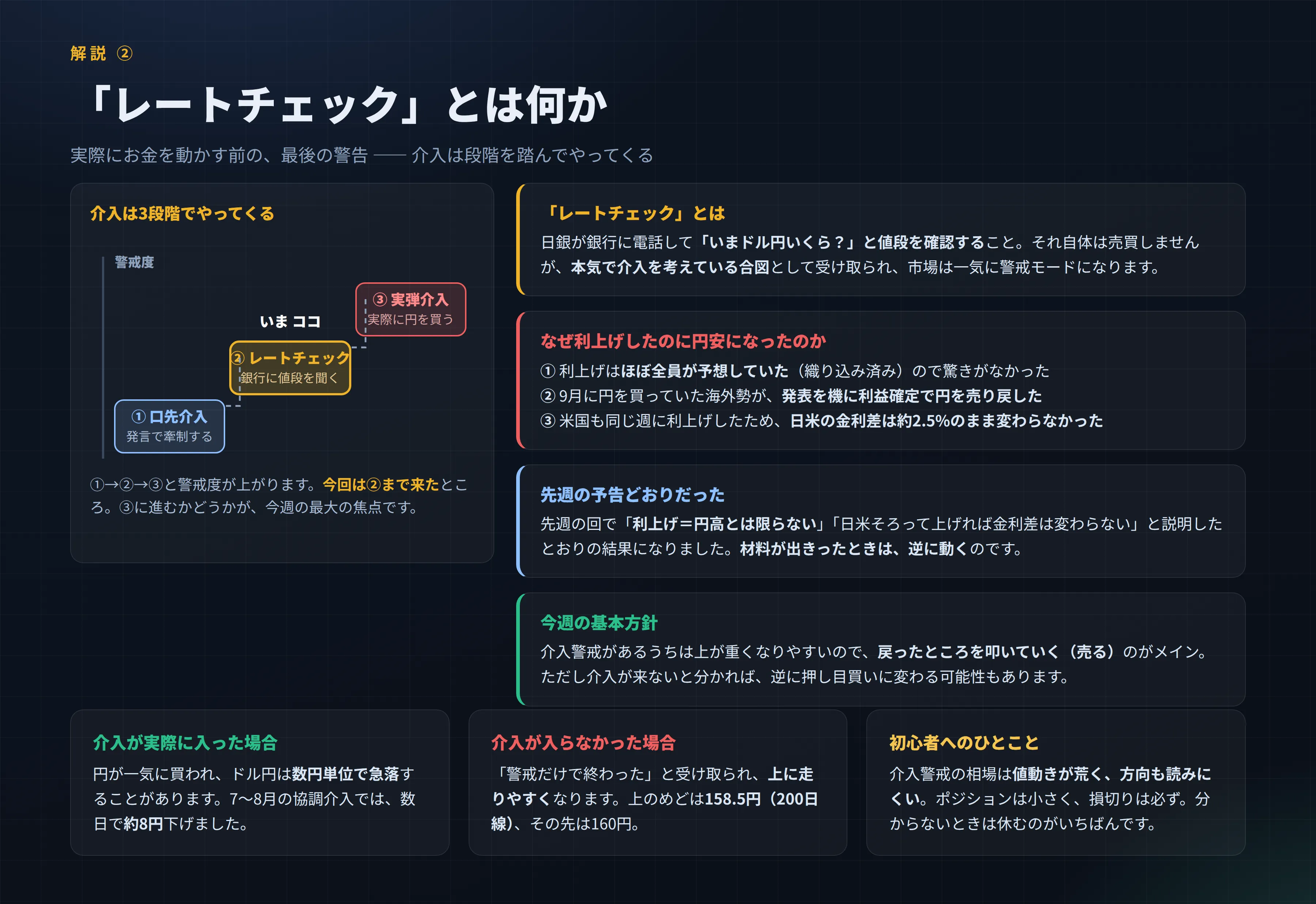
What is a “rate check”
The BOJ calls a bank
to ask, “What is the USD/JPY rate now?”
to check the price.
That in itself does not involve buying or selling. But in the market
it is interpreted as a sign that the BOJ is seriously considering intervention
and a state of alert spreads rapidly.
Intervention comes in three stages
┌──────────────┐
│ ③ Real-strike intervention │
│ Actually buying yen │
└──────────────┘
↑
┌──────────────────┐ ← Now
│ ② Rate check │
│ Ask banks for the price │
└──────────────────┘
↑
┌──────────────┐
│ ① Verbal intervention │
│ Discourage with statements │
└──────────────┘
Alertness level: ① < ② < ③
This time, we have reached up to ②.
Whether we move to ③ is the biggest focus this week.
[For reference] In the July–August US-Japanese coordinated interventions,
the USD/JPY fell by about 8 yen in a few days.
When actual intervention occurs, the movement tends to be that large.
Strategy for this week (week of 9/21)