

How to Use Channel Line ~ Channel Line Part 2 ~ 【Line Analysis Basics Course #8】
Hello! I’m SAKU!
Previous article continues with Channel lines discussion!
This time, how to actually apply channel lines to trading and where to use them will be explored!
Before that, a quick review: while trendlines indicate when to enter a new position, what was the nature of channel lines again?
That’s right. Channel lines are a guide for taking profits, aren’t they?
If you’re still unsure, review the previous article before reading this article!
Profit-taking using channel lines as a guide
There are many personal approaches to profit-taking, but you can also use channel lines as a guide for profits.
A simple method is to enter near the trend line and take profits near the channel line.
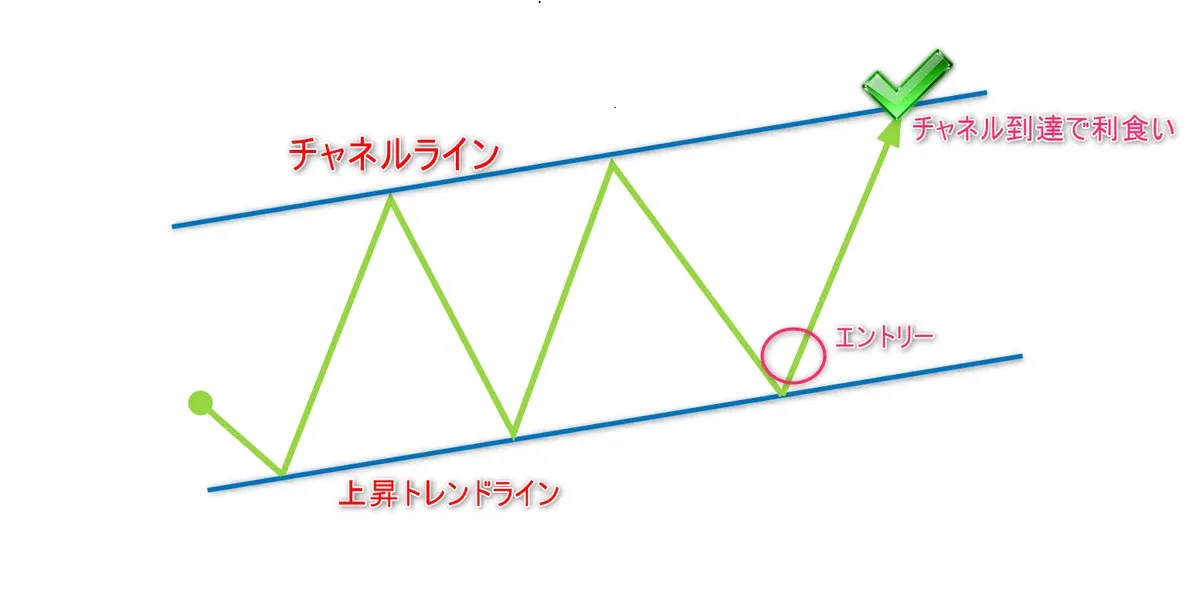
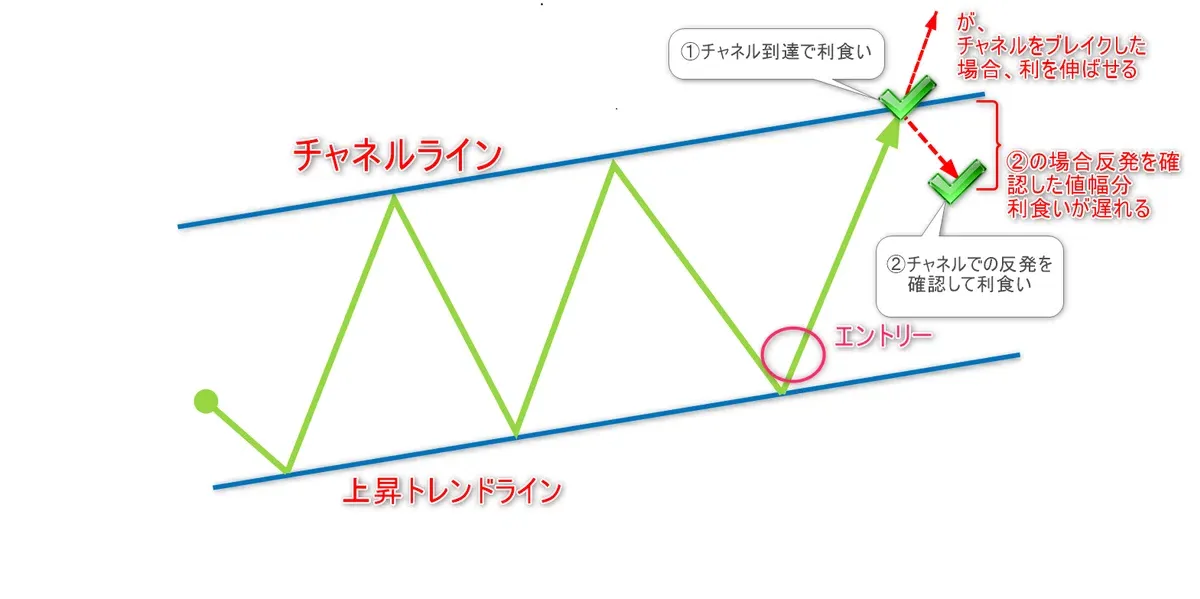
Here,① Do you take profits when you touch the channel line,② or when price reverses after touching the channel line, you might wonder, but honestly either is fine!
In case ①, if price reverses from the channel line afterward, you can secure more profit than in case ② (since you didn’t confirm the reversal, you might take profits near the peak). If price breaks the channel line, you end up taking profits at a less optimal level.
In case ②, if there’s no reversal and it breaks the channel line, you can expect further gains, but if there is a reversal, you’ll reduce profits slightly compared to case ①.
Both have pros and cons, so choose the approach you prefer and are comfortable with!
Channel line break
In the previous section on profit-taking, I briefly mentioned channel line breaks. What should we consider when a channel line breaks?
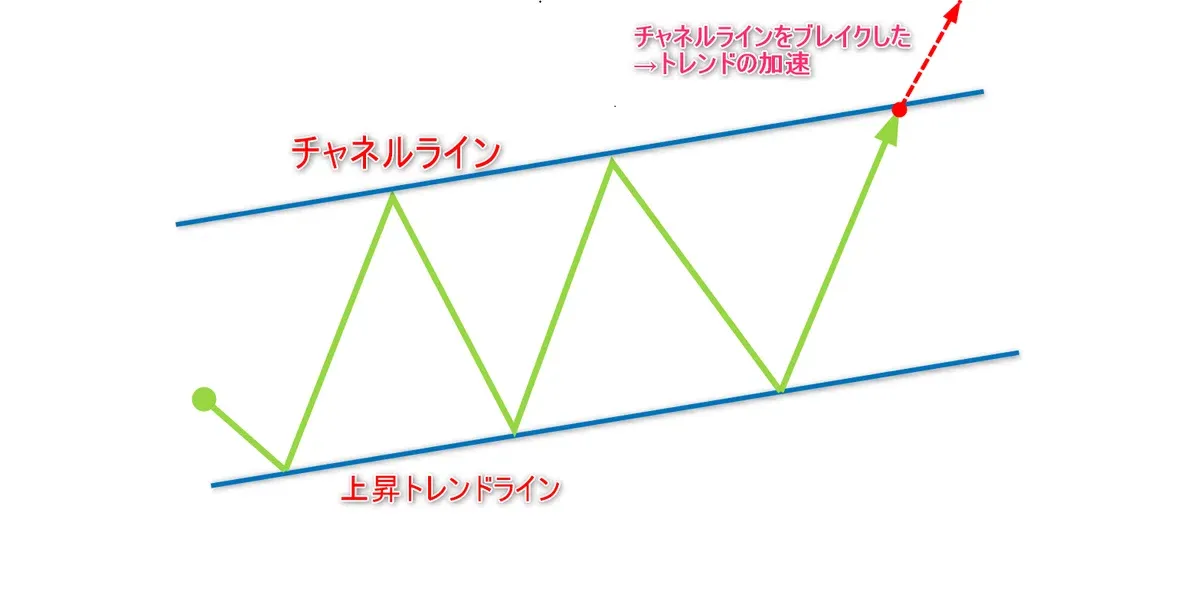
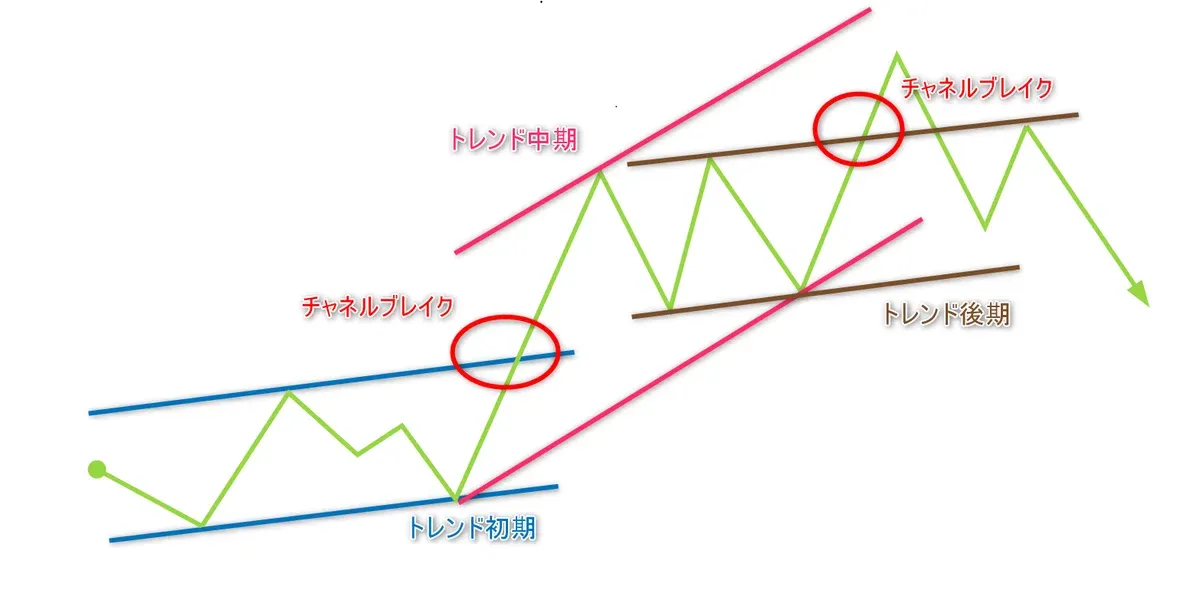
Channel line breaks indicate a speeding up of the trend can be thought of as
Channel lines are mainly used as profit targets, but breaking them implies that momentum in the trend direction is strong.
However!
Just because the channel line is broken doesn’t mean you should jump in immediately!
After the break, if price keeps moving, it’s because of including stop-loss orders and new positions. This is why it tends to extend further, right?
When a trendline breaks, those who were following the trend might retreat, but channel lines have weaker characteristics in this regard.
Why? because channel lines, unlike trendlines, are not a typical basis to open new positions, meaning there may not be much accumulated stop-loss near the line!
So even after a channel line break, price often snaps back into the original channel quickly.
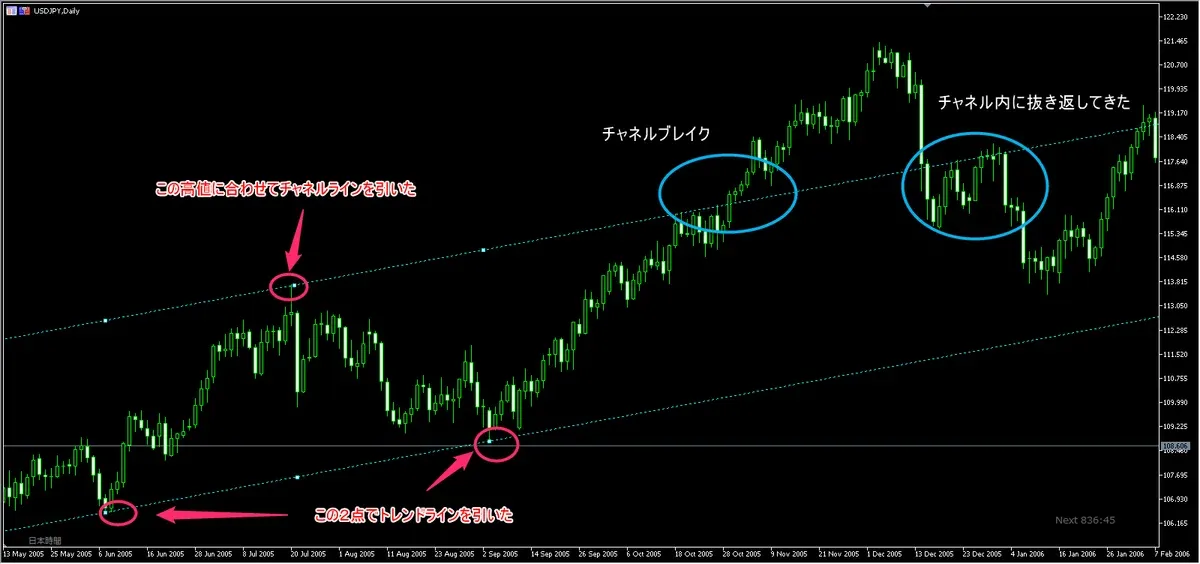
Of course, price may keep advancing, but in that case it’s safer to wait for a pullback or retrace before re-entering.
By the way, when a channel break occurs early in the trend, it’s expected to develop into an even larger trend; when it occurs late in the trend, a top or bottom may be near.
This area can get complicated with wave theory, so at first you may not need to worry about it.
Unreached channels
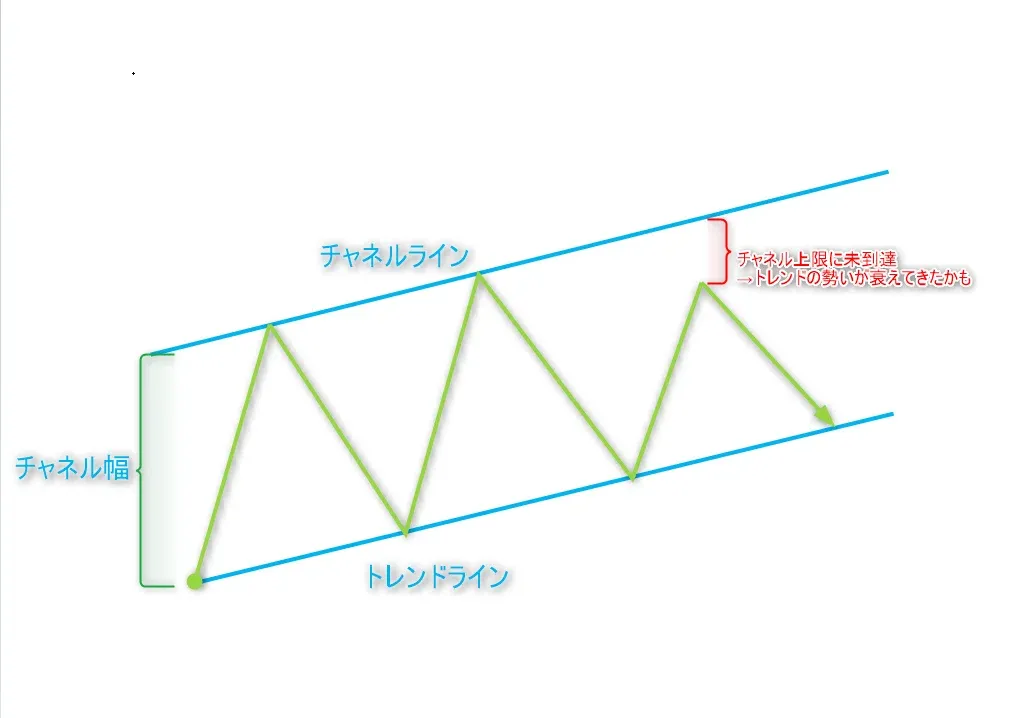
Drawing a channel line parallel to the trendline defines the channel width, but sometimes price movement stops reaching the channel line.
In that case, unreached channel implies weakening momentum in the price movement in the direction of the trend.
Understanding this sign of trend weakness can help you plan for the future!
Summary of channel lines
So far, we’ve looked at channel lines in this and the previous article. How was it for you?
To recap, here are the key points:
・Channel lines are drawn parallel to trendlines
・Channel lines serve as profit-taking guides (trendlines for new positions)
・Entry near channel lines (reversals or break entries) should be avoided early on
・Interpret channel unreached to anticipate momentum weakening
Actually, I sometimes enter near channel lines.
However, that’s a more advanced entry, so I’ll write about it when the opportunity arises.
For now, understand and master the properties and usage of trendlines and channels well!
Honestly, if you study and can properly use horizontal lines, trendlines, and channel lines, you can confidently trade the markets.There are many who are already winning with just these concepts.
In fact, many find horizontal lines alone sufficient.
A line is a weapon whose strength depends on how you use it.
First, organize what you’ve learned so far and practice a lot to master it!
Next time, I plan to write about points and tips for line analysis!
Stay tuned!
If you found this article helpful, please like and give a ♡! It motivates me!
If you want to learn more advanced and practical line analysis and setup patterns from the basics, check this out ↓
→MTF Multi-Time-Frame Analysis Essentials (There’s a free trial available)

【Limited-time opening campaign!】→ MMS Market Guide- Understanding the “structural traps” that individual investors fall into and a market microstructure analysis to reveal major players' footprints - (There’s also a free trial)