

[BOJ Showdown Complete Strategy] Market-embedded 80% “1.25% rate hike” and three-stage trap — a devilish timetable connecting from CPI to Ueda press conference, to US PMI
On September 18, 2026, we will迎える the release of the Bank of Japan's monetary policy meeting results that will influence trends in the forex market and Governor Ueda's regular press conference.
Because the previous day’s U.S. FOMC delivered a unanimous 25 basis point rate hike and hawkish dot chart, USD/JPY rose to the 156 yen level briefly. However, in the Tokyo market it was pushed back to the mid-155s, and ahead of the BOJ decision the market remains in a highly nervous range.
“If the BOJ raises rates by 0.25% and lifts policy rate to 1.25%, will the USD/JPY crash?”
In short, “the move up to 1.25%” is already largely priced in by the OIS market (about 80%) and almost all private economists surveyed have priced it in.
What will decide the market is not whether there is a rate hike, but whether Governor Ueda will proceed with additional rate hikes within the year (accelerating at a quarterly pace), and how he navigates the wave attack from the morning Japanese CPI to the night U.S. PMIs.
Tomorrow’s market-dominating “three-stage trap,” the eight-scenario branching table, and practical monitoring indicators will be explained clearly.
Chapter 1: Tomorrow’s main battlefield is the “three-stage time-difference trap”
Tomorrow’s USD/JPY is not a one-off event-driven market. Five waves will roll in from 8:30 in the morning to late at night.
【September 18 – Devil’s timetable】
[Wave 1]
08:30 ?? August national CPI (overall +2.0% forecast, core +1.8% forecast)
[Wave 2]
Around noon ?? BOJ policy rate announcement & statement release (1.25% rate hike as the base)
[Wave 3]
15:30 ?? Governor Ueda’s press conference (★ biggest turning point, hints of additional hikes)
[Wave 4]
22:15 ?? August IP and capacity utilization
[Wave 5]
22:45 ?? September flash PMI (manufacturing, services, composite)
The most dangerous move is to jump on the initial reaction to the “noon policy announcement (Wave 2).”
Even if the policy rate announcement causes a temporary yen gain, if Ueda’s press conference at 15:30 yields cautious remarks, there is a risk of a rapid yen selling reversal (Sell the fact).
Chapter 2: BOJ Meeting “All 8 Patterns” Complete Scenario Branching Table
We have covered the market impact of policy rate decisions, the statement, and Governor Ueda’s press conference.
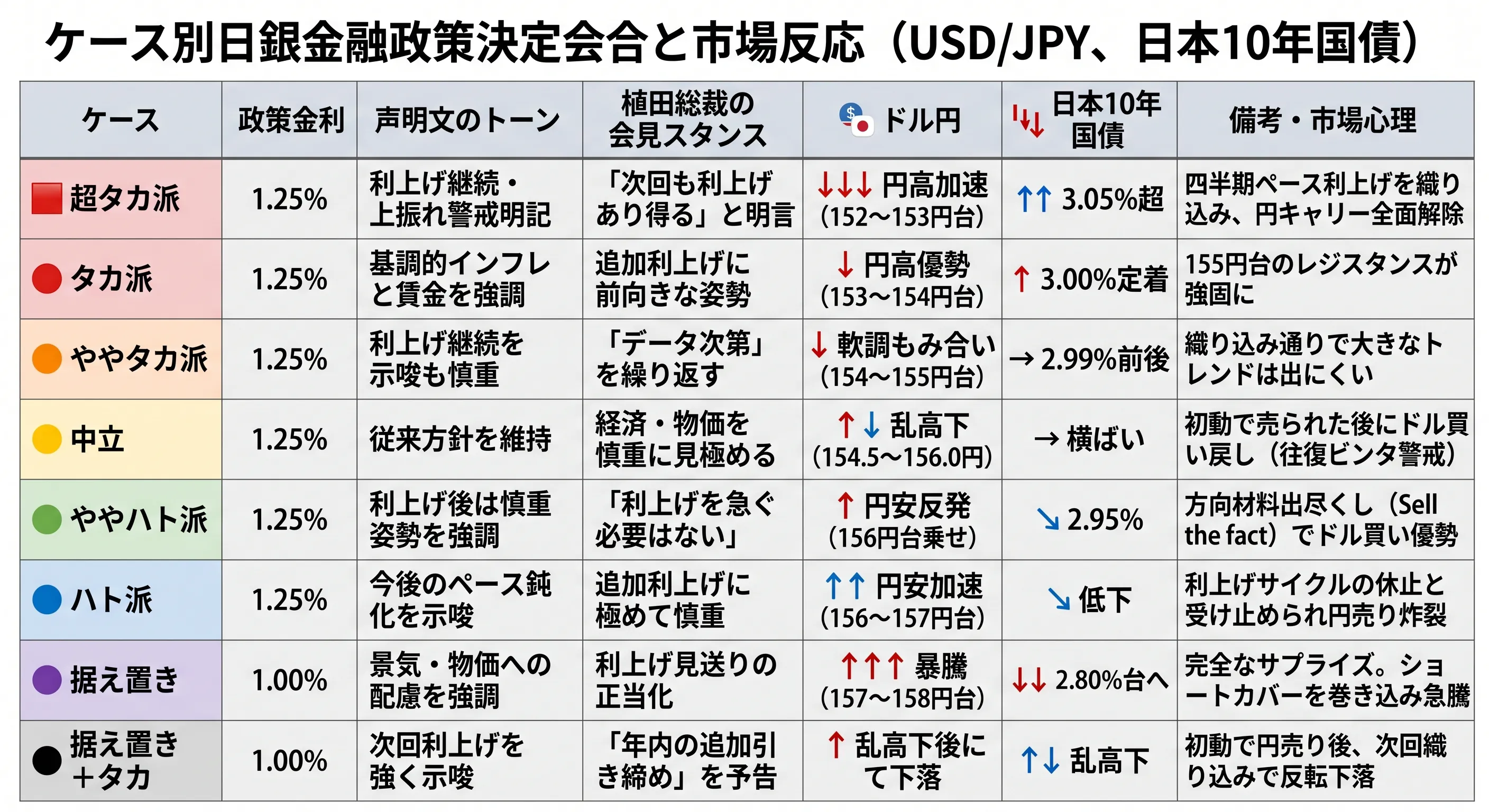
Chapter 3: The Three Core Points That Decide the Market
These are points that must not be overlooked when parsing tomorrow’s meeting.
1. Governor Ueda’s wording on “degree of easing”
When policy rate reaches 1.25%, the lower bound of the neutral rate that the BOJ estimates (a rate that neither cools nor heats the economy) begins to be breached.
If in the press conference he emphasizes that even at 1.25% financial conditions are still very accommodative, the market will interpret it as ample room for further tightening to 1.50% and will push the yen higher.
Conversely, if the tone softens, implying we are entering a tightening area and we should observe cautiously, a sense of rate hikes topping out could emerge and trigger a strong yen selling rally.
2. BOJ stance on long-term Japanese yields around “3.00%”
The new 10-year JGB yield is around 2.99% now, approaching a 30-year high near 3%.
Will the long-term yield rise be accepted as proof of economic normalization, or will concerns about fiscal policy and market functioning cause restraint? A single phrase from Governor Ueda can send the bond market into wild swings and ripple into the forex market.
3. The government and intervention encirclement around the 155–160 yen range
Background includes yen weakness cautions from Chief Cabinet Secretary Kishida and Finance Minister Katayama, and justification of coordinated intervention by U.S. Treasury Secretary Yellen.
Even if the BOJ leans doveish and USD/JPY jumps to the 156–157 range, there remains a giant cap of “real intervention by U.S.-Japan authorities” above.
Chapter 4: Practical use of the “Four Major Indicator Correlation Matrix”
If you only watch the USD/JPY rate, you may get swept up by institutional traders. Always display the following four indicators side by side on your screen to monitor.
【Practical monitoring screen】
① USD/JPY (yen rate)
② Japan 10-year yield (defense of 3.00%)
③ U.S. 2-year yield (around 4.72% / reflecting expectations of further Fed hikes)
④ Dollar Index: DXY (is the dollar broadly strong or is the yen alone weak)
Rules for initial action in practice
True yen-strength trend (following a short):
Japan CPI surprises high + BOJ at 1.25% + hawkish Ueda + Japan 10-year at >3% + U.S. 2-year yield declines
➔ USD/JPY breaks below 155 and accelerates toward the 153s.
False yen-strength (do not short carelessly):
If USD/JPY alone jumps into the 154s while U.S. 2-year yields rise above 4.75% and DXY climbs.
➔ There is a risk of the U.S. dollar buying pressure pushing USD/JPY into the upper 155s rapidly.
Summary
September 18, 2026 is a day when “priced-in rate hikes” clash head-on with the BOJ’s future stance.
From the morning CPI to the night U.S. PMI, market bias will shift rapidly.
Discard the simple preconceptions of “short because of hikes” and “long because of holds,” and approach with a two-stage strategy that clearly separates the policy announcement (noon) and Ueda’s press conference (15:30).
Compare the confirmed values of important indicators and indicators signals calmly, and master the tumultuous market with disciplined trading.
? [GogoJungle listing page]