[FOMC全面解析] Market's 93% Trap: Even with a rate hike, USD/JPY plunges in a "data-drought scenario" and the tug-of-war at 155 yen
The momentous turning point in the financial markets is finally here: the results of the US Federal Reserve's FOMC announcement are imminent.
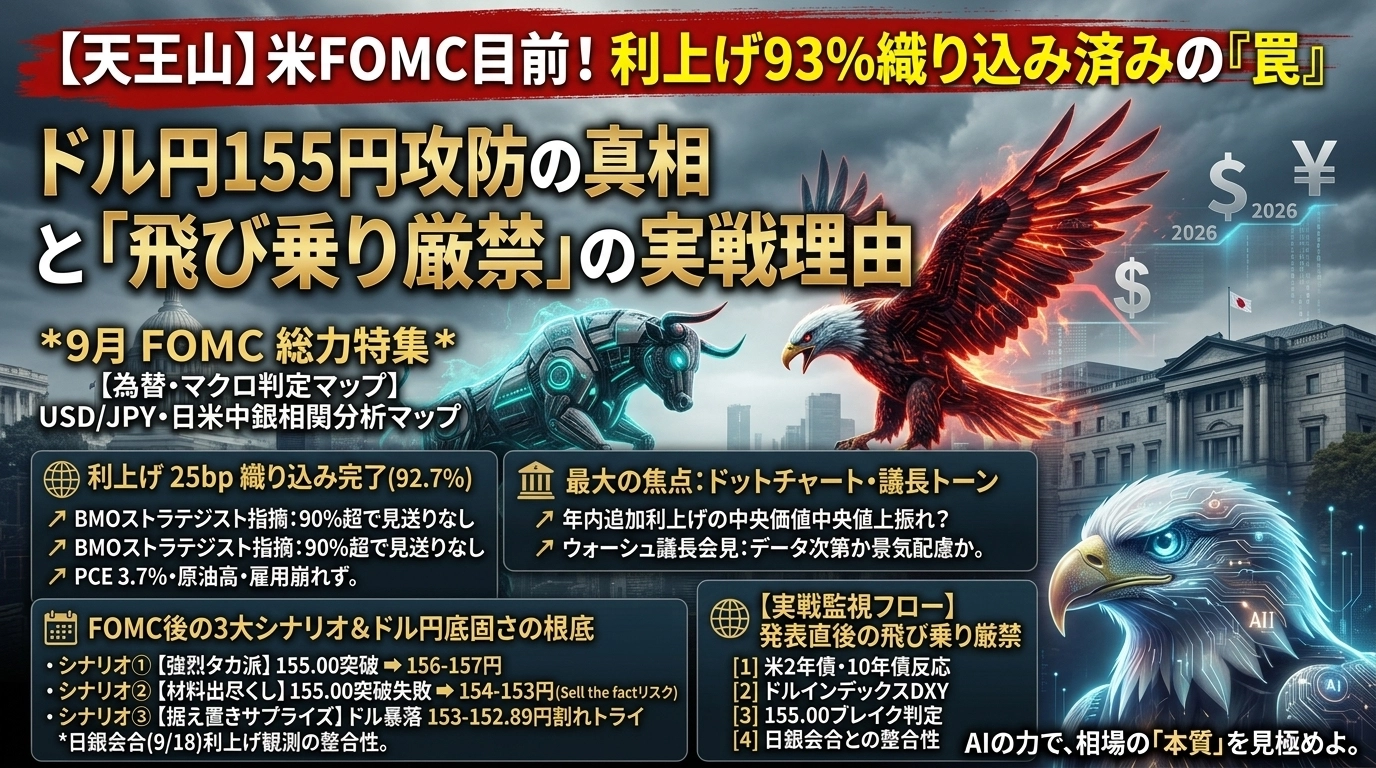
Currently, the CME FedWatch shows the probability of a 25bp rate hike on September 25 at about 92.7%. The market has already priced in a rate increase as a near-certain path, the US 10-year yield briefly surpassed the 5% threshold, and USD/JPY is engaging in a fierce battle around the psychologically significant 155 yen level.
“If the probability of a rate hike is 93%, isn’t buying USD/JPY long at the moment of the announcement a sure win?”
If you think that, you are in extreme danger. As historical market data shows, “the rate hike itself” has already been priced in, and the real drivers moving the market have shifted to other factors.
I will clearly explain the dynamics just before the FOMC, how to interpret Chair Powell’s posture, how to read the dot chart, and practical reasons to absolutely avoid jumping in immediately after a rate hike.
Chapter 1: Why did the Fed get cornered into raising rates?
This rate hike reflects less of a deliberate decision by the Fed and more of being forced to hike due to persistent inflation and high crude oil prices.
【The three major pressures forcing the Fed to raise rates】
1) Persistently high inflation:
US PCE inflation is at 3.7%, well above the 2% target
2) Middle East tensions and crude above $100:
Surge in energy prices directly hits inflation concerns
3) Robust employment and growth remains:
August non-farm payrolls up by 162,000, Q3 growth still in the mid-2% range
Major financial institutions (Goldman Sachs, JPMorgan, HSBC, Deutsche Bank, etc.) have also steered toward predicting a 25bp hike. As BMO strategists note, “there has never been an instance where the futures market priced in a policy change of 90% or more and the Fed did not act,” so raising the policy rate to 3.75–4.00% in September is no longer a surprise.
Chapter 2: The biggest focus is whether there will be continued hikes—dot chart and Powell’s tone
With rate hikes having become the norm, market participants are watching whether the year will see consecutive hikes in October and December, or if this will be the end (a wait-and-see stance).
Two points to watch:
1. The hawkishness of the dot chart (distribution of interest rate projections)
In June, participants expecting at least two rate hikes this year were only six. In this revision, whether the dot plot shows majority support for one more hike this year (a higher median) will be the crucial turning point.
2. Powell’s press conference tone
Powell signaled a strong hawkish stance at the August Jackson Hole symposium, saying that if inflation remains too high, further hikes would be warranted. Whether his press conference will maintain the stance of tightening depending on data, or soften with a nod to economic growth, will determine the market’s fate.
Chapter 3: The three major USD/JPY scenarios after the FOMC and the 155 yen turning point
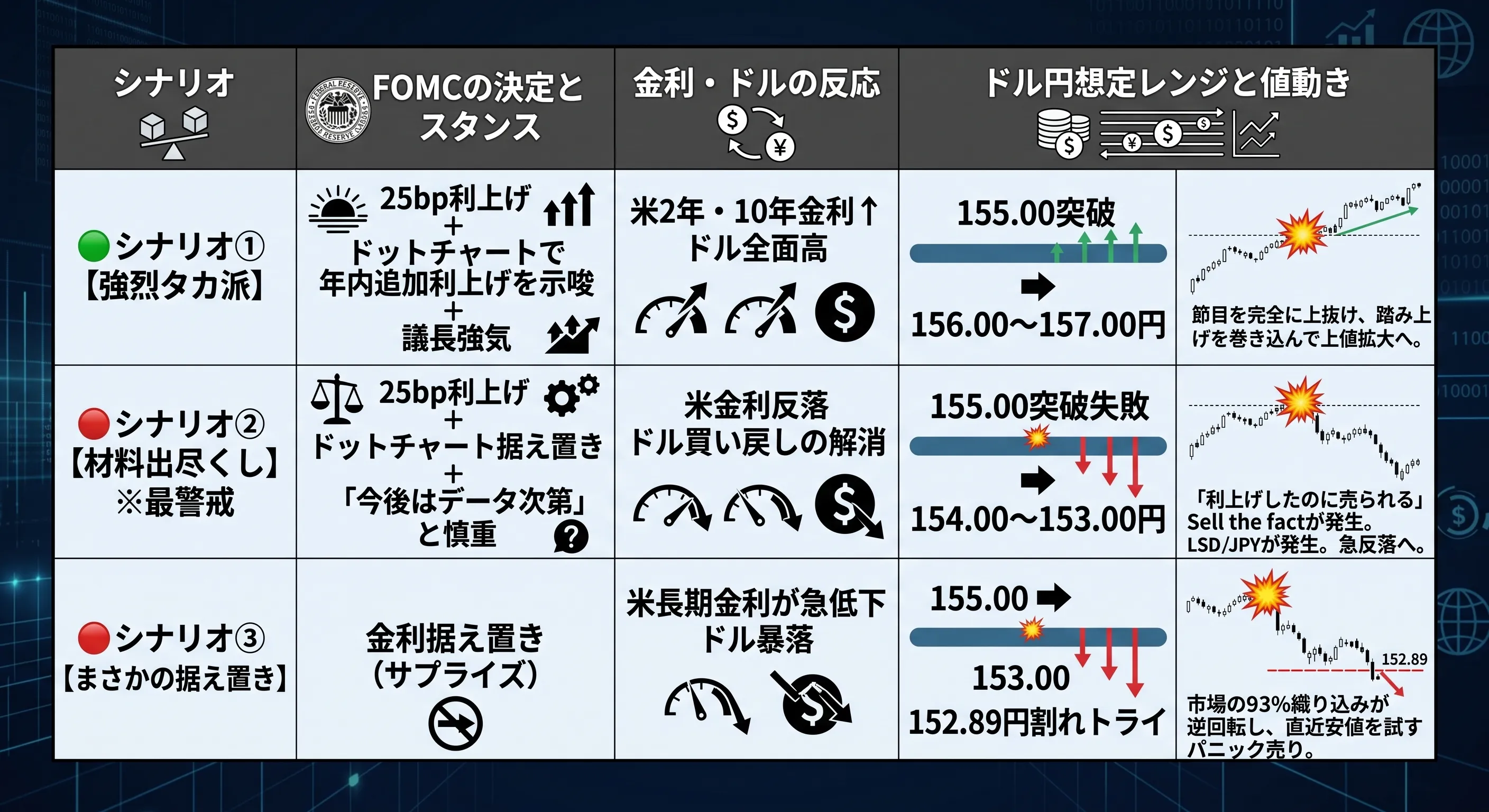
Currently, USD/JPY sits just below the formidable resistance of 155.00 yen. Depending on the FOMC outcomes and statement, it will diverge into three routes.
Attention should especially be paid to Scenario 2 (exhaustion of catalysts).
After a “Hike decision!” headline pushes it into the upper 155s for a moment, if the chair’s press conference introduces caution about further hikes, the US 2-year yield could plummet sharply, knocking the pair down to the low 153s—a common “rope-a-dope” pattern.
Chapter 4: No jumping in right after an announcement! A practical five-stage confirmation flow
To survive the volatile central-bank landscape, absolutely avoid trading on emotion in the first few minutes after the announcement.
The verification steps to understand the market’s essence are as follows.
【FOMC immediate verification flow】
[Stage 1] Reaction of the US 2-year treasury yield (most accurately reflects the policy direction)
[Stage 2] Maintenance of the US 10-year yield (whether it settles around the 5.00% level)
[Stage 3] Direction of the Dollar Index (DXY)
[Stage 4] Break determination of USD/JPY at “155.00” (whether it closes through the level on a daily close, not just a wick)
[Stage 5] Consistency with tomorrow’s Bank of Japan meeting (expectations for a rate hike to 1.25%)
If US 10-year yields remain above 5% but USD/JPY cannot hold 155, that signals a strong sense that upside is heavy and there is hidden yen-strength pressure.
Summary
The true test of this FOMC is not whether rates will rise, but whether the market’s already-embedded 93% probability can be exceeded by the Fed’s even more hawkish stance.
Moreover, tomorrow, September 17–18, the Bank of Japan policy meeting—where further rate hikes are strongly anticipated—will take place.
Discard the simplistic thinking of “buy when it goes up, sell when it goes down.” Wait for the correlation between interest rates and exchange rates and for objective confirmatory signals from technical indicators, and proceed with calm and deliberate actions.