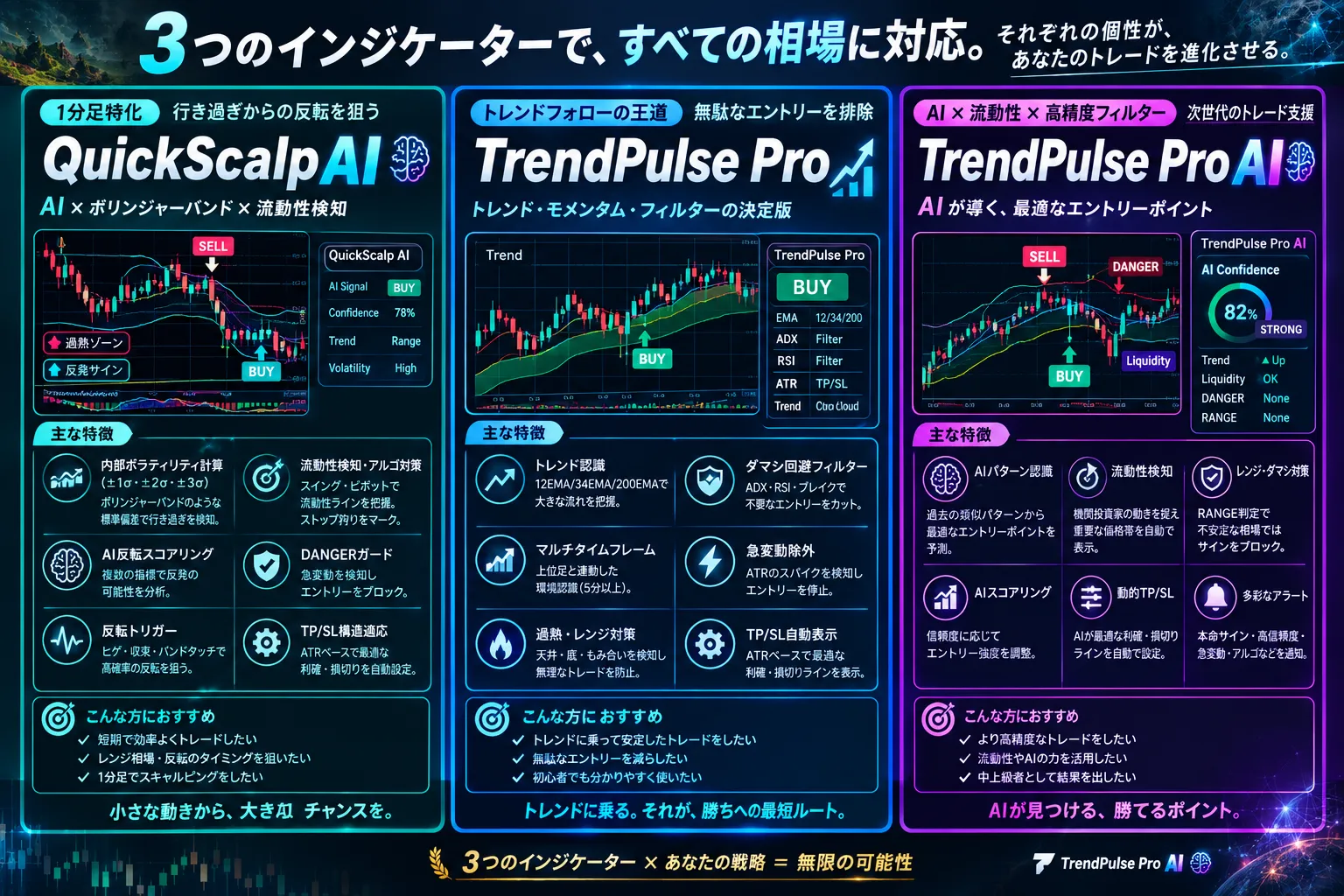
[1-Minute Chart Only] QuickScalpAI Practical Manual | High-velocity scalping technique aimed at the initial move of a reversal and convergence to strike it down
Thank you for always checking out our content.
In this article, we focus on 1-minute chart scalping, deriving the market’s“Overheat/Expansion/Convergence”cycle to
pinpoint the initial move of a reversal“QuickScalp 1M AI (v14.4)”practical usage
explained.
We have also detailed how to accurately read each dashboard item and the specifications of the 1-minute chart’s “instant alert” feature.
We’ve organized it clearly.
1. Basic Philosophy of 1-Minute Scalping
The 1-minute market is full of noise, and typical indicators frequently give false signals.
QuickScalpAI confirms only at the moment when market overheating begins to reverse and converge, matching with the AI to
identify,about 5 to 10 pipsof profit is steadily accumulated with high turnover logic.
.
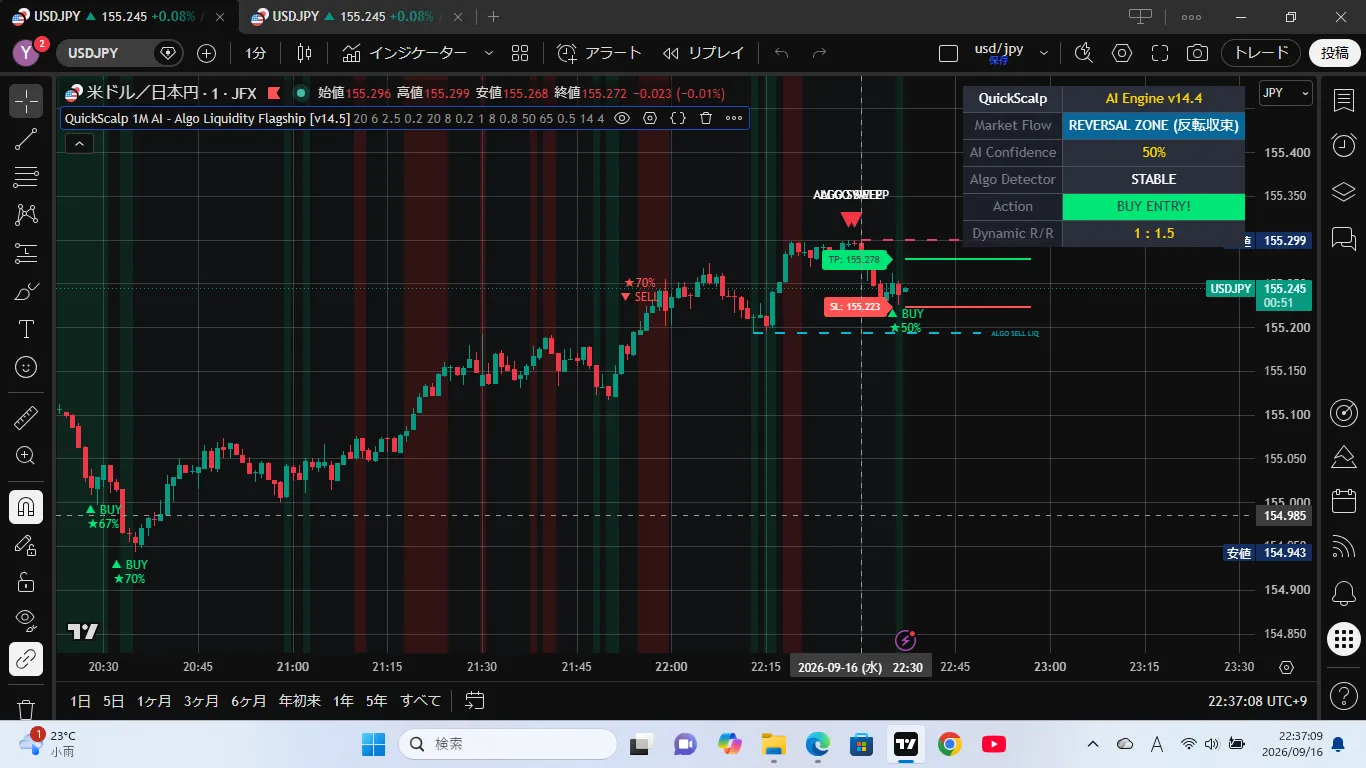
Overheat Zone Background Color
When price breaks through the market’s overheating threshold, the background changes (red: overbought, green: oversold).
Reversal Convergence Signals (▲BUY / ▼SELL)
When band contraction, reversal momentum (pin bars or engulfing patterns), and AI score (60% or higher) align, they light up.
ALGO SWEEP Detection
Detects stop-hunting against the nearest swing high/low on the 1-minute chart and automatically blocks the next two bars for a contrarian pullback.
2. How to Read the Real-Time Dashboard (Status Monitoring Panel)
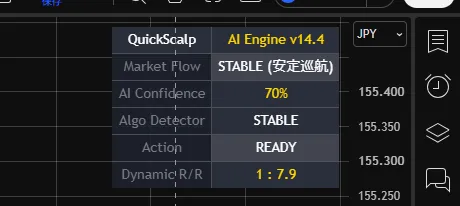
The dashboard constantly displayed in the upper right of the chart is a control panel that instantly monitors the rapidly changing 1-minute chart’s market state and system actions.
From the top, you should check the following five items.
Market Flow (Market State)
REVERSAL ZONE (Reversal Convergence)
An entry-ready state where the volatility expansion has passed its peak and reversal energy is starting to accumulate.
HIGH VOLATILITY (Rapid Expansion Warning)
Because a strong trend is emerging, dangerous contrarian signals are automatically blocked.
CONSOLIDATION (Stagnation Pause)
A state where volatility narrows extremely. To avoid wasted back-and-forth signals, signals are fully locked.
DANGER (Sudden Change Stop)
Emergency stop state when an abnormal wick of ATR×2.5 times or more is detected.
STABLE (Stable Cruise)
A state of typical price movement.
AI Confidence (AI Reliability)
Displays the AI’s rebound expectation based on past chart patterns (★〇〇%). It is typically blocked when below 60%, and entries are permitted when the score is 70% or higher.
Algo Detector (Algo Detection)
STABLE
A state free of major traps and stable.
? LIQ SWEEP
The moment a stop-hunt occurs at the latest high/low.
COOLING
After a stop-hunt occurs, to prevent a false signal, there is a two-bar safety alert and signal freeze.
Action (System Instructions)
BUY ENTRY! / SELL ENTRY!
Entry signal that satisfies all reversal conditions and AI score.
READY
Standard state waiting for reversal conditions.
WAIT (Alert / Second Wave Alert)
Paused temporarily while watching for large players’ setups or aftershocks of rapid changes.
LOCKED / DANGER STOP
System completely blocks trading due to consolidation or dangerous market conditions.
Dynamic R/R (Dynamic Risk-Reward)
Real-time ratio of risk (stop loss width) to reward based on the most recent noise width on the 1-minute chart.
3. Alert (Instant Reporting) Specifications and Important Handling Notes
The indicator’s alerts do not follow TradingView’s standard “bar-confirmation waiting”; instead, they are designed to sound instantly the moment the condition is met (alert.freq_once_per_bar).
Benefits of Instant Reporting
1-minute chart scalping requires only a few fractions of a second of delay. Because it sounds without waiting for the candle to close, you can jump on the initial move at the fastest possible moment.
Cautions (Signal Disappearance Risk)
If the price is pulled back sharply after the candle forms and before the bar closes, the arrow signal on the chart may disappear (it may look like repainting).
There are cases like that.
Practical Trading Approach:
When the alert sounds, if Market Flow on the dashboard is in the REVERSAL ZONE and there is a clearly formed reversal wick on the candle pattern, this is the most reliable point to enter visually.
4. Real Trade Entry and Quick Take-Profit Procedure
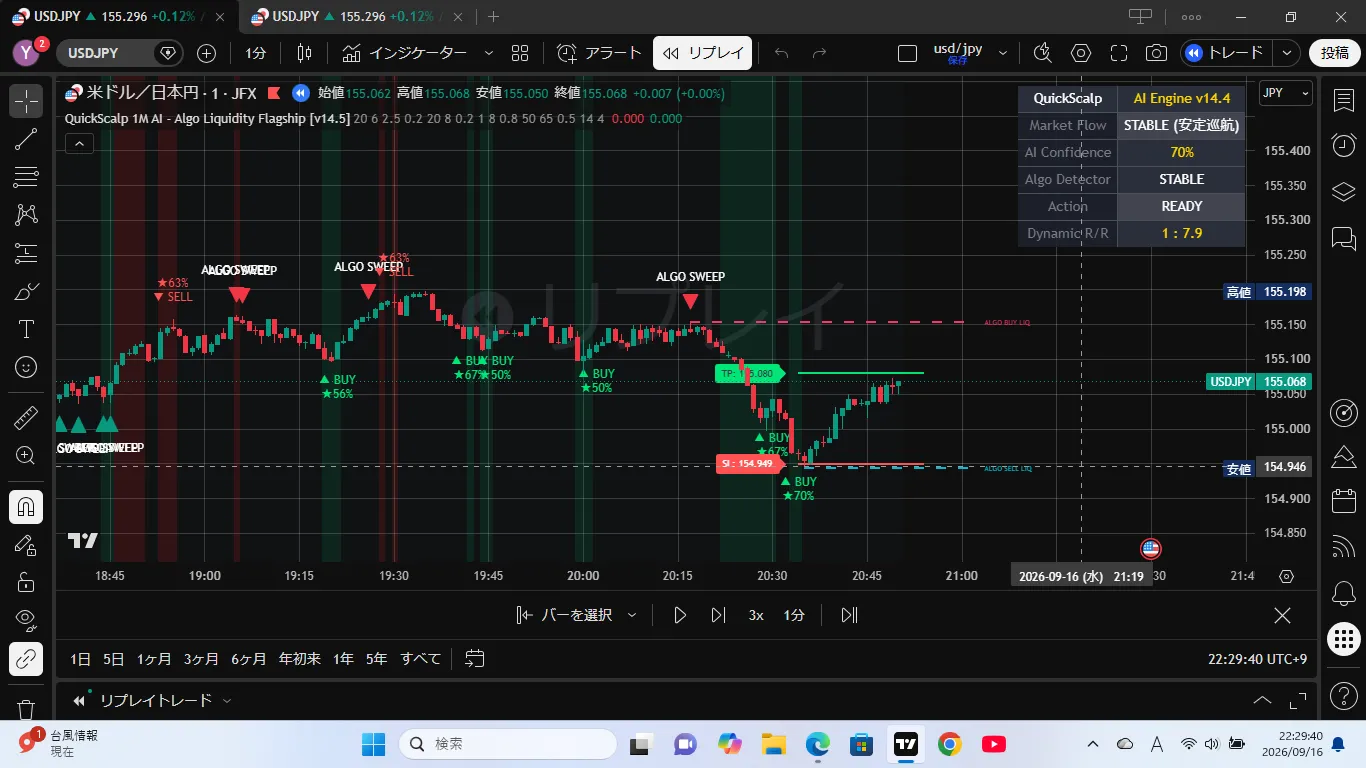
【Step 1: Confirm “Reversal Readiness” in Market Flow】
Ensure the top panel has moved to the REVERSAL ZONE (Reversal Convergence) and that entry preparation is ready.
【Step 2: Enter as Soon as the Signal Lights】
In the overheated background (red/green), signals such as “▲ BUY ★72%” appear (or an alert fires instantly); enter when they appear.
【Step 3: Safe Take-Profit at the Center Reversion (TP Line)】
When the signal lights up, a green TP line (slightly above the SMA20 average price) and a red SL line are drawn.
In 1-minute scalping, avoid greed: exit promptly when reaching this TP line or when the momentum of the reversal weakens.
5. Strengths of this Tool
Thorough avoidance of market overheating-related false signals
During strong one-way trends, automatic stopping of contrarian signals prevents typical losses from being trapped on the wrong side.
Stop-hunt Resistant SL
To withstand the final wick-hunt just before reversal on the 1-minute chart, it automatically calculates a stop loss with a sufficient buffer from the most recent high/low using ATR×0.40.
High Turnover, High Efficiency:
Since the trade is completed within minutes from the trend’s end to center reversion, there is no overnight risk.
6. Structural Drawbacks (Weaknesses) and Mitigations
Weakness
This tool is designed to target convergence from overheating, so it may not function well in the early-to-mid stages of a trending market, where a strong one-direction trend dominates.
Mitigation
Leave trend-following to“TrendPulse Pro” seriesand use QuickScalpAI only in ranging markets such as Tokyo hours or after rapid moves in Europe/NY hours.
Impact from widened spreads at major economic releases
Because the 1-minute chart targets a small price range, spreads widening to 1–3 pips during U.S. jobs data, CPI, etc., can cause the logic to lose to spread even if the signal is correct.