

Why do people end up amplifying losses?
Why do people expand their losses?
That day was the first time I looked at a chart.
What appeared on the screen was a 5-minute chart.
As I casually watched, a single candlestick stretched upward sharply.
“This is a chance!”
In that instant, I became convinced of it.
No—I became certain about it.

I gripped the mouse quickly.
The position size was 5.
All that remained was to press the buy button.
But just as I was about to press, my hand stopped.
“No, wait. Maybe buy after it comes down a bit.”
It would be fine to buy a little lower.
That thought lasted only a moment.
The candlestick continued to rise, further upward.
Up and up.
“Huh? Ah? …”
Even though it was only a few seconds, it felt like an eternity.
And at the same time, regret surged in.
“Why didn’t I buy it just a moment ago?”
A rush and regret swirled together.
“Should I buy now?”
“No, should I wait?”
“But if this continues to rise……,”
I hesitated.
Should I buy now?
Or――
Or, should I buy or not buy.
Only a few seconds in time.
I thought I was just hesitating.
Yet my thoughts were already narrowed to “when to buy.”
“Why is it rising?”
“How high will it go?”
“Where will I cut losses?”
Those things were no longer in my head.
Then it happened.
Nyo-ki!
The candlestick stretched even higher.
“If I don’t buy, I’ll miss out.”
By then, I had already pressed the buy button.
I seemed to be hesitating, but in reality I wasn’t.
Once I entered, strangely, the adrenaline that had been coursing through my body calmed a little.
I looked at the chart.
Even after buying, the price kept rising.
“Okay! It’s moving nicely. I’ll add to my position here!”
I clicked.
It rose further.
The unrealized profit kept increasing.
Watching it, I kept piling on more positions.
“It’s a big win after a long time.”
I was happy.
No, more than that, I was glad that my judgment had been correct.
The trade I hesitated on so much, I had jumped into, was now about to yield a big profit.
The unrealized profit continued to grow.
My mood shifted to professional trader mode.
“See, my judgment was correct after all.”
I even started thinking that.
However, after a while, a change in price movement appeared.
—It stopped moving.
The price, which had risen so vigorously before, stopped rising.
Bullish candles.
Bullish candles.
Bullish candles.
The once-strong candlesticks disappeared without a trace.
Short bullish candles.
Bullish candles with upper wicks.
Small bearish candles.
And then, doji candles…
Clearly, the momentum from before had disappeared.
I stared at the screen intently.
The unrealized profits that had been increasing easily just moments ago were no longer increasing.
“Well, this is probably just a correction.”
I told myself that.
It had risen so rapidly.
Some people take profits in the middle.
“Profits have been taken. It will go higher from here.”
If I thought that, it didn’t seem wrong at all.
No—That’s what I wanted to think.
My posture in front of the chart became more slouched than usual.
Bearish candles appeared.
“It’s okay.”
Bullish candles appeared.
“See, I knew it would go up after all.”
Yet, the bullish candle could not recoup the range that was retraced by the previous bearish candle.
Another bearish candle.
The unrealized profits slowly decreased.
There were still profits.
There were still gains.
Nevertheless, unrealized profits that had been so joyful just a moment ago now looked like they were shrinking.
I changed the time frame.
Daily, 4-hour, 1-hour, 15-minute, 5-minute, 1-minute. And back to daily.
The rapidly changing screen would make a person who doesn’t know FX think,
“Wow, this person is a pro!”
The speed was such that it could give that impression.
But I wasn’t analyzing anything.
I was just changing the chart’s time frame.
And, in the switched view, watching the latest candlestick.
Is it rising?
Is it falling?
That was all I watched.
I would switch frames, looking at the rightmost candlestick.
If it’s bullish, I’d feel safe.
If it’s bearish, I’d feel uneasy.
I would move to another time frame, making up convenient reasons.
That’s all I did.
There was no longer any concept of
“analysis.”
I was desperately searching for something that would reassure me within the chart.
And before I knew it, I stopped changing time frames altogether.
What appeared on the screen was—1-minute candles.
I couldn’t move away from that anymore.
Whenever a single bullish candle appeared, I felt relieved,
Whenever a single bearish candle appeared, I felt uneasy.
Just one minute.
My feelings were being tossed around by a single candlestick.
A larger bearish candle appeared.
Unrealized profits decreased.
A small bullish candle appeared.
A bit of a rebound.
“Okay… pull back”
But it wouldn’t fully recover.
Another bearish candle.
Unrealized profits decreased again.
Bullish candles were appearing.
There was also a bounce.
Yet, it couldn’t recover the width of the fall.
Little by little.
Truly little by little.
Still, unrealized profits were steadily eroded.
Until not long ago,
I watched the same chart, hoping,
“How high will it rise?”
Now I watched it with a different feeling,
“Please don’t drop.”
No—
Perhaps I wasn’t even looking at the candles properly anymore.
What I finally watched was the current value line moving up and down on the 1-minute chart.
I wasn’t really looking at a chart anymore; I was chasing the current value with my eyes.
“I don’t want unrealized profits to drop any further.”
“Shall I take profits now?”
That thought was real, too.
Yet I watched as the price began to fall,
seeing the maximum unrealized profits vanish before my eyes.
Since then, it had already decreased by 50,000 yen in earnings.
“I’m losing 50,000 yen…”
No.
I wasn’t actually losing money.
There were still profits.
Yet, at that moment, I could only think I had lost 50,000 yen.
50,000 yen is a lot of money to me.
I didn’t want to miss out on that.
“If only half of it could come back…”
The more I wished, the more bearish candles kept appearing.
Soon, unrealized profits had halved from their maximum.
“Ah, a huge loss.”
“Even if just a little, even if a bit.”
I thought I would take profits as soon as it rose even a little.
But the price kept dropping.
And if it rose even just a little, would I have taken profits?
Probably not.
If it pulled back a little more,
“Just a little more.”
If it pulled back further,
“Just a bit more.”
And as it approached its maximum unrealized profit,
“If it’s come back this far, perhaps it will surpass the high this time.”
I probably thought that.
In the end, the place where I could be satisfied was only beyond the maximum unrealized profit I had just seen.
Boom!!!!
My heart stopped.
Clearly different from all previous candles.
A large bearish candle suddenly appeared on the screen.
The current value line, which had been fluctuating up and down until just now, suddenly moved sharply downward.
“What, what?”
For a moment, I didn’t understand what happened.
My head couldn’t catch up with what was unfolding in front of me.
The unrealized profits were dropping at an enormous rate.
“What?”
“Wait…”
“Wait, hold on…”
I clenched the mouse.
But I didn’t even know what I was gripping for.
Should I close the position?
Should I wait?
Should I confirm something?
My mind went blank.
Only one thing became clear.
The unrealized profits that had previously reassured me that I was still winning were disappearing at an enormous rate.
The 1-minute chart confirmed.
A large bearish candle.
Profit was now less than half of what it had been at its peak.
“Huge loss.”
“No, no, I don’t want to lose!”
Negative emotions swept through me.
Nevertheless, the current candles continued downward, stretching lower and lower.
Yet, unrealized profits still remained.
But I did not take profits.
I could not.
Taking profits would be scary because the price might rebound immediately after.
If I take profits now and the price goes up right after—
I would surely regret it.
“Okay, if I return to break-even, I’ll cut it then.”
There was no longer even the word “take profits” in my head.
What remained was “withdrawal.”
I chose no profit over a tiny gain.
Booming thud!
Even bigger bearish candles formed than before.
“Ah…”
Unrealized losses turned into actual losses in an instant.
Still, the unrealized loss was about 10,000 yen.
Only 10,000 yen.
This is where I should have cut.
That was all.
Yet, by this point, I couldn’t cut.
Because, considering the maximum earnings,
I had already lost tens of thousands of yen.
“If only I could return to break-even…”
FX isn’t so kind as to grant that wish.
The 1-minute candles fell cleanly downward.
At a 45-degree angle to the bottom-right.
Almost without hesitation.
Just down.
Down.
“Enough already.”
Something snapped.
“Wait for break-even, or wait for forced close.”
That became my answer.
I switched the chart to the 1-hour timeframe.
“…”
A bearish candle like I had never seen before in recent times.
I couldn’t bear to look at it.
I switched back to the 1-minute chart.
But the decline did not stop.
“Why is it dropping so much?”
I started looking for reasons again.
I opened a news site.
There must have been something.
Since it dropped this much, there should be a reason.
I searched.
But nothing was posted.
I looked at the chart again.
It was still dropping.
I opened X (Twitter).
Was there any information?
Did someone write about this decline?
I searched.
I searched.
But there was nothing in particular.
Again, the chart—
“Poon”
A clean electronic chime sounded.
“Huh?”
For a moment, I didn’t know what sound it was.
“Could it be…?”
I timidly looked at the screen.
Position — 0.
Unrealized profits — 0.
Everything — 0.
For a moment, I didn’t understand.
No.
Actually, I did understand.
Forced liquidation.
That “poong” sound, so clean, was the sound of my position being forcibly liquidated.
My assets were
halved.
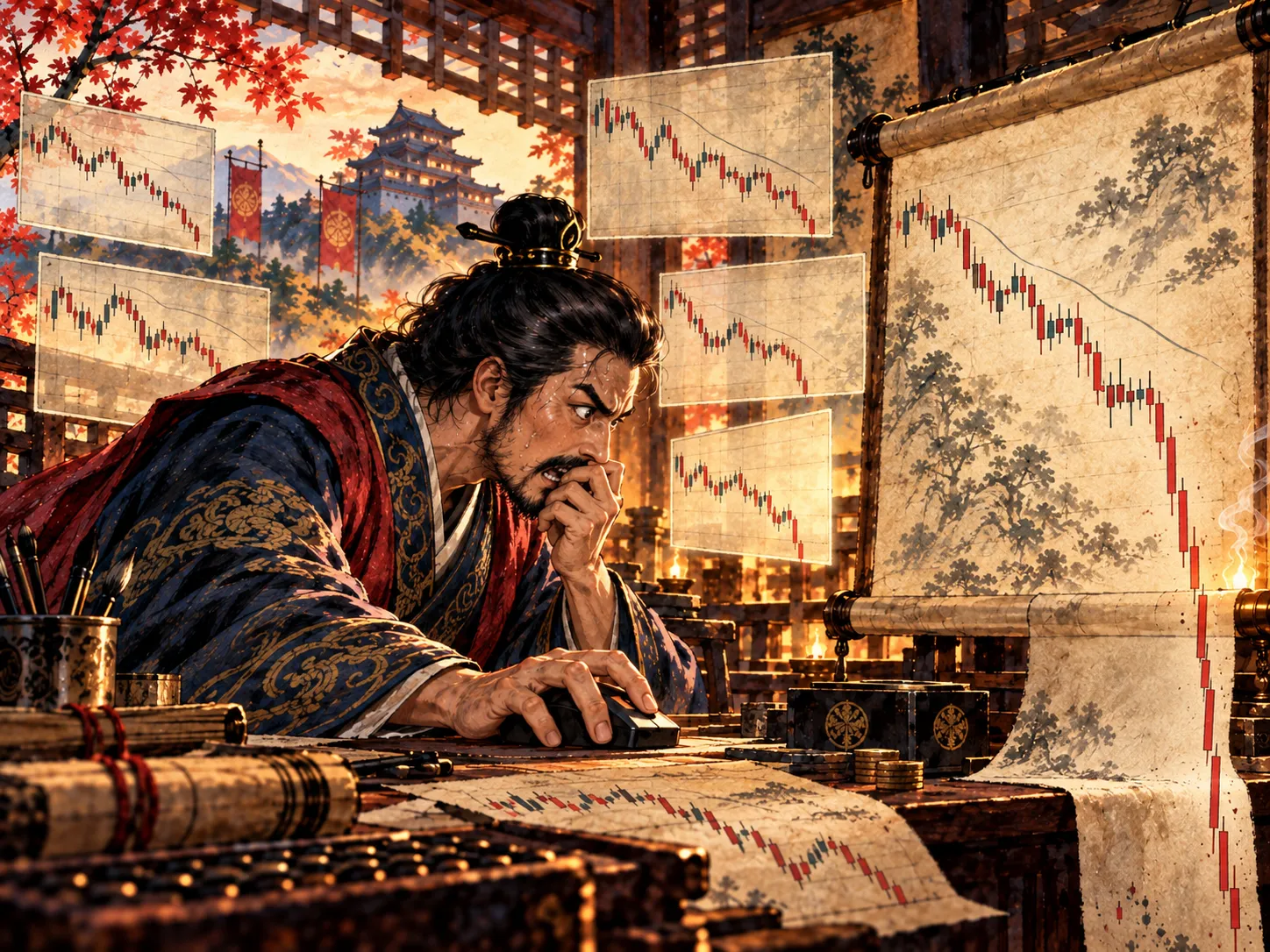
From there, my actions were quick.
First, I calculated the difference between the maximum earnings at take-profit and my current funds.
The gap was unbelievably large.
Next, I calculated how many lots I could enter with my current funds.
“I want to recover it.”
My spirit wasn’t broken yet!
So, should I buy or sell?
I studied the candlesticks seriously.
It’s a 1-minute chart.
It moves up and down.
But the range of movement was less than 1 pip.
But still, selling seemed dominant. That’s why I felt that way.
“What should I do, what should I do?”
“Should I buy or sell?”
“Which way?”
Meanwhile, the candles swung violently up and down.
Up, down.
Up, down.
Yet, the range was less than 1 pip.
I panicked.
“I must hurry.”
“Buy or sell, which should I do?”
It wasn’t about whether the price would go up or down anymore.
If I entered again,
whether I lose money on a buy, or
whether I lose money on a sell.
Which would cause less mental damage?
I made a decision.
“Okay… this time I’ll go with selling and take the challenge!”
That’s why I felt.
Sell as much as I can.
“If the recent downtrend continues, if I do it right I can recover half of the losses.”
I was convinced.
The basis was that I felt it.
“Now, what will happen?”
I watched the chart.
“Huh?”
There was a candlestick shaped like the letter I.
“I?”
When I looked closely, it was a legitimate lower wick.
To me, it looked like Tokyo Skytree viewed from afar.
At least taller than Nagoya TV Tower.
“Profit?”
For such a small lot, it was a large loss.
Impatience was about to explode.
“I don’t want to admit it.”
“It should drop.”
But it rose faster than the drop had.
The forced liquidation happened in an instant.
At that moment, my face was probably bright red.
It had been a long time since someone online teased me for a “red-faced uncle.”

Nevertheless, my actions were fast even then.
“How much is in the bank now?”
I quickly calculated my money.
Yet I couldn’t take my eyes off the price movements.
“Drop! Drop!”
I needed it to fall.
If it doesn’t fall, the first forced liquidation and the second forced liquidation lose their meaning.
For the first forced liquidation,
“If I hadn’t been forced out, I would have lost all my funds.”
I wouldn’t be able to convince myself otherwise.
“My prediction was correct.”
That minimal pride would be gone.
But the rebound from the earlier drop had been enormous.
I couldn’t stand watching it.
I deleted the chart.
And I resolved firmly.
“Okay! Tomorrow I’ll deposit.”
And then…
The end
Why do people expand their losses?
Now, this trade.
Where exactly did I go wrong?
Was it wrong to have been forcibly liquidated?
Of course, that is a major issue as well.
However, looking back, the mistakes started much earlier.
The first mistake was deciding to buy after seeing the 5-minute candle stretch up, without performing any analysis.
What I should have done first then was not to reach for the buy button.
First, calm down and analyze the chart.
Where is the current price?
What position is it in on higher timeframes?
Where are the zones?
From where is there price movement?
After confirming those, I should have construct a scenario.
And only after the scenario had a basis with concrete evidence should I consider entering.
But at that time I thought,
“If I don’t buy, I’ll lose.”
There’s a big mistake here.
Since I hadn’t entered, even if the price rose, the loss would be zero.
I wasn’t afraid of losing; I was afraid of missing profits.
That impatience caused me to skip over everything I should have checked.
Furthermore, as the price rose and unrealized profits increased, I began to think it proved my judgment was correct.
And I added to my position.
However, earning profits and trading correctly are not the same thing.
Position size is not determined by mood or confidence.
Before entering, one should decide the distance to stop loss and the amount of loss they can tolerate.
And once unrealized profits started to decrease, my judgment became even more faulty.
Even though I had lost only 50,000 yen from the maximum unrealized profit, I thought,
“I’m losing 50,000 yen.”
Even though profits remained.
I had already treated the previously seen maximum unrealized profit as if it were my own money.
What I should have looked at was not the maximum unrealized profit.
Where to take profits.
Where to cut losses.
Which timeframe to base judgments on.
Those should have been decided before entering, and those criteria should have been followed.
However, whenever I felt anxious, I changed timeframes.
Daily, 4-hour, 1-hour, 15-minute, 5-minute, 1-minute.
I thought I was analyzing, but in reality I wasn’t.
I was just seeking candlesticks that would reassure me.
The timeframes to judge should not be changed to suit your position after you have taken it.
The timeframe for deciding entry and stop loss must be decided in advance.
And when a crash begins,
“If it just comes back a little.”
“If it returns to break-even.”
I began hoping for the price to return.
Here, I can’t say I’m looking at the market and making decisions.
I was forcing my own wishes onto the market.
If the basis had collapsed, I should have retreated on my own according to my pre-set exit rules.
That was all I should have done.
Opening the news or X to search for a reason for the decline was the same.
Looking at information isn’t inherently bad.
The problem is that after the losses grew large, I began looking for something to justify my position.
And in the end,
“Wait to return to break-even or be forcibly liquidated”
became my reasoning.
This is not stop-loss.
I had simply abandoned my own judgment.
Forced liquidation is not a substitute for stop-loss.
Your own funds must be protected by your own decisions.
However, the real problem continued afterward as well.
Immediately after forced liquidation, rather than reflecting, I thought
“I want to recover it.”
And I calculated how many lots I could trade with the remaining funds.
This would have been the time to stop trading.
What you need after a big loss is not the next entry.
It’s to reflect on why you lost in the first place.
Yet I again reasoned
“Because I felt it”
and sold again.
Nothing had changed from the initial buy.
Whether buying or selling, you must first analyze, build a scenario, and check for concrete evidence.
Without that, it’s just a hunch.
And the second forced liquidation.
Still, the final answer I gave myself was,
“Okay! Tomorrow I’ll deposit.”
In hindsight, perhaps this was the scariest part.
The problem wasn’t that I ran out of funds.
It was why I lost that money in the first place.
If you don’t fix that and put new money in, you’ll merely repeat the same trade.
Looking back now, my losses were not born from one big failure alone.
Deciding to buy without analysis.
Fretting that “if I don’t buy I’ll lose.”
Happening to get a profit, and thinking my judgment was correct.
Becoming fixated on the maximum unrealized profit.
“If it just returns a bit.”
“If it returns to break-even.”
Wishing for a favorable outcome.
Dragging out stop losses and being forced out by a margin call.
And next,
“I want to recover.”
So I traded again, driven only by that emotion.
Each decision at the moment may have been small,
but one misstep led to another.
And repeating that caused the losses to grow.
That’s why, in trading, it’s crucial to have your own decision criteria before emotions move you, not after.
First analyze the market.
Create a scenario.
Check if there is concrete evidence.
Enter only after conditions are met.
And before you hold a position, decide on take profits, stop loss, and risk management.
Learning these sequential steps of trading is what resilience FX is about.
What you learn in resilience FX is not just,
“Buy here.”
“Sell here.”
That entry method alone.
Where to focus in the market.
How to create a scenario.
What evidences would justify an entry.
Where to take profits and where to retreat.
How to protect your funds.
And, how to face the market with your own criteria without being swayed by impatience, greed, unrealized profits or losses.
In resilience FX,
Analysis → Scenario building → Entry → Exit → Money management
is learned as a single flow.
You jump on because the market rose.
You panic because unrealized profits decrease.
You try to recover because you lost.
Rather than trading by momentary emotions,
you analyze the market yourself,
you build your own scenarios,
you verify concrete evidence,
and you act according to your own judgments.
Once you master it, you can use it for life.
You survive by your own strength.