
[Rejected in the U.S. Senate] The truth behind the collapse of the large-scale crypto bill "CLARITY Act" — why did the market plunge as U.S. interest rates surpassed 5%?
On September 15, 2026, in the U.S. Senate, the large bill touted to determine the fate of the crypto industry, the CLARITY Act (Digital Asset Market Structure Act), was defeated in effect as it failed to reach the required 60 votes for advancing after a procedural vote, with 49 votes in favor and 50 against.
Following this report, Bitcoin (BTC) briefly plummeted toward around $74,900. XRP dropped about 10%, and related stocks such as Coinbase (COIN) plunged by more than 11% in a sharp decline.
“Does the U.S. intend to ban cryptocurrencies outright?”
“How is this connected to the surge in U.S. long-term interest rates beyond 5%?”
The rejection is not a denial of cryptocurrencies. The truth is that “the rules to formally integrate crypto assets into the U.S. traditional financial system were blocked by political wrangling.”
We will unpack the combined shocks of the 5% U.S. long-term rate, the divergence in impacts on BTC and altcoins, and the global macro fund-flow mechanism including the dollar-yen FX pair.
Chapter 1: What was the CLARITY Act? Why was it rejected?
The CLARITY Act (Digital Asset Market Clarity Act) aimed primarily to clarify, through Congress, the long-ignored gray area of “which crypto assets are securities (SEC jurisdiction) and which are commodities (CFTC jurisdiction).”
【CLARITY Act’s intended regulatory framework】
SEC (Securities and Exchange Commission)
Oversee investment contracts and tokens with high fundraising potential
CFTC (Commodity Futures Trading Commission)
Oversee decentralized crypto assets and commodity-type tokens
Legitimize ambiguous regulatory jurisdictions and formally integrate them into the U.S. financial infrastructure
Even the U.S. Treasury Secretary Yellen and Coinbase CEO Armstrong strongly supported it as an essential bill to maintain U.S. financial and frontier technology leadership.
However, five competing axes of conflict intertwined, causing bipartisan consensus to collapse.
【Five sparks that blocked the bill】
① Conflicts of interest surrounding Trump administration and family crypto businesses (strong opposition from Democrats like Senator Warren)
② Conflicts between the banking industry and the crypto industry (concerns about outflows of deposits due to yields on stablecoins)
③ Strengthened AML (anti-money laundering) and national security surveillance on the crypto industry
④ Jurisdictional power struggle between the SEC and the CFTC
⑤ Internal Republican dissent (opposition votes from Moran, Paul, Hawley, Tillis, and others)
Beyond technical arguments about crypto assets, political contention and entrenched interests (the banking industry) were the main reasons the bill stalled.
Chapter 2: The deadly temperature gap between Bitcoin and “altcoins and related stocks”
The damage from this rejection would not uniformly affect all crypto assets.
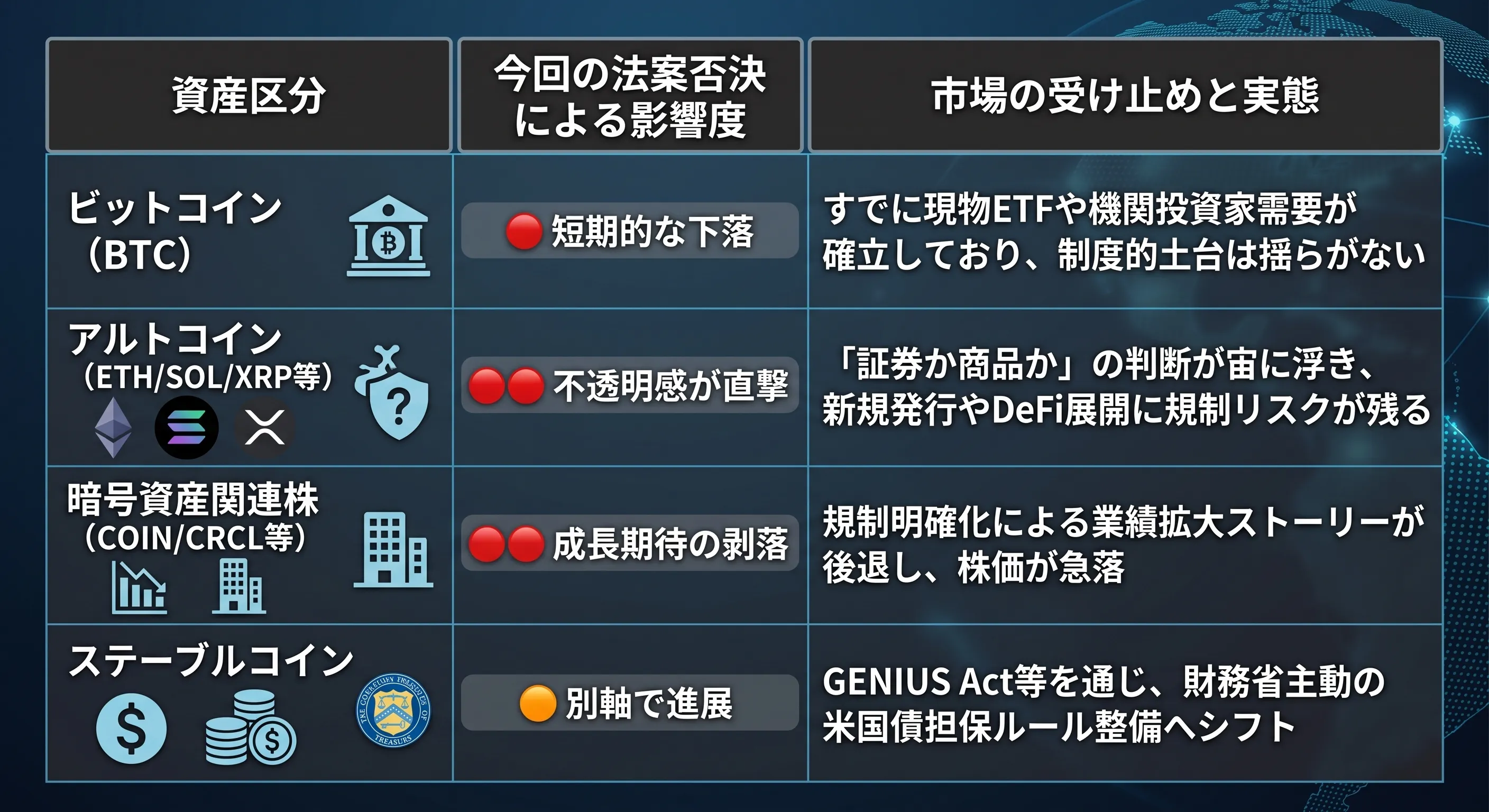
BTC has already established its status as a commodity, so the system itself isn’t collapsing.
What is serious is that altcoins and DeFi projects that had not resolved the risk of being sued by the SEC face heightened concerns of capital outflows to overseas markets (EU, UAE, Singapore, etc.) due to stalled clear regulation.
Chapter 3: The double punch of “regulatory factor x U.S. rate at 5%” hitting the market
The crypto market’s sharp drop was not only due to the bill’s rejection but also to the macro factor of U.S. long-term rates breaking through 5%.
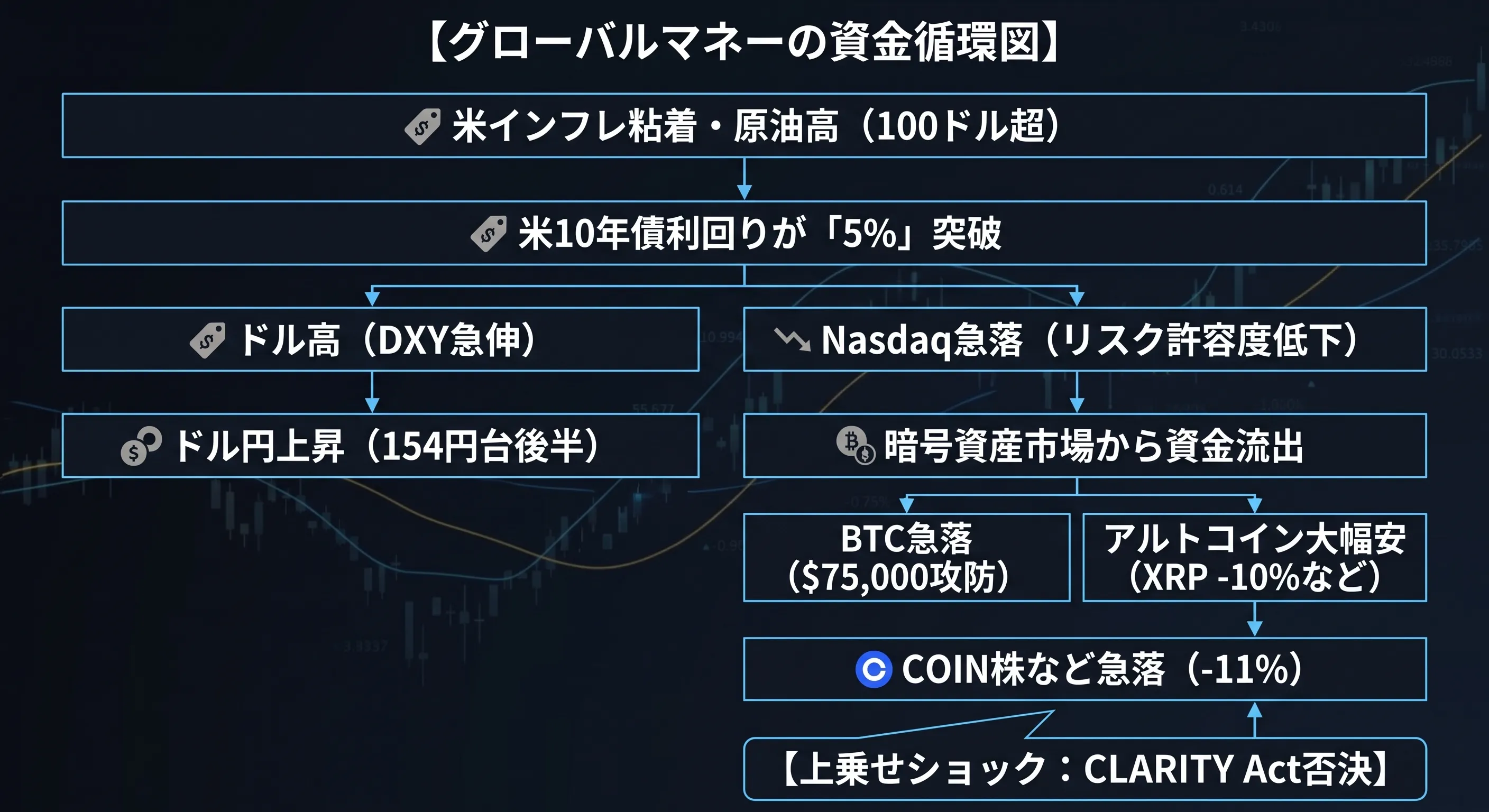
As the yield on risk-free U.S. Treasuries reached 5%, the opportunity cost of holding highly volatile crypto assets surged. This was a convergence of macro tightening pressure and regulatory clouds.
Chapter 4: The “true correlation” between FX (USD/JPY) and Bitcoin
FX traders should be most wary of the fact that BTC’s decline does not necessarily imply a correlated fall in USD/JPY.
Normal risk-off
Stocks fall and BTC falls → yen as a safe haven buys → USD/JPY declines
Risk-off driven by U.S. rate increases (current)
U.S. rate surge → dollar buys → BTC plunges + USD/JPY rises sharply
What is currently happening is the latter pattern. The rapid rise in U.S. interest rates is creating a distorted correlation of “dollar strength, stock weakness, BTC weakness, USD/JPY strength.”
Three correlation patterns to observe in practice
U.S. rates down + BTC up: improved financial conditions, healthy risk-on.
U.S. rates up + BTC down: rising rates tighten risk assets in a typical tightening period (current environment).
U.S. rates up + BTC rebound: signs that crypto-asset–specific buying demand is absorbing the bad news (trend reversal signals).
Chapter 5: Future practical monitoring checklist
Priority watch points to determine whether the market is stabilizing.
Defense of BTC at the “75,000-dollar” line:
Whether it can hold the 75,000 level as a daily close; a break could lead to a 72,000 slide.
Coinbase (COIN) stock rebound:
Whether related stock prices stop falling is a leading indicator of the regulatory shock cycle.
SEC/CFTC individual responses (Reg Crypto, etc.):
With the bill stalled, what guidelines and exemptions will SEC and CFTC roll out administratively?
Behavior of the U.S. 10-year yield (around 5.0%):
After FOMC rate hikes and dot plots, will U.S. rates peak near 5%?
Summary
The rejection of the CLARITY Act does not mean the future of crypto assets is closed off.
However, it is an undeniable fact that the speed at which the U.S. financial system could be integrated was greatly delayed by political conflict.
Rather than reacting to a single news headline, constantly be mindful of the massive money-flow chain that connects “U.S. long-term rates → dollar → U.S. stocks → BTC → USD/JPY.”
With an understanding of broad money flows, follow the objective milestones and signals drawn by technical indicators, and practice disciplined trading that is not swayed by emotions.