

Free Version [Tiger Parameters Public] Small Amount Ultra-Fast Mode & Martingale Mode | Publicly Available Fund-Specific Operational Methods
This time, for the semi-discretionary EA “White Tiger,”we will disclose the actual operation parameters and money management methods.
There are various ways to use White Tiger, but what I’m currently paying special attention to are two in particular.
① “Speedy mode” focused on win rate for starting with a small amount of capital
② “Martingale mode” starting from around 100,000 yen
Even with the same White Tiger, the approach is quite different.
In the small-fund mode,maximize capital efficiency.
In the Martingale mode,increase capital while calculating the loss probability and required margin.
This time, we will introduce each approach along with concrete parameters.
■ ① Small-fund “Win rate-first, speedy mode”
First, this is the approach currently used in the publicly available “1-Man Challenge.”
What this operation is aiming for is,
to maximize capital efficiency above all
In the actual challenge, we start with a small fund of 10,000 yen and aim to grow the capital in a short period.
As a guideline, the target is
a roughly +100% in one week
a very high profit rate.
Of course, this differs completely from ordinary asset management.
Because we aim for such a high rate of return,the risk is naturally very high as well.
What becomes important then is
“manage losses by actual invested margin, not by lots (trades)”
this concept.
■ The idea of letting losses be managed by the margin rather than by stop loss
In this mode, to maximize the profit rate, if a large adverse move occurs,we effectively use the account’s stop-out as the maximum loss line in a high-risk operation.
It may seem very dangerous at first glance, but the important thing is
how much you put into the account
.
For example, even if you have 1,000,000 yen of operating funds, you do not need to put all of it into the account.
Against surplus funds of 1,000,000 yen,
1% would be 10,000 yen
3% would be 30,000 yen
5% would be 50,000 yen
and only that amount is put into the trading account.
Even if a stop-out occurs, as long as you have not placed more than the predetermined amount into the account, you can limit the overall loss of the trading funds.
In other words,
“not to avoid stop-out, but to limit the damage to the total funds even if a stop-out occurs”
is the idea.
■ It’s possible to operate with a small amount
This is one of the reasons I’m doing the 1-Man Challenge.
With 10,000 yen, even a stop-out can limit the maximum loss.
But,
the aim is to double or triple the funds in a short period
which is extremely aggressive.
Of course, it won’t work every time.
In the first 10,000-yen Challenge,
10,000 → 35,281 yen
increasing to
38 trades, 38 wins, +252.8%
reached, but then a reversal caused a stop-out.
Including that, I think this is a feature of this method.
That’s why the important thing is
“Don’t keep exposing the growing profit to the same high-risk operation”
I consider, for example, to switch the method when the profit has grown by about +200–300%.
There are two main ways:
① Withdraw profits and reset the margin
For example, when 10,000 yen becomes 30,000 yen, withdraw the extra 20,000 yen and restart the speedy operation from 10,000 yen.
This way you can secure the profits obtained and re-challenge.
② Move the increased “profit portion” to a 1:1 trade
Another option is to separate from the original small fund’s speedy operation andbet the increased margin on a 1:1 trade with either double or zero outcome.
White Tiger’s win rate is around 50%–60%, so there is an expectancy.
For example, if 10,000 yen grows to 30,000 yen,you would operate once on a 1:1 trade with 30,000 yenas the image.
In other words,
“Create profits in speedy mode”
↓
“Extend the profits further with a 1:1 trade”
This is a two-step approach.
Also, regarding this speedy mode,limit the operating funds to 100,000 yenas the cap.
Increasing funds does not mean continuing the same high-risk operation with 200,000 yen, 300,000 yen, or 1,000,000 yen.
The purpose of this operation is, after all,to use a small fund to aim for high capital efficiency.
Therefore,
“speedy operation up to 100,000 yen”
“make +200–300% a single profit securing and switching point”
“use the increased margin for 1:1 trades with double or zero”
these rules are set so that while pursuing profitability, the amount exposed to risk does not grow without limit.
Attack with a small amount, and guard once profit appears.
This is the basic capital management I have in mind for this small-fund mode.
■ ② From around 10 million yen onwards, “Martingale mode”
Another one is
Martingale mode
.
Here the money management concept changes from the small, fast mode.
After a loss, you raise the lot size to recover the previous losses with the next win.
The target profit rate is roughly
Monthly +100–200%
.
From the perspective of ordinary asset management, this is extremely high, so it is indeed high risk.
However in Martingale, what matters is not simply “how many times to multiply.”
past win rate
maximum losing streak
probability of a losing streak
loss per single loss
Martingale multiplier
required margin
.
“how many consecutive losses can the capital withstand?”
in the design.
■ Martingale is capital-managed based on “loss streaks”
For example, even with a high-win-rate EA, losses will occur in a row.
Because the win rate is 60%,
“after 10 trials, 6 wins and 4 losses”
is not guaranteed.
Three, four, or even longer losing streaks can occur.
The scary part of Martingale is this losing streak.
Therefore,
we check how many consecutive losses have actually occurred in historical data
and set the margin accordingly.
Not that “win rate is high so it’s safe,” but
“if the expected losing streak occurs, how much is needed?”
and calculate backward from there.
This is the basic capital management of Martingale mode.
■ Considering risk from a year of losing-streak data
What matters most in Martingale mode is not just the win rate.
What I focus on is
“how many consecutive losses have actually occurred, and to what extent?”
In the past year’s1,476 tradesbacktest, the losing streaks were as follows:
| Consecutive losses | Occurrences in a year | Actual frequency out of 1,476 trades |
|---|---|---|
| 1 loss | 195 | about 13.21% |
| 2 losses | 98 | about 6.64% |
| 3 losses | 54 | about 3.66% |
| 4 losses | 23 | about 1.56% |
| 5 losses | 5 | about 0.34% |
| 6 losses | 4 | about 0.27% |
| 7 losses | 0 | 0% |
| 8 losses | 1 | about 0.07% |
In this year, the maximum losing streak of8 consecutive lossesoccurred once.
What is particularly noteworthy is
5 consecutive losses: 5 times
6 consecutive losses: 4 times
8 consecutive losses: 1 time
as the result.
Rather than thinking, “as win rate is high, Martingale is safe,”you must design the margin assuming losing streaks will occur, even with high win rates.
■ It’s easier to see when looking at “X consecutive losses or more”
If you summarize annual actual data by how many times that losing streak of that length or more occurred, it becomes
| Losing streak | Annual occurrences of that length or more |
|---|---|
| 3 or more losses | 87 times |
| 4 or more losses | 33 times |
| 5 or more losses | 10 times |
| 6 or more losses | 5 times |
| 7 or more losses | 1 time |
| 8 or more losses | 1 time |
In other words, during this validation period,5 consecutive losses or more occurred 10 times a year, and 6 consecutive losses or more occurred 5 times.
Meanwhile, reaching 8 consecutive losses occurred only once per year.
Therefore, I focus on Martingale mode as
“not predicting how many consecutive losses will occur, but designing capital to endure a certain number of losses”
.
Just because eight consecutive losses happened once in the past does not guarantee that eight or more will never occur again. There is a possibility of nine, ten, or more losses.
Therefore,a combination of past maximum losing streak + required margin + initial lot + Martingale multipliershould be set by calculating backward from the maximum loss you can tolerate.
And, by deciding a target amount to withdraw in advance, you can secure profits.
From January to around May this year, I have experience growing from 100,000 yen to 1,000,000 yen.
Also, starting from the probability of occurrence, I start with 0.01–0.02 lots per 100,000 yen and gradually increase the lot size.
■ The two modes have different purposes
In summary, the settings disclosed here are positioned as follows.
| Small amount, win-rate-focused mode | Martingale mode | |
|---|---|---|
| Starting capital guideline | From a small amount | Around 100,000 yen |
| Goal | Rapid capital increase | High monthly profit rate |
| Profit rate target | Aim for around +100% in a week | Aim for +100–200% per month |
| Loss management | Limited by invested margin | Losing streaks + margin |
| Characteristics | Emphasis on capital efficiency | Risk management such as losing streak resets possible |
| Risk | Difficult to pull out midway | Can be stable and decide to pull out mid-way |
It depends on operating funds and how much risk you are willing to tolerate.
■ Parameters
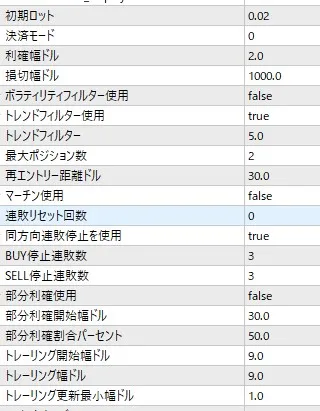
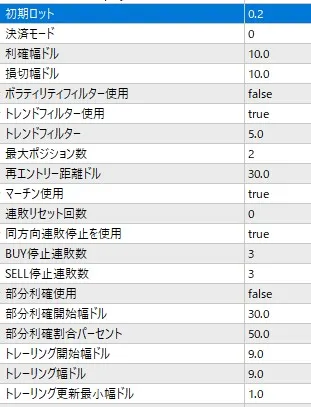
From here, I’ll disclose the parameters I actually use.
【Small amount, win-rate-focused mode】
【Martingale mode】
■ Decide not only on “profit rate” but also on “how much you can lose” first
The two operation methods introduced this time are not standard low-risk operations.
They aim for very high profit rates in a short period, at the cost of taking substantial risk.
Therefore,
to answer the question of how much you want to earn,
more than that
“how much can you lose at most?”
is important to determine.
In the small-mode, you put only amounts that you can tolerate a worst-case stop-out into the account.
In Martingale mode, you decide the durability based on past losing streak data and the required margin.
Because you chase profitability, you manage risk in numbers.
This is White Tiger’s current operating policy.
In the future, I will continue testing on real accounts and disclose not only good results but also stop-outs and losing streaks.
Semi-discretionary EA “White Tiger” can also be used in a free trial version, so please consider it after checking actual operation.
■ First, run it on a demo account
Regarding the parameters introduced this time, please try running them on your own demo account, not just looking at the numbers.Please try running them at least once on your own demo account.
White Tiger offersa free trial version.
see how often you enter trades
what kind of winning and losing streaks occur
how much funds move relative to the margin
I believe it is most easily understood by actually running and confirming.
In particular, the “small amount, speedy mode” and “Martingale mode” described here carry higher risk because they aim for higher profits than ordinary operations.
That is whythere is no need to start with real funds immediately.
First, please try the free trial version plus the demo account with the parameters disclosed here as-is.
Then,
“Can I operate with this level of risk?”
“How many consecutive losses can I endure?”
confirm this and then adjust your funds and lot sizes to suit you.
I will disclose the parameters. Beyond that, please run them and verify the numbers with your own eyes.
The free trial version is7 days usable.
First, carefully check White Tiger’s movements on a demo account.
Note that backtests or past performance do not guarantee future profits. High-leverage, high-risk Martingale operations carry substantial losses. When performing live trading, always decide within the range of funds you can tolerate.
https://www.gogojungle.co.jp/tools/indicators/84179