
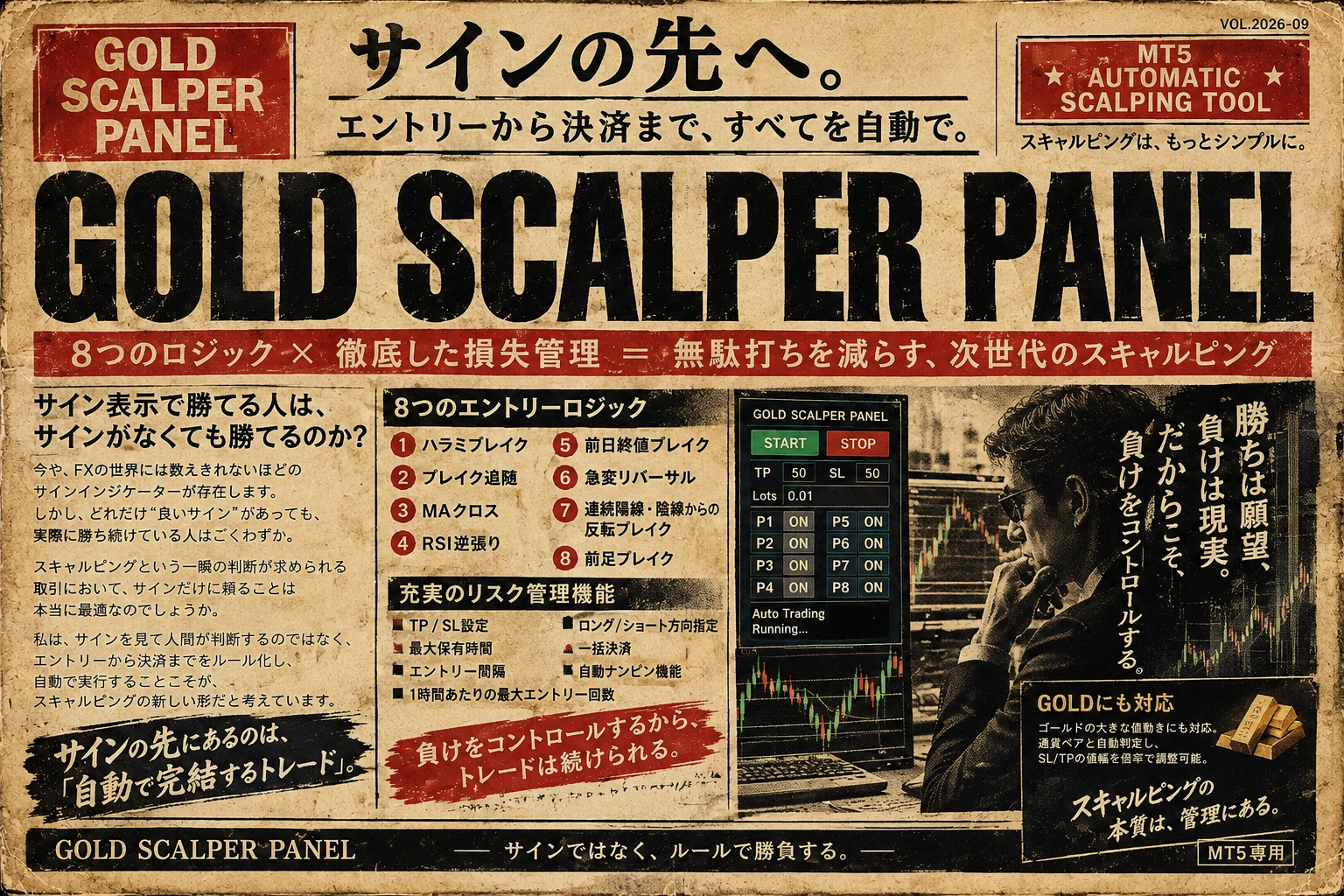
For completely automatic scalping to “reduce wasted trades.” GOLD SCALPER PANEL equipped with eight logics
When you’re scalping, there are many moments where you feel that it isn’t enough to simply “increase the number of entries.”
Rather, what’s important is,
“Where to enter”
“In which situations not to enter”
“How to manage after entering”
I believe this is the case.
That’s why I developed the MT5 version of the “GOLD SCALPER PANEL.”
This tool is designed so that you can use multiple scalping logics while operating from a panel on the chart.
After you press the panel’s “Start” button, all aspects—entry judgment, take-profit/stop-loss execution, and holding-time management—are handled automatically by the tool. It is not a semi-automatic tool where you click when a signal appears; after you press “Start,” it operates as an automated trading system from entry to exit.
Instead of simply trading with a single entry condition, its big feature is that it offers multiple patterns with different characteristics.
Eight entry logics
Currently, GOLD SCALPER PANEL includes eight types of entry patterns.
・Harami Break
・Breakout Following
・MA Cross
・RSI Reversal
・Previous day close breakout
・Sudden-change Reversal
・Reversal breakout from consecutive bullish/bearish candles
・Earlier-foot Break
Each targets different market conditions.
For example, with breakout-type logics, you follow the trend after breaking through a set number of highs/lows.
On the other hand, RSI reversal utilizes moments when the market is overheated in a short time.
In other words,
“not entering under the same conditions every time,”
“depending on the current price movement state,”
adopting different approaches is possible.
Three patterns I especially want you to use
What I find interesting is the combination of patterns 2, 4, and 8.
Pattern 2 is a breakout-following type using a set number of highs/lows on M5.
If the price clearly breaks below a certain period’s low, you target the short side.
Pattern 4 is RSI reversal.
It aims for a reversal when RSI enters an overheated level.
And Pattern 8 is an earlier-foot break.
It uses shorter-term price movement changes such as breaking below the previous candle’s low.
These three patterns each offer different perspectives:
“the big trend”
“reversal from overheating”
“recent momentum”
and so you can view the market from those angles.
You can also use it in a fixed-short mode
GOLD SCALPER PANEL also includes a direction specification function.
Normally it can be used for both buy and sell directions, but with certain settings it can operate as long-only or short-only.
For example, when you want to target dollar-yen’s movements in the direction of yen strength and dollar weakness,
you can center settings on patterns 2, 4, and 8 and permit only short direction.
That usage is possible.
In that case, even if a buy signal occurs, you do not enter; you only use the sell signal.
Of course, the market won’t always move in the direction you predict.
That’s why, even when fixing a direction, we assume it will be used in combination with management functions such as maximum holding time and number of trades.
Not only entry but also manage the “after”
In scalping, pursuing only the entry condition isn’t enough.
Therefore, this tool offers,
・TP/SL settings
・Maximum holding time
・Trade interval settings
・Maximum entries per hour
・Long/Short direction specification
・Batch settlement
・Auto average-in feature
and more.
In particular, restricting maximum holding time and entry frequency is crucial in scalping.
Rather than “enter as many times as possible when conditions appear,”
you can reduce wasteful consecutive entries by applying certain limits.
A quiet but important measure to prevent wasted trades
So far, the features described are numeric-type management, like TP/SL and holding time.
However, from personal experience with long-term scalping, I realized that there are “loss patterns” that numbers alone cannot prevent. GOLD SCALPER PANEL includes a quiet but effective mechanism to preempt such loss patterns in real operation.
Do not enter in the opposite direction for a fixed time after a recent loss
After a loss on SL, you may impulsively jump in the opposite direction and lose again. If you’ve traded with discretion, you’ve likely experienced this “ping-pong” loss. By blocking entry in the opposite direction for a fixed time only when the previous trade was a SL loss and the direction was opposite, we prevent this.
Do not react to the very first bar when starting operation
Right after you start the panel, you tend to notice price movement that has already finished. If you react dutifully here, you can end up with a late-entry, capturing the end of the move. By delaying new entries until the bar that serves as the basis for the operating start changes, we avoid chasing.
Group manage positions added by averaging in
On a hedging account, the extra positions added by averaging in are treated as separate tickets from the initial position. If you look at them separately, you may see a mismatch like “the group as a whole is in the red, but the display shows a profit.” Keeping P/L and settlement results aggregated for the entire group avoids this discrepancy.
We designed not only what signals to issue, but also when not to enter and how to treat expanded positions as a single block. This is a strong, understated point of this tool.
Also supports Gold
As the product name suggests, it is designed with gold in mind as well.
Gold can move more than currency pairs like USD/JPY, so fixed-width handling can be difficult.
So we automatically detect gold and adjust SL/TP widths by a multiplier.
Setting them according to the relative volatility of USD/JPY and gold is another feature of this tool.
Does a signal guarantee winning? If you win with signal display, you can win without signals
When looking for scalping tools, you often see indicators that show buy/sell signals on the chart.
Of course, signals have real value in assisting entry decisions.
However, I have wondered this as I’ve scalped:
“What do you do after a signal appears?”
In scalping, you may be asked to decide on exit within minutes or even seconds after entry.
Even if the signal was correct,
“Where to take profit?”
“Where to cut losses?”
“When to retreat if the move diverges from expectations”
“If several signals appear in succession, should you enter all?”
These questions remain.
Of course, making these judgments manually is part of the appeal of scalping.
But if you could consistently win by simply looking at signals, traders wouldn’t struggle so much.
…This is something I also find a bit of a mystery (laugh).
That’s why I think it’s not enough to simply tell you, “Please enter here.” Ultimately, I believe automating entry to exit under a fixed rule is one of the ideal forms of automated trading, including scalping.
If you can spare the time to click after seeing a signal, that’s fine. But everyone’s time to monitor charts between work and life is limited. GOLD SCALPER PANEL is categorized as an indicator, but it’s built not as something you look at to decide, but as something that operates to completion on its own.
When you’re looking for scalping tools, there are many indicators that show buy/sell signals on the chart.
Of course, these help decision-making to enter.
But here, I want to pose one question:
“Do people who win from signal displays also win without signals?”
Today, the FX world is full of signal indicators.
Each product claims features like high-precision signals, carefully chosen entry points, and reduced unnecessary entries.
Then why are there so many people who struggle to consistently win in actual trading despite so many “good signals”?
I believe the difficulty is unique to scalping.
In scalping, the duration from entry to exit is extremely short.
Every trade can be like a living creature, different from the last.
This time a signal appeared and move in the desired direction after a few minutes.
Next trade, waiting the same few minutes may not yield the same result.
You may see profits quickly.
Or movement may go in the opposite direction right after entry.
It might dip a little before recovering.
Each time, price action and the time required to settle differ.
In short, even if you capture the moment a signal appears, what happens afterward is a separate issue.
Especially in scalping, the minutes or seconds after a signal are crucial.
・Where to take profit.
・Where to cut losses.
・How long to wait.
・What to do if the move differs from expectations.
・If multiple signals appear in a row, should you enter all?
Ultimately, even if a signal tells you where to enter, if you must judge what to do next every time, the difficulty of trading remains.
That’s why I began to question, “Are signals and scalping truly a good match?”
Of course, I don’t intend to deny signal indicators themselves.
In discretionary trading, increasing decision input is valuable.
However, in scalping, where time is tight, judging, clicking, and then timing the exit after seeing a signal may have inherent limits.
If you could win stably just by looking at signals, many traders wouldn’t be struggling this much.
…This is also something I personally find a bit of a mystery.
So I thought about what lies “beyond signals.”
Instead of displaying signals and leaving entry judgment to humans, I rationalize the entry conditions themselves into a rule.
And after entering, predefine TP/SL, maximum holding time, entry interval, and number of trades.
In other words,
Instead of humans judging after seeing signals,
the decision itself is codified and executed automatically
is the idea.
GOLD SCALPER PANEL is technically an MT5 indicator, but the aim is not merely to display signals.
After you press the panel’s “Start,” the tool handles entry to exit automatically.
Even if a human stops watching the chart, trades are completed according to predetermined rules.
That is where I believe the “signal ahead” of scalping lies.
What I aimed for is not signals, but what comes after
GOLD SCALPER PANEL is not simply for showing buy/sell signals.
It prepares multiple entry logics and combines TP/SL, maximum holding time, entry interval, entries per time, direction specification, and mechanisms like anti-reping and post-trade prevention.
In other words,
It “tells you the trigger for entry,”
and
“strives to codify the subsequent trades as much as possible.”
That is the direction.
While it’s possible to have a setup where a human watches the entry moment and times the exit themselves, GOLD SCALPER PANEL is designed to complete the process without human intervention after you press Start. Even when calm, people are prone to emotional judgment after a string of losses or while profits are growing. Delegating that to mechanical rules is precisely why this tool exists, not just as an indicator that issues signals.
Of course, complete automation does not guarantee winning.
There is no such thing as an absolute in markets.
Still, because scalping demands split-second decisions, I believe there is value in codifying and automating entry and exit, not just relying on human judgment after seeing signals.
Treat wins as hope, losses as reality
Another important point I consider when developing this tool is
to not only chase wins but to control losses.
As a trader, you cannot win every time.
No matter how high-precision your entry logic is, markets move contrary to expectations.
You may think, “This logic will win.”
“This signal will be profitable.”
You can hope for that.
But that remains wishful thinking and hope.
In actual trading, losses occur as a matter of course.
That’s why I believe the value of a product lies not only in how much it can win, but in how well it limits losses when things go wrong.
・Improve entry accuracy
・Reduce unnecessary entries
・Set TP/SL, maximum holding time, and entry count to prevent excessive losses
I think it’s crucial to combine this philosophy with the entry logic.
If a product only emphasizes winning and hardly considers losing, can it truly be equitable to users?
I believe the developers of trading tools should face not only the probability of winning but also the probability of losing head-on.
GOLD SCALPER PANEL is not a tool that promises victory.
There is no absolute in the market.
Therefore, I designed it as a single approach that encompasses entry, exit, and loss management.
That is what I value most in developing this tool.
In conclusion
I believe the most important aspect of a scalping tool is not flashy win rates alone.
What kind of market are you entering?
Why is that the location?
And in what scenarios should you refrain from entering?
With those aspects as clear as possible, I’m developing tools that can actively support actual trading.
GOLD SCALPER PANEL is not yet a product with overwhelming sales on GogoJungle.
That’s why I decided to apply for this “I’m a challenger” slot this time.
If even one person learns that something like this scalping tool exists
I’d be glad.
#GogoJungle Scalping Feature 2026