③If this doesn’t work, give up MAX sales countdown to 5 days
Even with the same "pullback," there are pullbacks you should enter and pullbacks you should not
In yesterday's article,
we talked about
“In FX, waiting is important.”
https://www.gogojungle.co.jp/finance/navi/articles/125684
Please read this only if you are okay with getting hurt
https://www.gogojungle.co.jp/finance/navi/articles/125685
Today, we will take a step further.
For example, suppose an uptrend is occurring.
Naturally, what you’d want to target is the “pullback.”
Rising
↓
drops once
↓
rises again
This is the pattern.
But,
If you think, “it pulled back, so buy,”
that can be a bit dangerous.
Because,
even pullbacks that look similar
have pullbacks you can enter and pullbacks you cannot enter.
“Falling equals buy” is not necessarily true
Many people misunderstand this.
Prices are rising.
They dip a little.
“Pullback arrived!”
Buy.
But it then slides further down.
Stop loss.
Why does this happen?
Because you are only looking at the fact that it “dropped.”
What’s important is,
“how far did it drop”
And,
“what kind of move did it make where it dropped to”
is what matters.
For example, look at the “resistance band.”
On a chart, there are price levels that are revisited many times.
Do they react there?
Or do they break through easily?
Just looking at this changes how the same pullback looks.
Furthermore,
the candlesticks’ movements.
The wicks’ appearance.
The strength of the rebound.
Price action up to just before.
By combining these,
we determine, “Is this really a place where buying is worth considering?”
This is crucial.
Merely remembering the “pattern” is not enough
When you look at FX materials,
you often see explanations like,
“Buy when this pattern forms!”
Of course, it’s important to learn patterns.
But real markets don’t necessarily form clean textbook patterns.
A little bit of breaking apart.
A fake-out once.
Only the wick appears.
It continues to move higher.
Conversely, even if the pattern looks clean, it may not move.
Therefore what’s needed is,
not “memorize the pattern,” but “how to judge that pattern.”
Understanding this can significantly change trading.
In actual charts, you look at “this moment.”
For example,
you decide, “this is a pullback candidate.”
Instead of entering immediately,
you first observe price movement.
Does it rebound?
Is selling strong?
Does it break below?
And then,
you wait for the point where “entering here is okay.”
This sequence of judgments is what MAX edition aims to convey.
Simply put,
it’s not just about “pullbacks should be bought.”
“How to determine that pullback”
is considered as deeply as possible.
And this applies to long positions as well as short positions.
Of course, the same applies to shorts.
Prices fall.
↓
They bounce back once.
↓
Fall again.
So-called “reversal selling.”
This is also,
not just “sell when it comes back.”
Where did it come back to?
Where did it stop?
What movement did it make there?
How did it move after that?
Looking at this, you determine, “Now, can I target short?”
In other words, the approach for long and short is the same.
“Where does it come to, and what should you check?”
Decide this in your mind.
FX is more about “judgment” than “prediction.”
I think this is very important.
“I think it will go up from here.”
“I think it will go down from here.”
That alone does not make a trade.
What you need is a concrete criterion for entering, such as,
“If this happens, I will enter.”
And,
“If those conditions are not met, I will not enter.”
This is equally important.
Therefore, in MAX edition,
we use actual charts to explore,
“this is targetable”
“this one you should still wait for”
“this is where you should consider entering.”
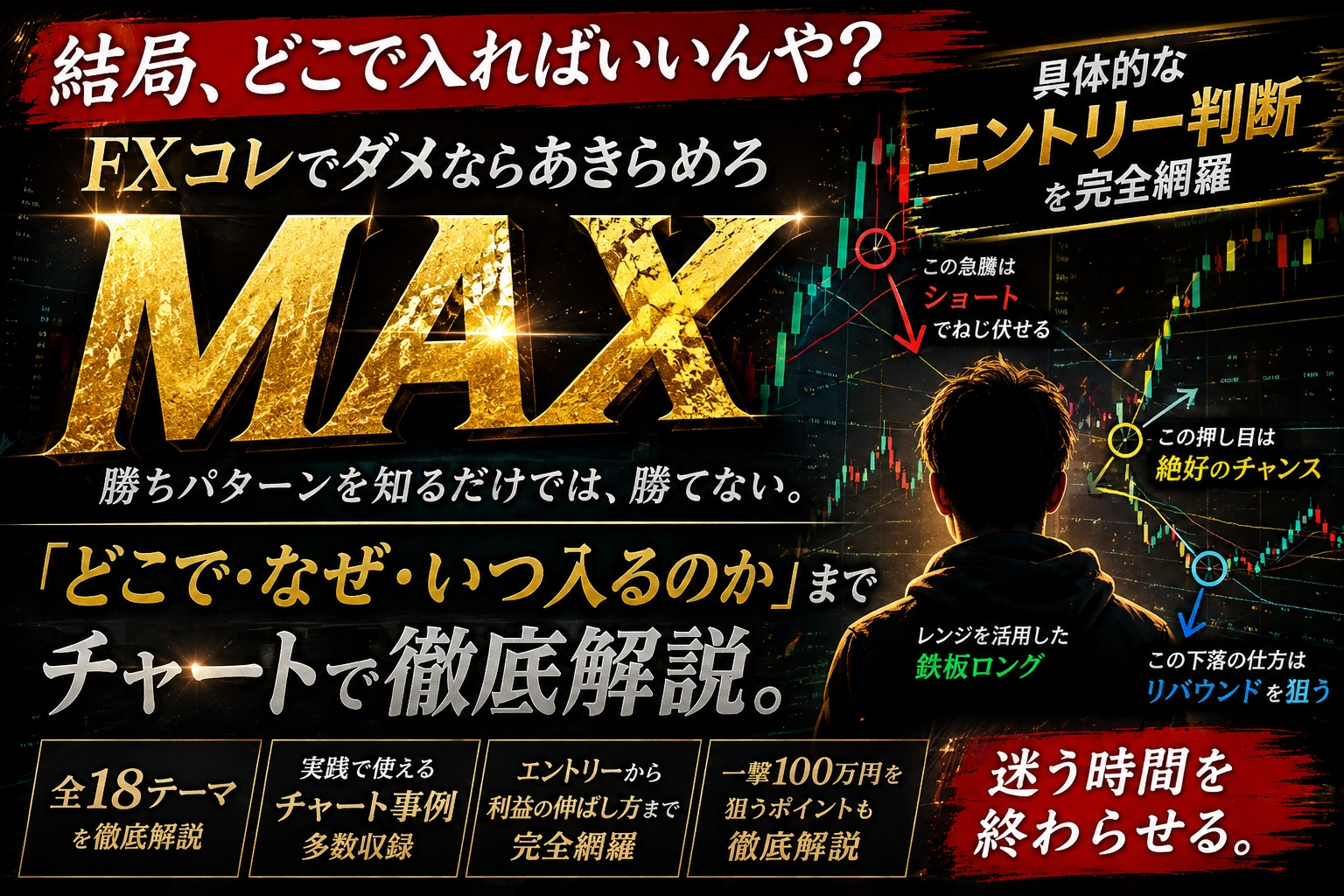
We delve into these up to 18 patterns.
In this MAX edition,
including concrete long and short patterns,
a total of 18 themes
explaining entries.
A long using a range.
A long from a triangle.
A pattern targeting a pullback.
Shorts from a spike against the trend.
A rebound after a decline.
And,
“The pattern you should look at first when unsure.”
Not only introducing patterns,
but also considering “why you would target here” while looking at real charts.
With "FX Colle, if you can’t do it, give up,"
what to target.
And in MAX edition,
where to enter.
By pairing these two questions,
charts you used to skim through will start to look different.
It goes on sale on the 20th
Five days left until release.
Tomorrow,
we will discuss “a market that looks like you can win but actually is not good to enter.”
Not only where to enter,
but also where not to enter.
Knowing this is also very important in trading.
If you don’t know this, simply chasing “winning patterns” won’t give you stable results.
From now until the 20th, we’ll gradually approach the core every day.
If you haven’t purchased FX Colle, give up and buy now.
※ Even if you don’t buy as a set, I believe this is an extraordinary product
https://www.gogojungle.co.jp/tools/ebooks/55598
Be sure to read the previous article as well