

[Do not adopt the displayed answer as-is] AI and the market also verify the route
When a convenient answer comes out, do you pause once in front of the screen?
Good evening!
This is Masashi^^
This week, the topic spread that AI display and actual processing path are not always the same. In the market too, being up appears one thing, and meeting the buying conditions is another.
What I want to leave behind is not fear of AI or market predictions. It is a small sequence of what to verify first as a primary source after viewing the display.
This week, I will organize the order up to adoption rather than the visible answer.
✅ Separate the conclusion shown on screen from its grounds
If the summary is neat, you tend to treat the text as the grounds themselves.
The concrete sentence in this chapter is [with sources / with confirmation date / one item of unconfirmed points].
At that time, what easily happens is confusing the smoothness of output with the strength of facts.
What should we look at to separate the conclusion on the screen from its grounds?
In my case, I start by placing the source and the confirmation date beside the conclusion.
The actual record is [with sources / with confirmation date / one unconfirmed point].
If the grounds for adoption are visible, you can keep a distance without giving up convenience.
Confusing the smoothness of output with the strength of facts makes judgments lean forward little by little.
Then only one important sentence returns to the original source.
Tomorrow, what you read is not the result but the operation of [with sources / with confirmation date / one unconfirmed point].
When separating the conclusion from its grounds on screen, you do not increase confirmation items.
Placing the source and confirmation date beside the conclusion becomes this chapter’s stopping line.
Finally, only the last important sentence returns to the original material, which completes this chapter’s verification.
✅ Key point: Place the source and confirmation date beside the conclusion.
? Example: with sources / with confirmation date / one unconfirmed point
? Decide the endpoint of the work handed to AI
When you assign the investigation, you want to read related information one after another.
The concrete sentence in this chapter is [three points for confirmation / finish if there is no contradiction].
What tends to happen then is continuously rephrasing questions until you feel secure.
What should you look at to decide the endpoint of the work handed to AI?
In my case, I start by writing the target of the investigation and the end condition first.
The actual record is [three points for confirmation / finish if there is no contradiction].
The farther you reach an endpoint, the evaluation is based on use rather than quantity of answers.
Continuing to rephrase questions until you feel secure makes judgments lean forward little by little.
So before adding questions, reread the initial request.
Tomorrow, what you read is not the result but the operation of [three points for confirmation / finish if there is no contradiction].
When deciding the endpoint of the work handed to AI, you do not increase confirmation items.
Placing the target of investigation and end condition first becomes this stopping line.
Finally, if you complete by rereading the initial request before adding questions, this chapter’s verification is complete.
? Key point: Write the target of investigation and end condition first.
? Example: three points for confirmation / finish if there is no contradiction
? Do not let the appearance of the market become a basis for order approval
When strong movement occurs, you feel you have seen the direction.
The concrete sentence in this chapter is [location as candidate / waiting for reaction / cancellation updates the low].
What easily happens then is assuming that the magnitude of price movement alone satisfies the order conditions.
What should you look at to avoid turning the market appearance into order approval?
In my case, I start by returning to the three columns: location, reaction, and cancellation.
The actual record is [location as candidate / waiting for reaction / cancellation updates the low].
If the three columns are separated, you can avoid mixing momentum with preparation.
The idea that price movement alone satisfies the order conditions makes judgments lean forward little by little.
If there is a single blank, you keep it as a candidate.
Tomorrow, what you read is not the result but the operation of [location as candidate / waiting for reaction / cancellation updates the low].
When not turning market appearance into order approval, you do not increase confirmation items.
I will return to the three columns: location, reaction, and cancellation, as this chapter’s stopping line.
Finally, if there is a single blank, you leave it as a candidate until the end.
? Key point: Return to the three columns of location, reaction, and cancellation.
? Example: location as candidate / waiting for reaction / cancellation updates the low
? Do not place primary information and commentary in the same box
News and commentary flow at the same speed on screen.
The concrete sentence in this chapter is [facts are announced figures / interpretations may continue to react].
What easily happens then is recording someone’s viewpoint as if it were a fact.
To avoid putting primary information and commentary in the same box, what should you look at?
In my case, I begin by separating the facts column and the interpretation column side by side.
The actual record is [facts are announced values / interpretation is that a reaction may continue].
Dividing the columns ensures that even if opinions change, the record’s foundation remains.
Recording someone’s viewpoint as a fact and judgments lean forward little by little.
Then I first verify the source of the facts.
Tomorrow, what you read is not the result but the operation of [facts are announced values / interpretation may continue].
When primary information and commentary are not in the same box, you do not increase confirmation items.
I will divide the facts column and interpretation column as this stopping line.
Finally, verify only the source of the facts first, and that completes this chapter’s verification.
? Key point: Separate the facts column and the interpretation column side by side.
? Example: facts are announced values / interpretation is that a reaction may continue
⚠ Do not entrust convenience to the final judgment
As automation increases, there are more occasions where you can proceed without confirmation.
The concrete sentence in this chapter is [save display is available / remains the same after reloading].
What tends to happen then is to publish or treat as order complete using only the displayed successful processing result.
To avoid entrusting convenience to the final judgment, what should you look at?
In my case, I start by reopening the result screen and reconciling the state.
The actual record is [save display is available / remains the same after reloading].
The process of returning for confirmation catches up with the discrepancy between display and actual.
Judgments lean forward little by little when you treat the successful display as publishing or ordering.
Then only the action of exiting is watched until reloading.
Tomorrow, what you read is not the result but the operation of [save display is available / remains the same after reloading].
When not entrusting convenience to the final judgment, you do not increase confirmation items.
The result screen is the stopping line for reconciling by reopening the display.
Finally, if you watch until the exit action is complete, this chapter’s verification ends.
⚠ Key point: Reopen the result screen and reconcile the state.
? Example: Save display is available / remains the same after reloading
? Do not increase the number of things to doubt
Once you notice a mismatch, you can feel you cannot trust anything.
The concrete sentence in this chapter is [look at funds, exposure, and sources in that order].
What tends to happen then is rechecking all information with the same weight, which becomes exhausting.
To avoid increasing what you doubt too much, what should you look at?
In my case, I start by assigning verification priority from items with larger losses.
The actual record is [look at funds, exposure, and sources in that order].
Once you set importance, verification becomes management rather than anxiety.
Rechecking all information with the same weight exhausts you and judgments lean forward little by little.
So before small embellishments, you look at the column with results first.
Tomorrow, what you read is not the result but the operation of [look at funds, exposure, and sources in that order].
When you do not increase confirmation items, you do not increase doubts.
I will start by assigning verification priority from the items with larger losses.
Finally, you look at the results first rather than small embellishments until this chapter’s verification ends.
? Key point: Assign verification priority from the items with larger losses.
? Example: look at funds, exposure, and sources in that order
? Return to one sentence in your own words
After reading a specialized explanation, you often feel you understood strongly.
The concrete sentence in this chapter is [for now, do not place an order because reaction not confirmed].
What tends to happen then is writing the reasoning for the judgment using the words you cited.
To return to one sentence in your own words, what should you look at?
In my case, I start by closing the screen and rephrasing the judgment briefly.
The actual record is [for now, do not place an order because reaction not confirmed].
Parts that cannot be returned to your own words are not yet adoptable knowledge.
Writing the judgment in the exact words cited and leaning forward little by little.
If you cannot rephrase, place it in the hold column.
Tomorrow, what you read is not the result but the operation of [for now, do not place an order because reaction not confirmed].
When returning to your own words, you do not increase confirmation items.
I will make returning to closing the screen and paraphrasing the judgment this stopping line.
Finally, if you cannot rephrase, place it in the hold column until done.
? Key point: Close the screen and paraphrase the judgment briefly.
? Example: Now reaction not confirmed, so do not place an order
? Keep evidence of confirmation small
Ending confirmation in your head will bring the same anxiety tomorrow.
The concrete sentence in this chapter is [check official materials / morning point / awaiting follow-up].
What tends to happen then is spending time re-searching from the start again.
To keep the confirmed evidence small, what should you look at?
In my case, I start by recording the reference and the confirmation time in one line.
The actual record is [check official materials / morning point / awaiting follow-up].
If there is a small piece of evidence, the next time you can continue from where you left off.
Also spending time re-searching from the start again and judgments lean forward little by little.
Therefore, only the information that needs updating is dated.
Tomorrow, what you read is not the result but the operation of [check official materials / morning point / awaiting follow-up].
When keeping confirmed evidence small, you do not increase confirmation items.
I will keep the reference and confirmation time in one line as this stopping line.
Finally, date only the information that needs updating.
? Key point: Record the reference and confirmation time in one line.
? Example: check official materials / morning point / awaiting follow-up
✔ Do not fail to confirm delays
When you investigate but cannot reach a conclusion, it feels like progress stalled.
The concrete sentence in this chapter is [do not adopt today due to lack of materials].
What tends to happen then is making a decision and sense of accomplishment with something ambiguous.
To avoid failing to confirm delays, what should you look at?
In my case, I start by formally choosing the state of unconfirmed as a status.
The actual record is [do not adopt today due to lack of materials].
If you can say why you didn’t decide, the delay becomes a finished judgment too.
Deciding something vaguely to create a sense of achievement makes judgments lean forward little by little.
So next, reserve only the next confirmation condition and close the screen.
Tomorrow, what you read is not the result but the operation of [do not adopt today due to lack of materials].
When you do not increase confirmation items for delays, you can keep it as unconfirmed state.
I will treat the unconfirmed state as the stopping line this time.
Finally, reserve only the next confirmation condition and close the screen.
? Key point: formally choose the unconfirmed state.
? Example: do not adopt today due to lack of materials
? Reduce confirmation checks after one week
If you aim for thoroughness, the number of confirmation items tends to increase each time.
The concrete sentence in this chapter is [one source material / one reload / one line of record].
What tends to happen then is repeatedly opening the same material under the banner of safety.
To reduce the number of confirmations after one week, what should you look at?
In my case, I start by keeping only the confirmations that prevented an accident.
The actual record is [one source material / one reload / one line of record].
Keeping only the effective steps makes the verification last longer.
Opening the same material again in the name of safety makes judgments lean forward little by little.
So on the weekend, remove one unnecessary round trip.
Tomorrow, what you read is not the result but the operation of [one source material / one reload / one line of record].
When reducing the number of confirmations after one week, you do not increase confirmation items.
Keep only the confirmations that prevented an accident as this stopping line.
Finally, remove one unnecessary round trip on the weekend to complete this chapter’s verification.
? Key point: Keep only confirmations that prevented an accident.
? Example: one source material / one reload / one line of record
? GOLD Cure Special Feature arranged^^
If you want to organize from the foundation of judgment, please check this as well.
? Summary: Decide the endpoint of verification
Instead of continuing to doubt the answer, check the path once before adoption. Once verification is finished, indecision also closes there.
When you separate on-screen display from the grounds for adoption, you can keep useful tools while leaving judgments on your side.
If you end one rejected trade, you can create new conditions for the next candidate instead of reclaiming it.
If you schedule time with no conditions, you avoid relying on willpower alone to wait.
What you need are the visible facts, cancellation conditions, and reasons for delays. Check whether you can say all three briefly.
Once verification is complete, you will not redo the same judgments repeatedly. Having an endpoint is also part of safety.
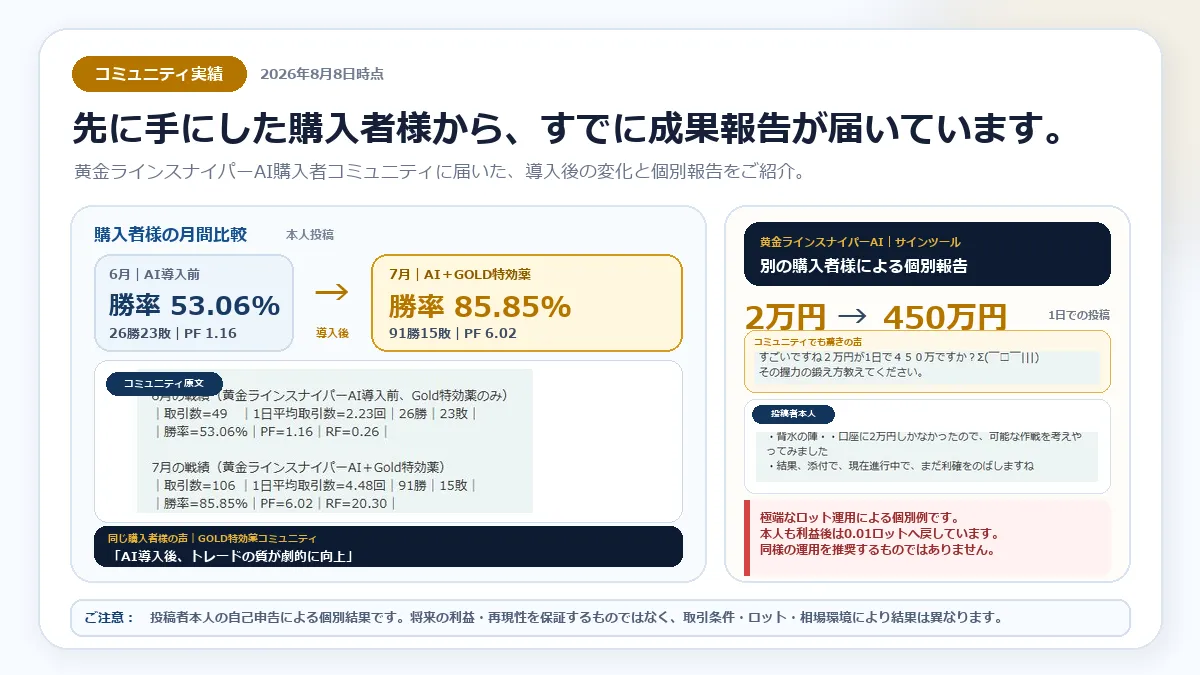
The Golden Line Sniper AI is not a substitute for decision-making but a tool to narrow down where to start verification.
? This week’s standard: When grounds are insufficient, do not produce a correct answer; instead, keep the state on hold.
View details of the Golden Line Sniper AI
Thank you for reading to the end today as well^^