
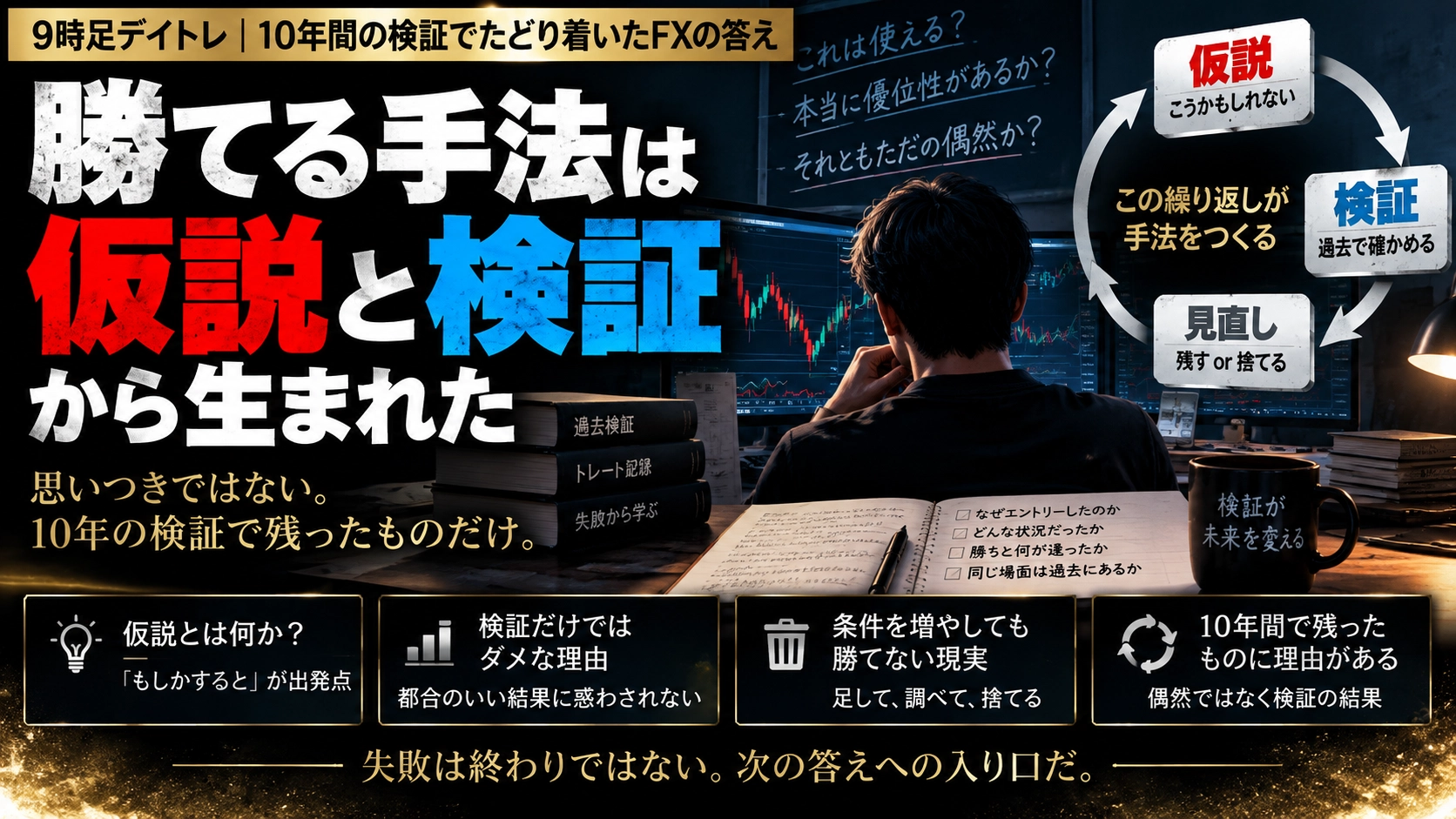
【9 o'clock intraday trading|The FX answer reached through 10 years of verification】A winning method is born from "hypothesis and verification"
Good morning. This is An-chan.
Lately I’ve been wishing for more sunshine, and although the rice ears are ripening and the new harvest season is just around the corner,
it seems farmers are suffering from a lack of sunlight.
Last time, I wrote a story titled “Yesterday's defeat is tomorrow's friend.”
When I look back at the trades I lost,
the question arises,
“Why did I lose here?”
Compared to the winning moments,
I sometimes think,
“Perhaps this difference is the cause?”
This isthe beginning of my hypothesis.
And I did not ignore that “perhaps”—I verified it against past charts.
Formulate a hypothesis.
Test it.
If it’s wrong, discard it.
Then form another hypothesis.
For ten years, I have repeated this cycle almost constantly.
There wasn’t a single answer from the start
The way I think today didn’t come to me overnight.
At first,
“I feel I win more in these kinds of situations.”
That was about all.
But “feeling” doesn’t make a method.
So I went back through past charts.
Looking for similar situations,
to see whether the following price movement really occurred in the same way.
I looked not only at successful moments but also at failed ones.
Sometimes the results were different from what I initially thought.
When that happened, I discarded the hypothesis.
Even if I spent hours researching, if the result was different, I threw it away.
I’ve done this many times.
“What worked well” alone is not enough for verification
When looking at the charts,
it’s easy to find moments where,
“Look, this also hit here.”
Humans want to see themselves as right.
So we tend to search for charts that fit our thinking.
I was the same.
But that isn’t verification.
What truly must be seen is,
“Where did this idea fail?”
If ten trades go well,
but the eleventh loses big,
what happened on that eleventh?
From that, new questions arise again.
So I stopped merely collecting winning charts to decide that “this method works.”
Rather,I seek evidence that my hypothesis is wrong.
If something remains, I move on to the next test.
This way of thinking greatly changed my trading.
Adding conditions does not guarantee improvement
As I continue testing, I feel like adding more conditions.
“If I also look at this, I can reduce losses.”
“If I include that in the conditions, my win rate will go up even more.”
At first glance, it seems the method is evolving.
But when you add more conditions and test again, another problem surfaces.
Losses decrease.
But I end up missing moments where I could win.
During some periods, it’s very strong.
Yet in other years it doesn’t work.
So I rethink again.
Is this condition really necessary?
Even when I thought it was needed and added it, testing sometimes showed I could remove it.
So my ten years have not been about endlessly adding conditions.
Add, examine, and discard if different.
Rather, it’s been more like that cycle.
I don’t try to make hypotheses “correct”
I think this part was the most important.
When you form a hypothesis, you want to make it true.
But if you do that, you only see results that favor you.
So I have come to believe that
Hypotheses are not about being right, but about questions to investigate
Not, “This condition will win.”
“Will this condition truly change the results?”
And ask the chart for the answer, not decide the answer first.
If it’s different, discard it.
There is a reason why what remained after ten years exists
I have been doing this for ten years.
During that time,
there were many times when I thought, “This is the answer.”
And I discarded it many times.
What was initially complex was pared down with each test.
Only what is truly necessary remains.
So now, when asked about the thinking I use,
“Why do you use that?”
there is a reason.
It’s not arbitrary.
It’s not because someone else used it.
Because it was repeatedly verified on past charts and still remained.
This is the verification I pursue.
Form a hypothesis.
Investigate including the possibility that your hypothesis is wrong.
If the results differ, discard it.
And then form the next hypothesis.
If you continue this loop, something strange happens.
It’s not that new things keep increasing.
Instead, the unnecessary things keep disappearing.
And finally, what remains becomes my personal method.
However, to reach this point, I had to repeatedly discard methods I truly believed would work.
Next time, I will write about
“Having discarded methods many times.”
That’s all
Well then, everyone, goodbye