

Chapter 3【Part 1】: A Blood-Mentrified Right Hand and the Resolve to Create Something of My Own
I. The success of outsourcing EA and the budding "conceit"

Spring 2020.
I handed the specifications to a MQL programmer I met through crowdsourcing, and my first EA, "The Daily Craftsperson," finally took shape. On the MT4 chart, a small smiley face would autonomously place limit orders and steadily accumulate profits, which moved me deeply.
Waking up at 7 every morning to manually calculate orders was no longer necessary, and even while I was on the road as a sales corporate employee, the system worked quietly in the background. In one month I earned an extra 60,000 yen, in two months 80,000 yen. The experience of money being generated by a programmed system while I wasn’t actively working embedded a strong sense of success in me as a part-time investor.
However, that success gradually morphed into a terrifying "conceit."
"What, automated trading (EA) is actually incredibly simple."
Holding the steering wheel of the company car, I smirked. "I earned with my method by handing it to a programmer. Then, if I bought several of the highly rated commercially available EAs and built a diversified portfolio, my monthly profits would jump by tens of thousands of yen."
As my account balance grew, the sharp pain of a past 150,000 yen blow that burned away my bonus faded, and my "desire" rose once again to the surface.
II. The excellent commercial EAs and my own weakness that prevented me from staying true to my ambition

From that day, I began seriously integrating commercially available EAs that were highly rated on GoGoJiang and in investment communities.
"A scalping EA with outstanding long-term forward performance."
"A range-trading EA that accurately captures market waves."
"An anomaly EA crafted through meticulous calculations."
All of them were excellent systems backed by extensive testing and actual results by their developers. Once I started them, every morning I would see profits accumulating steadily by hundreds of yen, then thousands.
"Indeed, a system designed by a professional developer has a different level of completeness."
At first I was impressed. But as I continued to operate and the market showed temporary reversals, my own "fragile heart" began to reveal itself.
One day during lunch break, I opened MT4 on my smartphone in the company car. The market moved with an unexpected trend, and the EA I had running held multiple positions with floating losses amounting to several tens of thousands of yen.
I knew in my head. "This EA should withstand a drawdown of this magnitude in past backtests and then reverse to profit. Following the developer's recommended rules, I should leave it alone and let the system do its job."
Yet, as I stared at the red numbers flashing on the screen, a cold fear rose from deep within me.
(What if… what if this pushes past the previous maximum drawdown and the account blows up…?)
That trauma of the summer bonus being blown away flashed back, and the trader’s instinct to "trust the rules and quietly watch" began to crumble in the face of fear.
"No…! If I cut now, the damage will be smaller…!"
Unable to endure it, I turned off the EA's auto-trading button with my own hands and manually closed out all the positions I held.
And just a few minutes later. The market, as if by textbook, reversed cleanly, and if I had left it alone, it would have reached the take-profit level without incident.
"... I did it again."
I pressed my forehead against the steering wheel and tormented myself with intense self-loathing.
The system wasn’t at fault. The EA hadn’t exhibited any erroneous behavior. It was all my own failure to fully trust the rules and my own wavering will.
No matter how many excellent systems others had, as long as the inside remained a black box, I would not be able to withstand the market’s turbulence. "If I don’t design the system myself and know, from 1 to 100, how it behaves in every situation, I will never escape this fear." I realized this weakness to the bone.
III. The devilish February — The whisper that "I can do it faster myself" —
Yet, while I was keenly aware of my fear of others’ EAs, I also held another fatal trap: overconfidence in a partial knowledge I had gained from past studies.
"I can’t fully trust someone else’s system. But I’ve got several years of technical analysis knowledge now. I’ve learned daily chart environment recognition. So why not, instead of waiting for small gains from an EA, just manually scalping during opportunities to speed up capital growth by a lot?"
The whisper of the devil always comes kindly and familiarly.
"Manually enter, grab +10 pips quickly, and exit with a win." Now that I can see the chart better than before, I’ll be fine."
That petty pride, wanting to be seen as a "strong-willed trader," caused me to reopen the forbidden "right-hand index finger click button" once again.
I will never forget the night in mid-February 2021.
That day, the world was awaiting a crucial U.S. economic report. On the chart, USD/JPY swung violently, and the candlesticks bounced like a storm.
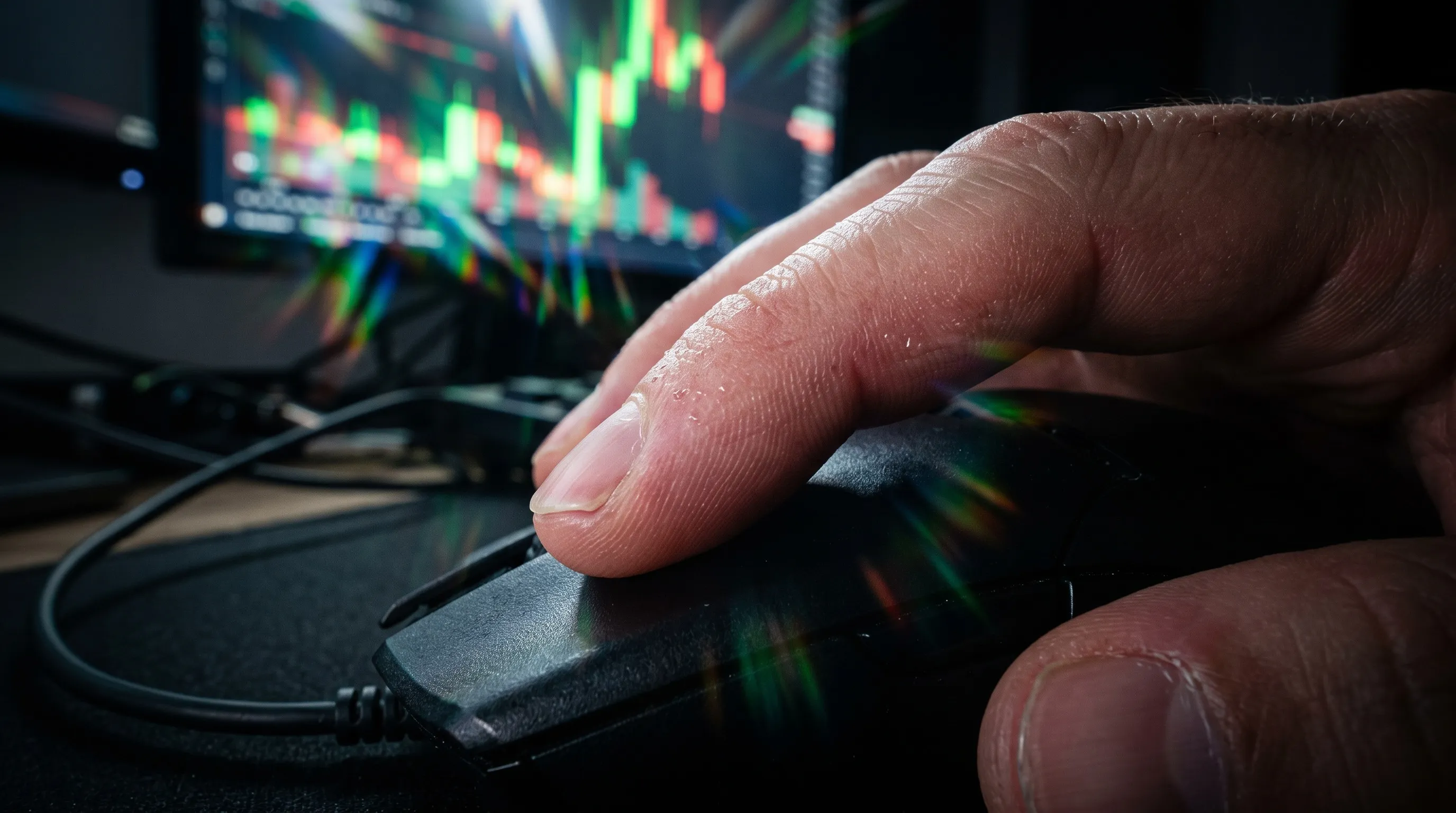
Gazing at the dancing green and red waves on the other side of the screen, I clenched the mouse tightly.
"It’s rising…! This is too overheated in the short term! I’ll short to catch the reversal!"
Click.
With my right finger, I pressed the market order sell button. That was the opening act of the life’s greatest trauma, the "devil’s 860,000 yen loss-cut incident"…