

Chapter 2 [Final Part]: The Labyrinth of Technical — Daily Immersion in Studying —
VII. Discovery of the Daily Chart Artisan and the First Winning Experience
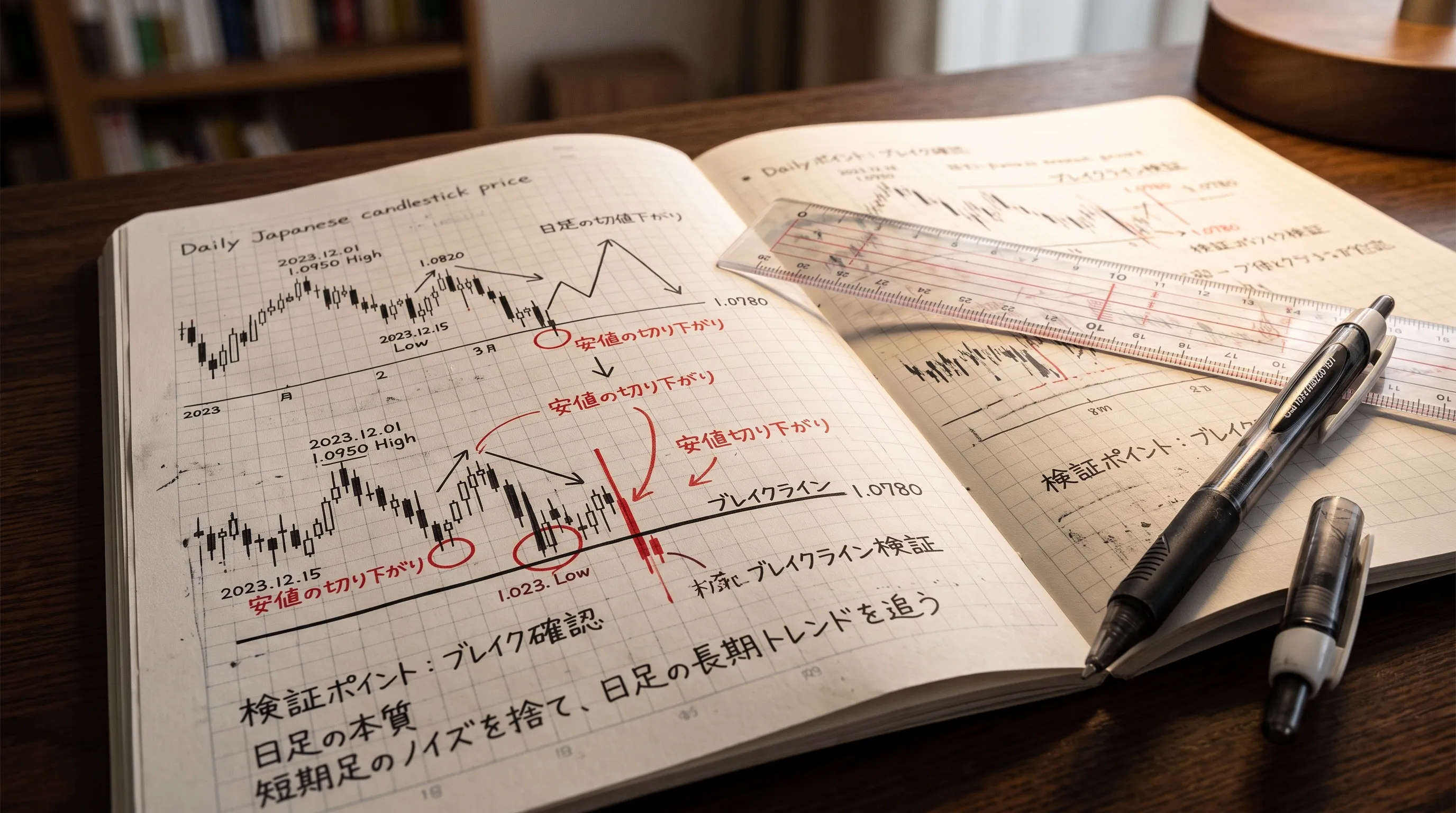
“Although my win rate is over 70%, as long as a real human is gripping the mouse, prospect theory (loss aversion, where losses loom larger than gains) rules and my account balance keeps shrinking….”
In the winter of 2019, after years of tinkering through the labyrinth of technical analysis and being crushed by deep weariness, I made a decision on a weekend to fundamentally change my approach.
“If I stop watching only the short timeframes like 5-minute and 15-minute charts, and instead basethe assessment on the larger price action, where the waves are bigger and global institutions care most about, the Daily Chart, what would happen if I based everything on that?”
I rewound several years of charts day by day, manually and roughly testing the shapes of daily candlesticks, the slopes of moving averages, and the funding inflow patterns of large investors. And at last I derived a simple yet powerful structural edge. I named this method with respect the ‘Daily Chart Artisan’.
======================================================================
“Daily Chart Artisan Logic” – Summary
• Setup: detect the limit of downside pressure under a down-trending series of lows.
• Trigger: enter when the close breaks above the high of the most recent bar.
• Money management: initial stop loss set below the recent low. Based on a fixed risk-reward, gradually trail with a trailing stop.
======================================================================
≪“At 7 a.m., I drink coffee and check the chart just once. If the conditions are met, I place a limit order and then close the PC until night. This way I can work as a traveling salesperson without fearing smartphone notifications or getting a stomach ache!”
I started living according to the rules of the “Daily Chart Artisan” with a small amount of real trading.
The results were dramatic. Of course there were days of stop losses. But by physically blocking emotional interference, the beautiful ‘loss smaller, gain larger’ trades accumulated calmly.
In one week, +15,000 yen. In one month, +60,000 yen. It was not a explosive windfall. Yet I experienced for the first time in my life the thrill of my account balance growing with a clean, rightward tilt.
“I can win…! If I discard emotions and follow the structurally-based rules with a wider time frame, the market can absolutely be mastered!”
In my chest, a small yet unwavering flame of hope was lit.
VIII. A Specification for the Programmer and the First EA Born
Over several months of accumulating profits with the Daily Chart Artisan rules, new challenges emerged amid the busy daily life as a salesperson.
“Waking up at 7 a.m. every morning, opening the chart, calculating the beard-length, and placing orders is becoming a burden during trips and busy seasons… If I oversleep or sudden tasks occur, I will miss perfect opportunities.”
So I realized the possibility of “fully automated trading (EA)” through programming.
“If the rules are so clearly quantified, why not put everything into code and create a system that runs 24 hours without rest?”
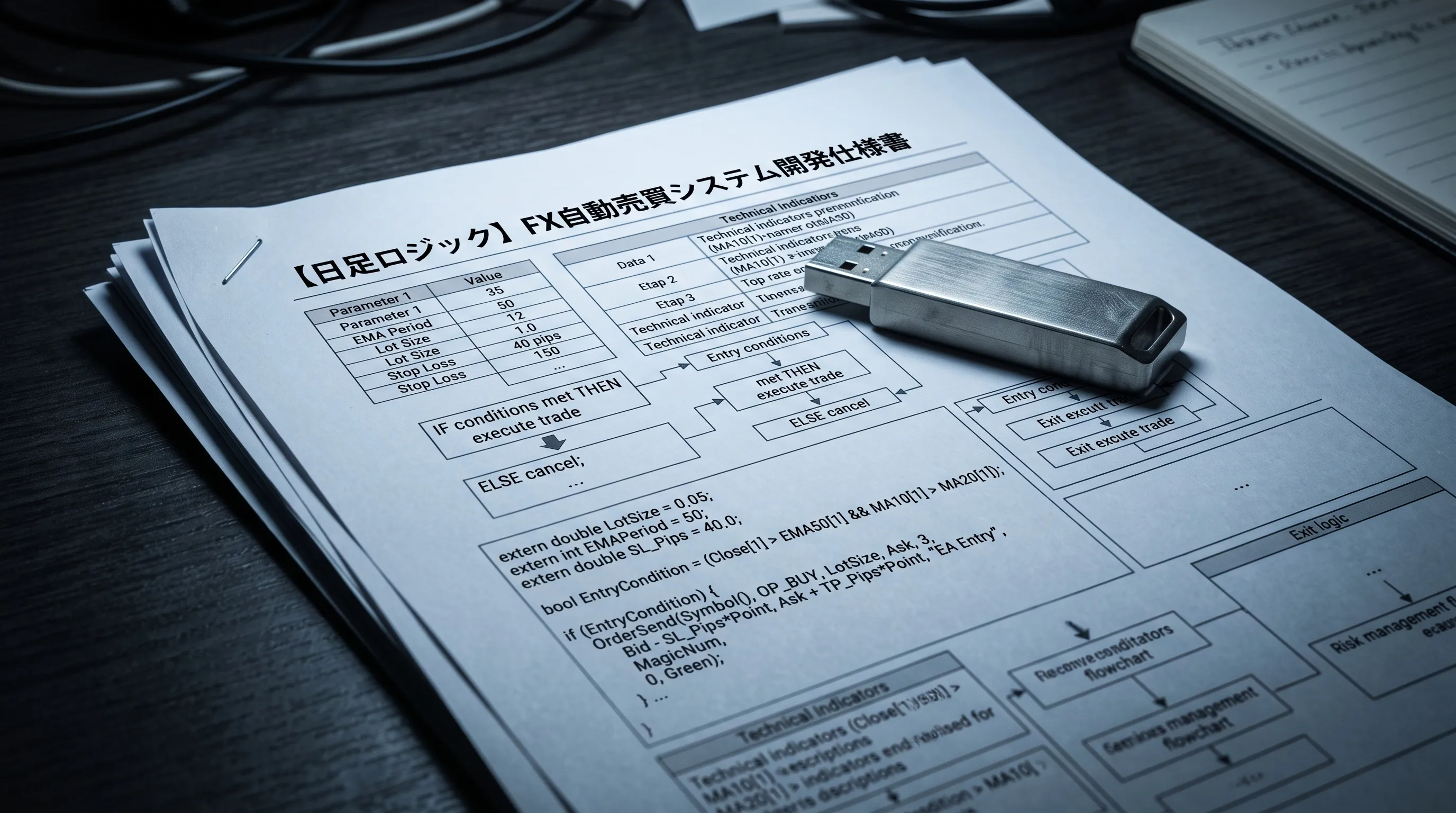
I opened Word and Excel and began drafting a “specification” that would translate the thinking I was doing in my head into language without a millimeter of ambiguity.
======================================================================
[Requirements for Systemizing Judgement-Based Methods (Specification Creation)]
• Strict decision branches:
Eliminate all human descriptive terms like “market momentum,” and
Translate into fully numerical conditions such as “the previous day’s high is exceeded by the body,” “the sequence of lower lows continues for X bars,” etc.
• Error handling and exception rules:
Specify safety rules to prevent the system from running amok, such as entry rejection during wide spreads around major news releases and weekend hold-prevention settings.
======================================================================
I searched a freelancing platform for an experienced MQL programmer and entrusted them with the complete specification for development.
One week later, the programmer sent a message that it was complete and delivered a single.ex4 file. With trembling hands I stored it in the MT4 folder and dragged it onto the chart. In the top-right, beside the EA’s name, a small smiley icon quietly grinned?
Click. I pressed the backtest start button. On the screen, the green equity line rapidly drew a beautiful upward curve.
“It moved…! The ‘Daily Chart Artisan’ in my head is now moving automatically…!”
My thoughts became electronic flesh and blood, and without any emotion, they pushed out profits in a calm, overwhelming way. I was glued to the screen and ran backtests again and again until dawn.
IX. The Limits of Outsourced EAs and the creeping shadow of Hubris
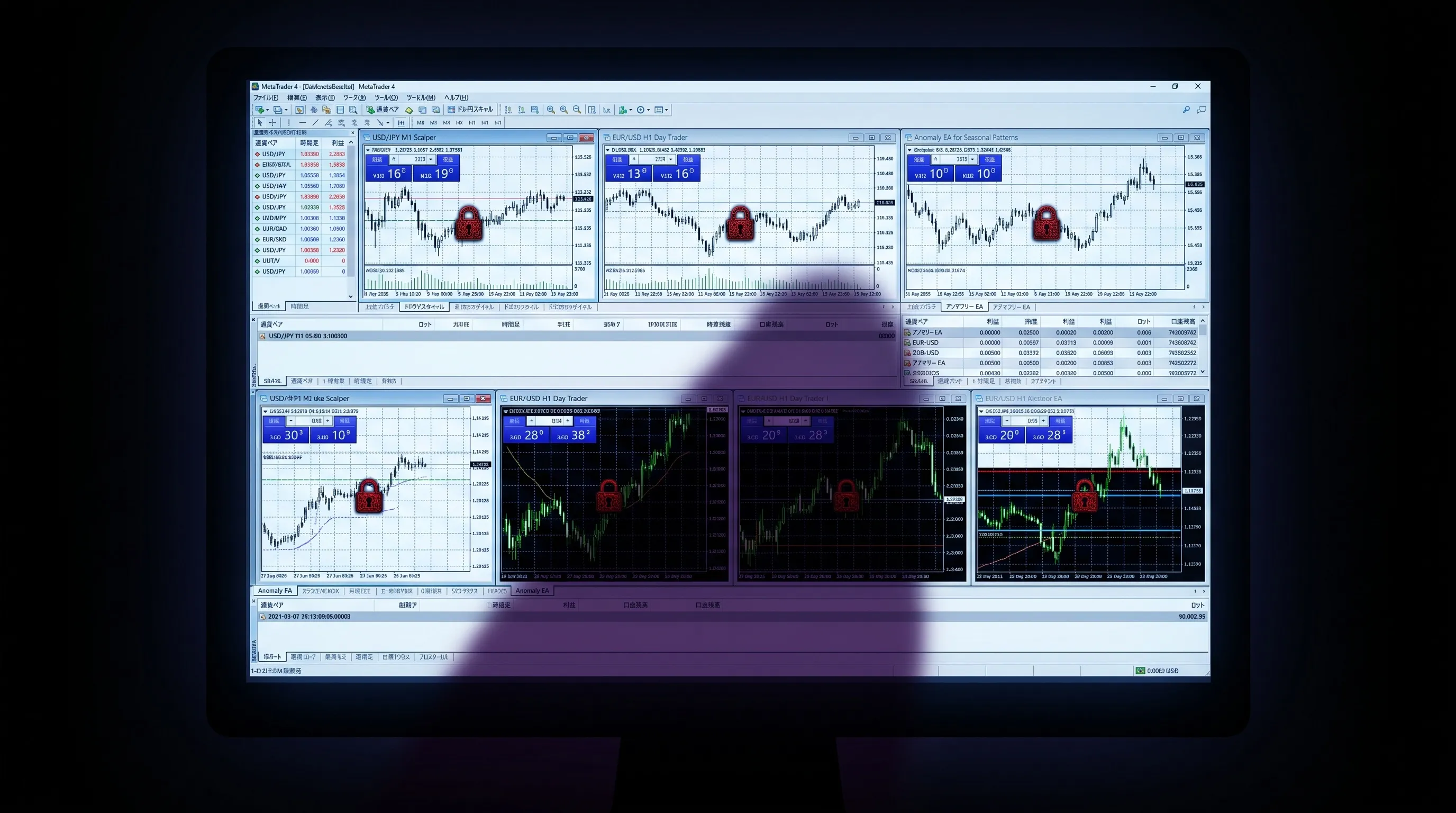
Yet the encounter with this first outsourced EA gave me the greatest thrill, while at the same time introducing a new sense of frustration and dangerous traps as a part-time investor.
The outsourced EA performs exactly as specified. But when the market changes slightly and I want to tweak the indicator’s calculation or refine the timing of the stop loss, I cannot touch the code at all. Each modification incurs extra cost and time, and the system’s black box (unseen inner workings) gradually becomes a seed of anxiety.
What was even more terrifying was my own growing arrogance caused by automatic profits.
“Well, automated trading isn’t that hard after all. If I can win with the daily-chart logic, surely I can collect well-known commercial EAs online and spin them to aim for billions in record time?”
With the account balance rising, the painful lesson I once learned from a 150,000-yen total loss and bonus erosion faded into arrogance.
And this hubris would soon become the trigger that dragged me into my life’s greatest nightmare—the “86,000-yen loss cut” hell…