

Free Version 【White Tiger Parameter Public】Small Amount Fast Mode & Martingale Mode | Publicly reveal methods of operation by fund level
This time, with the semi-automatic EA "Byakko" we will公開Operational parameters and money management methodsare disclosed.
There are various ways to use Byakko, but at present I am especially focusing on the following two.
① “Win-rate-focused, blazing-fast mode” starting with a small amount of funds
② “Martingale mode” starting around 100,000 yen
Even with the same Byakko, the approach is quite different.
In the small-fund mode,we maximize capital efficiency.
In Martingale mode,we increase capital while calculating the probability of a losing streak and the required margin.
This time, we will introduce the concrete parameters and the corresponding mindset for each.
■ ① Small-fund oriented “Win-rate-focused, fast-growth mode”
First, this is the approach currently used in the “10,000 Yen Challenge.”
What this operation is aiming for is,
to maximize capital efficiency above all
In the actual challenge, we start with a small fund of 10,000 yen and aim to grow the capital in a short period.
As a target, we are aiming for
about +100% in one week
which is a very high profitability.
Of course, this is completely different from normal asset management.
Because we are aiming for such high profitability,the risk is also extremely high.
Therefore, what becomes important is
“Manage losses not by lot size but by invested margin”
this mindset.
■ The idea of letting losses be managed by stop-out (loss-cut)
In this mode, to maximize profitability, when there is a large drawdown, it assumes a high-risk operation wherewe use the account's stop-out as the effectively maximum loss line.
At first glance it seems very dangerous, but what matters is
how much you put into the account
.
For example, even if you have 1 million yen of trading funds, you do not need to put all 1 million into the account.
For surplus funds of 1,000,000 yen,
1% would be 10,000 yen
3% would be 30,000 yen
5% would be 50,000 yen
will be put into the trading account.
Even if a stop-out occurs, as long as you do not place more than the predetermined amount into the account, you can limit the loss relative to the total trading funds.
In other words,
“not to avoid stop-out, but to constrain damage to the overall funds even if stop-out occurs”
this is the concept.
■ It is possible to operate with small amounts
This is one of the reasons I conduct the 10,000 Yen Challenge.
With 10,000 yen, even in a stop-out the maximum loss can be limited.
In return,
we aim to double or triple the capital in a short period.
It is a very aggressive strategy.
Of course, it does not succeed every time.
In the first 10,000 Yen Challenge,
10,000 → 35,281 yen
increased to
38 trades, 38 wins, +252.8%
reached, but later a reversal caused a stop-out.
This is also part of the characteristics of this method.
That is why the important thing is
“Do not expose the already earned profits to the same high-risk operation indefinitely”
this mindset.
In my case, as a general guideline, I consider switching the method once the profits have increased by around 200–300%.
There are two main options.
① Withdraw profits to reset margin
For example, if 10,000 yen becomes 30,000 yen, withdraw the extra 20,000 yen and again start ultra-fast operation from 10,000 yen.
This allows you to secure profits along the way while trying again.
② Move the increased “profit portion” to 1:1 trades
Separating from the original small-fund fast operation,the increased margin is used in 1:1 trades with either a 2x bet or zero.
Byakko’s win-rate is about 50–60% for a 1:1 balance, so there is an expectancy.
For example, if 10,000 yen becomes 30,000 yen,we operate the 30,000 yen in a single 1:1 trade just onceas a concept.
In other words,
“Create profits in blazing-fast mode”
↓
“Extend them further in 1:1 trades”
This is a two-step approach.
Also, regarding this blazing-fast mode,I have set an upper limit of the trading funds to 100,000 yen.
Even if funds increase, it does not mean that ultra-high-risk operations like 200,000, 300,000, or 1,000,000 yen will continue.
The purpose of this operation is solely toaim for high capital efficiency with a small fund.
Therefore,
“Blazing-fast operation up to 100,000 yen”
“Use the +200–300% as a single profit securing and switching point”
“Move the increased margin to 1:1 trades either doubling or zero”
This rule is in place to pursue profitability while limiting the risk exposure as much as possible.
Attack with a small amount, then protect with profits.
This is the basic capital management I am thinking for this small-fund mode.
■ ② For amounts above 100,000 yen, “Martingale mode”
The other mode is
Martingale mode
.
In this mode, the money management concept changes from the small-fast mode.
After a loss, by increasing the lot size, you aim to recover the losses on the next win.
The target profit rate is roughly
about +100–200% monthly
.
This, too, targets a very high return compared to ordinary asset management, hence it is high-risk by nature.
However in Martingale, what is important is not simply “how many times to multiply.”
What you should look at is
past win-rate
maximum drawdown
probability of consecutive losses
loss amount per occurrence
Martingale multiplier
required margin
.
By combining these, you first decide
“How many consecutive losses can the capital withstand?”
in advance.
■ Martingale is capital management based on losses in a row
For example, even with a high-win EA, drawdowns will occur.
Even if the win rate is 60%,
it does not mean that “in 10 trades you will have 6 wins and 4 losses.”
Three losses in a row, four in a row, and possibly more can occur.
The scary part of Martingale is this sequence of losses.
Therefore,
we check past data to see how many consecutive losses have actually occurred
and set the margin accordingly.
It is not “safe because the win-rate is high,” but
“If the expected drawdown occurs, how much is required?”
to back-calculate.
This is the fundamental capital management of Martingale mode.
■ Consider risk from a year of drawdown data
The most important thing in Martingale mode is not just the win rate.
What I value is,
“How many consecutive losses actually occur, and to what extent?”
In the past year,1,476 tradesbacktesting showed drawdowns as follows.
| Drawdown count | Occurrences in a year | Actual frequency out of 1,476 trades |
|---|---|---|
| 1 drawdown | 195 times | about 13.21% |
| 2 drawdowns | 98 times | about 6.64% |
| 3 drawdowns | 54 times | about 3.66% |
| 4 drawdowns | 23 times | about 1.56% |
| 5 drawdowns | 5 times | about 0.34% |
| 6 drawdowns | 4 times | about 0.27% |
| 7 drawdowns | 0 times | 0% |
| 8 drawdowns | 1 time | about 0.07% |
During this year, the maximum drawdown of8 in a rowoccurred once.
Of particular note are the results:
5 consecutive losses: 5 times
6 consecutive losses: 4 times
8 consecutive losses: 1 time
This shows that even with high win-rate, drawdowns will occur and margin must be designed accordingly.
Rather than predicting how many losses will occur,we design margin assuming drawdowns will happen.
■ Viewing risk by “x consecutive losses or more” makes it clearer
If you summarize annual actual data by how many drawdowns or more occur,
| Drawdown | Annual occurrences of drawdown or more |
|---|---|
| 3 consecutive losses or more | 87 times |
| 4 consecutive losses or more | 33 times |
| 5 consecutive losses or more | 10 times |
| 6 consecutive losses or more | 5 times |
| 7 consecutive losses or more | 1 time |
| 8 consecutive losses or more | 1 time |
In other words, during this validation period,10 times a year for 5 consecutive losses or more, and 5 times for 6 consecutive losses or moreoccurred.
On the other hand, cases reaching 8 consecutive losses occurred only once in a year.
That is why I focus in Martingale mode not on predicting how many losses will occur, but on how much losses the capital can endure.
Because there was only one instance of 8 consecutive losses in the past, it does not guarantee that 8 or more will never occur in the future. There is a possibility of 9, 10 consecutive losses, or more.
Therefore,combine past maximum drawdown + required margin + initial lot + Martingale multiplierto set from the perspective of the maximum loss you can tolerate.
And by deciding a target amount and withdrawing, you can ensure profits remain.
From January to around May this year, I have experienced reaching 100,000 yen up to 1,000,000 yen.
Also, based on probabilities, starting at 10,000 yen with 0.01–0.02 lots, and gradually increasing the lot size.
■ The two modes have different purposes
In summary, the settings公開 here have the following positioning.
| Small-fund, win-rate-focused mode | Martingale mode | |
|---|---|---|
| Starting funds estimate | From a small amount | Around 100,000 yen |
| Goal | Rapid capital increase | High monthly profitability |
| Profit rate target | Aim for about +100% in a week | Aim for +100–200% monthly |
| Loss management | Limited by invested margin | Losses by drawdown and margin |
| Characteristics | Focus on capital efficiency | Risk management like drawdown resets possible |
| Risk | Difficult to pull out midway | Can be stabilized with decision to exit mid-way |
There is no notion that one is superior.
It is something to use depending on trading funds and how much risk you are willing to tolerate.
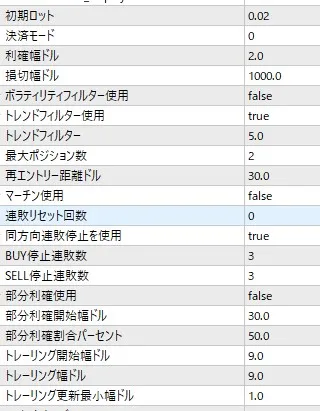
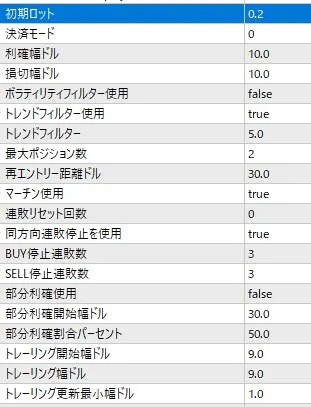
■ Parameters
From here I will disclose the parameters I actually use.
【Small-fund, win-rate-focused mode】
【Martingale mode】
■ Decide not only “profit rate” but also the amount you are willing to lose first
The two strategies introduced this time are not in the realm of typical low-risk operations.
Instead of aiming for extremely high profits in a short period, they take on large risk amounts.
Therefore,
instead of asking “how much do you want to earn,”
“what is the maximum you can lose?”
is more important to decide.
In the small-fund mode, only the amount that can tolerate a worst-case stop-out should be put into the account.
In Martingale mode, determine the tolerance range from past drawdown data and required margin.
Because we pursue profitability, we manage risk with numbers.
This is the current Byakko operating policy.
We will continue to test with real accounts and publish not only good results but also stop-outs and drawdowns.
Semi-automatic EA “Byakko” can be tried with a free trial version, so please first confirm its actual operation and then consider it.
■ First, try running it on a demo account
For the parameters introduced this time, please not only read the numbers but actually run them on your own demo account.Please give it a try on your own demo account as well.
Byakko offersa free trial.
Using the settings disclosed here,
how frequently you enter
what extent of winning streaks and losing streaks occur
how funds move relative to margin
I think the easiest way to understand is to actually run it and see.
In particular, the “small-fund, blazing-fast mode” and “Martingale mode” discussed here carry higher risk due to aiming for higher profitability than typical operations.
Therefore,you do not need to start with real funds immediately.
First, try the free trial plus demo account with the parameters disclosed here as-is.
Then,
“Is this risk level something I can manage?”
“How many consecutive losses can I withstand?”
Please adjust the funds and lot sizes to fit yourself after confirming.
The parameters will be published. Please run them and verify the numbers with your own eyes.
The free trial lastsfor 7 days.
First, please thoroughly observe Byakko’s movements on a demo account.
Note that backtests and past results do not guarantee future profits. Low-size high-lot operations and Martingale strategies carry large risk of loss. When performing live trading, always decide within the range of funds you can tolerate.
https://www.gogojungle.co.jp/tools/indicators/84179