
In the week with the first Japan-US coordinated intervention in 28 years, the pound-dollar won 7 of 9, or 77.8% (Paradise measured)
Hello, this is Nikotama.
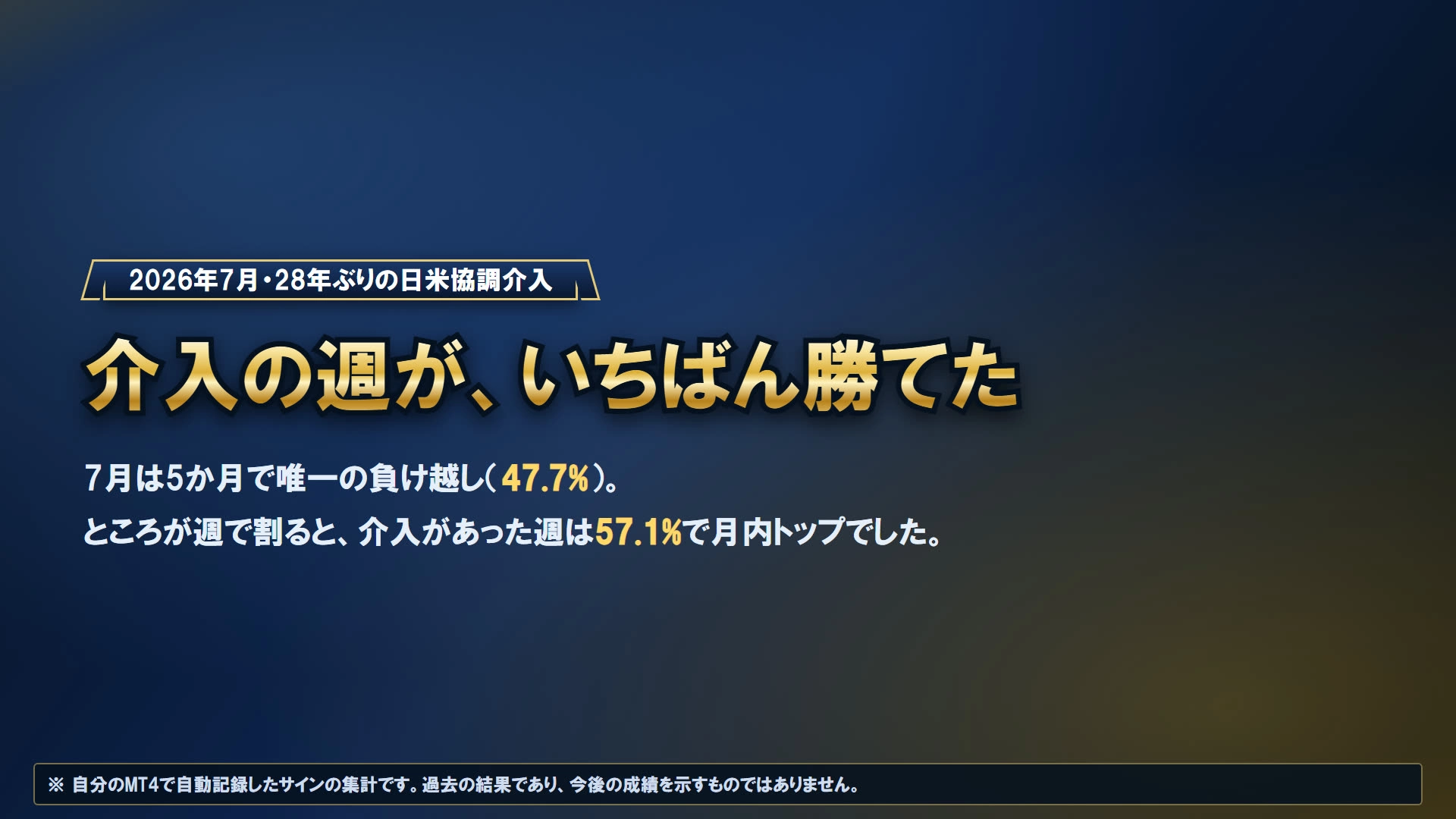
The dollar/yen rate was volatile in July. It reached 163.99 yen on the 23rd, a level not seen since November 1986. On the night of the 30th, Japanese authorities intervened unilaterally, estimated at 8.45 trillion yen. It is considered the largest single-day intervention on record. On the 31st, after the Bank of Japan meeting, the U.S. Treasury moved through the New York Fed, resulting in a coordinated U.S.-Japan intervention. Coordinated yen-buying interventions have not occurred for 28 years since 1998. On August 3rd, it dropped to 155.23 yen.
Because the signs are recorded automatically each time they appear, it can be re-counted later by week or by currency. If you divide the intervention week of July 27 by currency, it turns out like this.
■ Intervention week, pound-dollar won 7 out of 9
GBPUSD won 7 out of 977.8%. EURUSD won 6 out of 10 for 60.0%, USDCHF won 3 out of 9 for 33.3%. In the same week, with the same settings, results differed by currency to this extent.
If you look at days, July 28 had 3 wins out of 4 (75.0%), and the 29th had 5 wins out of 7 (71.4%). The two days just before the intervention were favorable. The weekly total was 16 wins out of 28 (57.1%).
In other words, it wasn’t that “a volatile week means everything fails,” but the results differed by currency and day, in reality.
■ If something doesn’t fit, tell us and we’ll fix it
This is a promotion. Paradise does not end by simply laying out and selling what’s finished.If you try it and find something that doesn’t fit, we will listen to your request and fix it.I think that is the biggest difference.
In the past few months, we have added things like these.
・Easy setup: It used to be difficult to select one condition at a time, so we made it so you only pick one from six combinations
・CSV of sign history: All numbers shown in this article are from this. Every sign and win/loss is automatically recorded on a new line
・Consecutive sign suppression: Stops signs from continuing during a specified number of bars
・Display in Japan time: Shows MT4 server time and Japan time side by side
・CSV of sign history: All numbers shown in this article are from this. Every sign and win/loss is automatically recorded on a new line
・Consecutive sign suppression: Stops signs from continuing during a specified number of bars
・Display in Japan time: Shows MT4 server time and Japan time side by side
All of these are things we added to fill gaps we felt while using it ourselves. We can do the same thing in response to your requests as well.
The judgment conditions are currently 38 items, operating with their ON/OFF combinations. If there aren’t enough, we will add them. Adding conditions, how to apply exclusion times, how to trigger alerts, the position and color of arrows and text, items to leave in the CSV. If adjustments of this level are possible,we accommodate purchasers’ requests at no extra charge. If it requires rebuilding from scratch, please consult us separately.
Please send requests via GogoJungle messages. A wording like “I want signs only when this condition overlaps with that condition” is fine. We will check whether it’s possible and respond with our findings.
→ This is the tool that outputs the numbers in this article:Paradise (MT4 indicator, 38 judgment conditions, 5,000 yen)