The Final Chapter ~ Winning by Feel Alone Is Difficult
I think it is quite difficult to continue trading only by emotions and senses and still win in the long term.
Today looks like it might go up.
Somehow I feel it looks strong.
It seems like it might reverse soon.
I want to recover the loss I just had.
I want to buy because it has fallen this much.
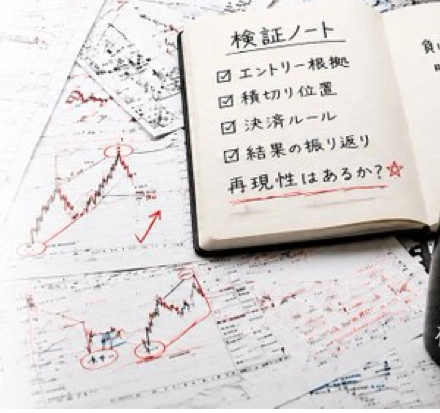
If I keep repeating these kinds of trades, I can't verify what was good or bad.
There is no reproducibility either.
In particular, FX may look like similar charts, but the inside can be completely different.
That’s why I think it’s important to be able to explain what I am basing my judgments on.
For each trade,
if someone asks me why I’m doing this,
I should be able to answer.
Why cut losses?
Why cut losses there?
Why let profits run?
Why enter at this point?
Why use this method?
Why not trade today?
There are reasons for all of it.
It’s not just because a famous person said so.
It’s not because it was written in a book.
It’s not because everyone else is doing it.
I think and convince myself on my own.
I think this is quite important.
In FX, it’s better to be a little contrarian
This is my personal view, but I think it’s better to be a little contrarian in FX.
Is this really okay?
Everyone does this, but is it really right?
Why is this rule necessary?
What happens if you reverse it?
This method is said to win, but what would happen if we tested it over a long period?
Questioning constantly.
Thinking about it constantly.
This is what we call critical thinking.
In normal society, if you thought about such things every time, you might be seen as a troublesome person.
In a company, there are times when being a person who obediently does what your boss says is valued.
But in the market, there is no boss.
There is no one to tell you the right answer.
Ultimately, you have no choice but to judge for yourself.
And it’s a world where many people struggle.
Then,
because everyone is doing it
is it really okay to act just for that reason?
That’s something you should question.
If I had been able to think like this earlier, I might have avoided a detour.
I read over 100 investment books, but I didn’t need to read that much
I read more than 100 investment books.
Of course, reading books has meaning.
It’s extremely helpful to acquire foundational knowledge.
However, looking back now, I don’t think reading over 100 books was necessary.
After reading to a certain extent, what is written tends to become similar.
Let’s cut losses.
Let’s manage risk.
Let’s avoid being emotional.
Let’s increase profits.
Let’s follow the rules.
Of course, all of them are important.
But the really difficult part is what comes next.
Why must we cut losses?
Why is it better to increase profits?
Where in my method should I cut losses?
How do I balance win rate?
What market conditions make this rule work?
How do I apply that to my trading?
This isn’t something you can learn just by reading a book.
You have to think for yourself.
You have to validate.
You have to learn from the actual market.
So, even if you returned to being a beginner with your current knowledge, you would still read books.
But I don’t think you’d read 100 books.
Once you have a solid foundation, you should move to thinking for yourself as soon as possible.
If I returned to being a beginner with my current knowledge, what would I do
If I could return to being a beginner with my current knowledge, I would first study the basics comprehensively.
What is cutting losses?
Why is it necessary?
What is taking profits?
Why is it necessary to extend profits?
What is risk-reward?
Why is capital management necessary?
Not just memorizing, but understanding why you should do these things.
I believe it’s hard for people to continue what they don’t truly accept for a long time.
It seems like cutting losses would be good.
So I cut losses.
But just this alone can lead to breaking rules when a large unrealized loss occurs.
If you understand why you must cut losses, your actions will change.
With that, you decide on the methods you will use to some extent.
And you test them.
Only those that pass testing are traded in real small amounts.
You also record the results of real trades.
If you lose, you study that loss.
If the testing results and real results differ, you consider the reasons.
Then you modify and test again.
You repeat this process.
It is incredibly plain.
But if I were myself now, I would do this.
Conversely, I wouldn’t jump into large sums with a method that hasn’t been tested.
There is no need to test with your own money in real markets what may or may not be profitable in the past.
Just before you start winning, you stop losing
I lost 500,000 yen that I borrowed from my brother.
After that, I didn’t suddenly start winning big.
First, I got to break-even.
I think this period lasted about a year.
A person who had been losing all along finally stopped losing as much.
And then, for the first time, I became positive on an annual basis.
However, even then,
I didn’t think, “This will surely work.”
It had been so long losing that I thought
perhaps I just happened to win this year.
But testing shows a past positive track record.
When I traded in real markets according to that testing result, I too became positive.
That was the moment I began to think it might not be a coincidence.
Since then, on an annual basis, I have continued to be profitable.
It’s been about 8-9 years since I started investing.
Looking back,
I kept losing.
I stopped losing.
I started winning.
That was the order for me.
There was a period before I started winning where I stopped losing.
I think that was also very important.
After you start winning, your intuition can be useful sometimes
I’ve talked about how trading purely by feel is hard up to this point.
But I’ll say something a little contradictory.
After you start winning to some extent, intuition can be useful.
The beginner’s intuition and the intuition of someone who has watched the market for thousands of hours are not the same.
The beginner’s sense of
“It looks like it might go up,”
and
the sense of someone who has observed and tested the same patterns for many years, who has repeated real trades,
feeling that “today is a little different from usual,”
is a difference in the substance of the same intuition.
A lot of experience can become an unconscious basis for making judgments.
For me, once a certain foundation was built, adding some of these experiential rules significantly improved performance.
But the order matters.
It’s not about doing it by intuition from the start.
There is a pattern first.
There is validation.
There is reproducibility.
On top of that foundation, you add refinements gained from years of experience.
In my case, this extra plus sometimes greatly boosted results.
Once a profitable method is established, finishing isn’t the end
And finally, one more thing.
Just because you’re winning now does not mean this state will last forever.
The market changes gradually.
Price movement changes.
Volatility changes.
Participants change.
Depending on the period, some things work well while others don’t.
Therefore, even if things are working well now, at the moment you think you’ve finished, you may slowly drift away from the market.
Even if the core essence doesn’t change much, you need to make small adjustments to suit the current market.
What is functioning in the current market.
What is different from before.
Where is your performance slipping.
These are things I still think about.
Even advanced traders can significantly improve by adjusting basic parts without changing them drastically.
It’s an improvement made possible because of accumulated experience.
Winning in the market isn’t the ultimate goal.
Even after you start winning, improvement continues.
My past self had no respect for the market
While writing this article, I’ve reflected on my old self and one realization came to mind.
I don’t think my old self had respect for the market.
It isn’t a spiritual thing.
Back then, I used to think,
I think it will go up.
So it should go up.
I studied this much.
Therefore I should win.
I think this method is right.
Therefore it should be profitable.
In this way, I was thinking of the market centered on myself somewhere.
But from the market’s perspective, how many hours I studied doesn’t matter.
Reading 100 books doesn’t matter either.
Having traded for years doesn’t matter.
How many losses I endured also doesn’t matter.
The market doesn’t move to match my efforts.
If you aren’t getting results, you have to doubt your thinking and approach.
That’s all.
Rather than trying to prove your correctness in the market, observe what actually happens and adjust yourself accordingly.
If I could tell my old self anything, it would be
don’t try to prove your correctness in the market
or perhaps, don’t rely on your own certainty.
Still want to win in FX?
Having read this far,
some of you may think, “Do I have to do all that?”
I think, however, that it’s fine.
If you read this and decide you don’t want to spend that much time on FX, that too is a valid answer.
I recorded my trades for years.
I printed charts of over 1,000 lots.
I chased the trades of winning people for years and analyzed thousands of hours.
I read over 100 investment books.
Even so, I didn’t win right away.
And I can’t say that if you do these things for years you will definitely win.
But spending more time doesn’t guarantee winning either.
No matter how many thousands of hours you repeat wrong things, you’ll just get better at wrong things.
So what matters is not just working hard, but
what you are actually doing.
Whether there is real edge in it.
Why you lost.
Whether that loss has reproducibility.
What to keep and what to discard.
I think about these continuously.
While saying you want to win in FX, you use a method whose profitability is unknown, you trade in real markets without testing the reason you lost, and you look for the next method without studying why you failed.
If you repeat this for years, the situation won’t change much.
That’s how I was in the past.
I want to win.
But I was chasing short-term money.
If I lost, I would change my method.
If I won, I would think it was correct.
Then I would lose again.
And keep chasing the next holy grail.
That cycle continued for a long time.
From there,
whether you win or lose, you can accept it.
Only do things that are reproducible.
Use only results that testing shows.
If you lose, research that loss.
Always consider that you might be wrong.
What you win total is important.
Rather than aiming to win big, first avoid big losses.
After adopting that mindset, my results started to change gradually.
In the end, most of what I did to become capable wasn’t flashy.
It was mostly mundane things.
Keep records.
Think.
Validate.
Lose.
Make corrections.
Validate again.
If necessary, discard even what you have believed for a long time.
That’s all I have repeated.
And I’m not sure I should be so pompous saying this, given it took me about 10 years to be able to win.
Rather, I was myself for a long time on the side of not really understanding what was truly needed while saying I wanted to win.
So I understand that feeling well.
You want short-term money.
You want to win fast.
If possible, you want to win easily.
You don’t want to lose.
You want to believe you are right.
But when that feeling grows too strong, you may lose sight of the market itself.
In my case, my obsession with winning gradually subsided, and once I could accept wins and losses as just results, I started to win more.
It’s a strange thing.
I still don’t think there is an absolute in the market.
There’s no guarantee that today’s approach will work the same 10 years from now.
So I still think about it now.
I test.
I improve.
And I leave room to be wrong.
After over 20 years in the market, I think this has become quite important.
Don’t try to prove your correctness in the market.
Adapt to the market.
When you can do that, I think you can finally emerge from the long era of being a losing trader
〜Part 1〜 Most people who say they want to win aren’t doing what is necessary to become able to win.
〜Part 2〜 I continued to record my trades on charts for years,