
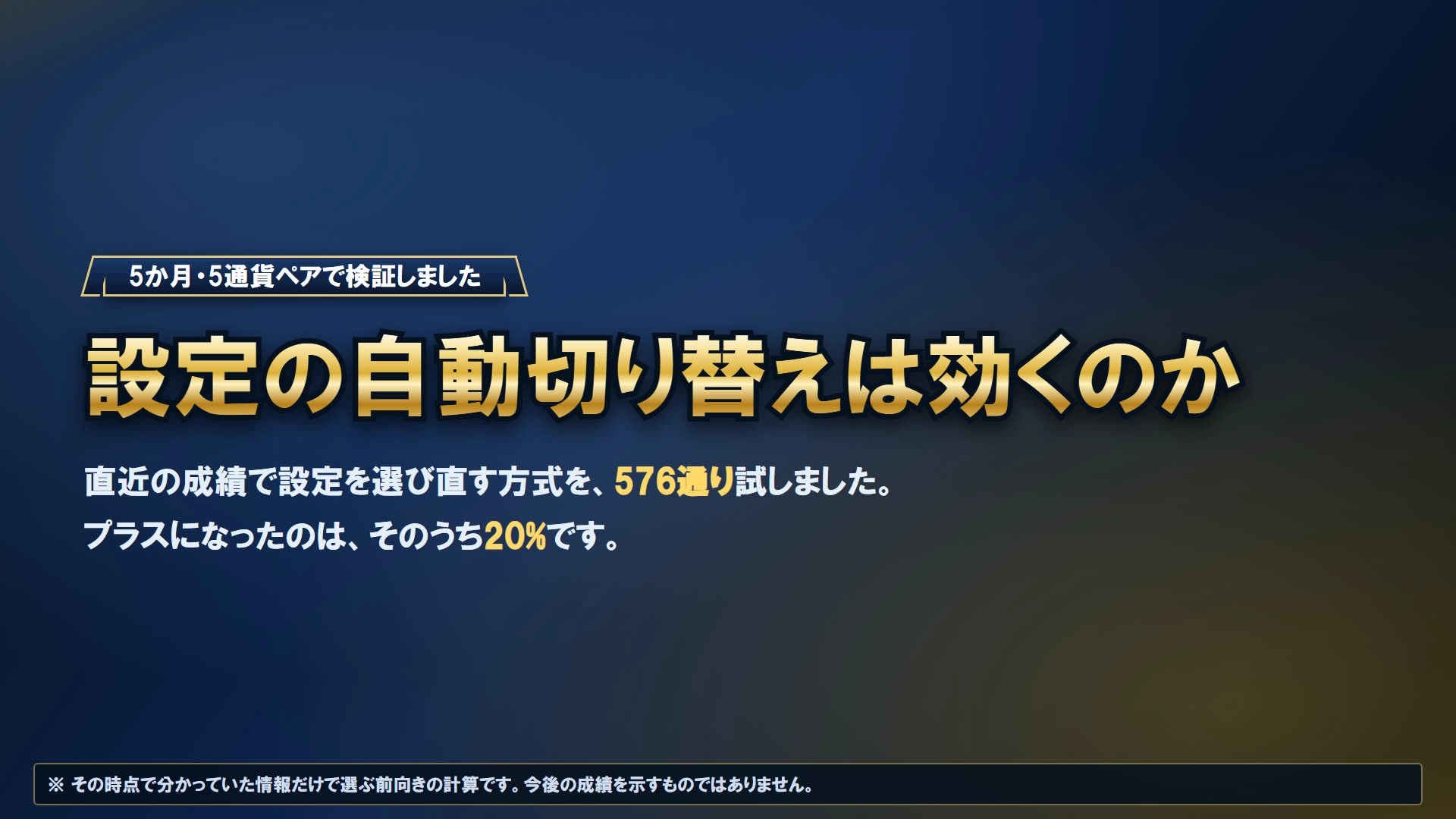
The combinations that scored 65% or higher also showed 61.4% thereafter (positive validation over five months of signs)
Hello, this is Nikotama.
I have been logging the outcomes of signals from my own indicator to a CSV every time they appear. Using that, I built a system that automatically selects only the well-performing settings and validated it over five months.
There is only one thing I paid attention to in the validation method.Use only the information known at that time to choose the settings. In hindsight you can tell that “GBPUSD hourly chart was good in August,” but if you apply that to August’s data it will obviously look good. To prevent that, at each moment I selected settings from records up to that point, and counted performance based on signals that appeared afterward. The range covered is May to September 2026.
■ Combinations that are clearly outstanding continue thereafter
The clearest example is here. I will line up the win rate at the time of scoring with the actual win rate that followed.
| Win rate at scoring | Number of subsequent instances | Actual win rate afterward |
|---|---|---|
| 65% or higher at scoring | 124 times | 61.4% |
| 60–64% at scoring | 174 times | 54.0% |
| 55–59% at scoring | 202 times | 49.0% |
| 50–54% at scoring | 223 times | 53.8% |
Combos with65% or higherat scoring61.4%continued afterward. Out of 124 instances, this level has persisted. The breakeven with an 1.88 payout is 53.2%, which is 8 points higher.
In other words, there are indeed winning angles, and they continue. However, limit it to those that are clearly outstanding.
■ When counted over five months, this is the result
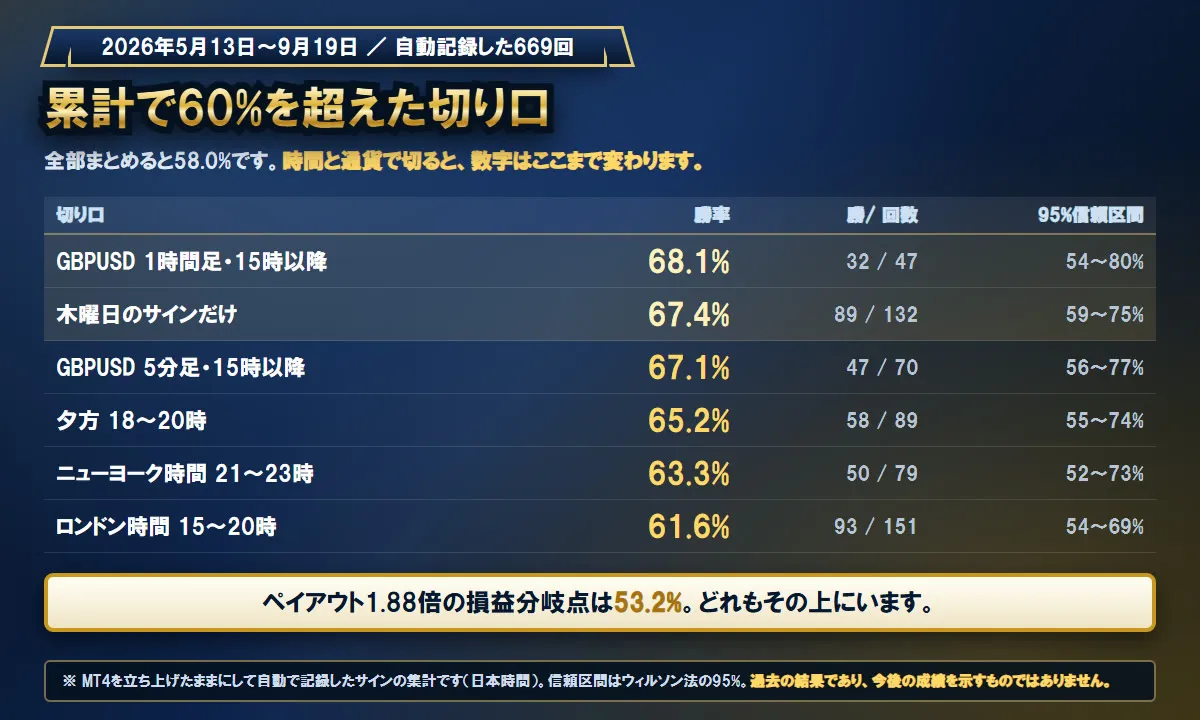
When counting 669 occurrences from May 13 to September 19, the overall rate is 58.0%. When broken down by time and currency as shown in the table above, you get the results above.
The day with the most occurrences is Thursday,89 wins out of 132 occurrences for 67.4%. Since the lower bound of the 95% confidence interval is 59%, I think this is not a random number. For GBPUSD hourly after 15:00 there were 32 wins out of 47, 68.1%, and in the evening 18–20:00 there were 58 wins out of 89, 65.2%.
Rather than switching in small increments, fixing clearly outstanding entry points is more reliable at this time.Fix the clearly outstanding angles.
■ If something doesn’t fit, tell me and I’ll fix it
This is promotional content. Paradise does not finish by simply displaying and selling finished products.If something doesn’t suit you when you try it, I’ll listen to your request and fix it.I believe that is the biggest difference.
In these months I added things like the following.
・Simple settings: Selecting one condition at a time was burdensome, so I reduced it to choosing from six combinations
・Signal history CSV: This article’s validation uses a full tally of it. Every signal and its win/loss is automatically recorded on a new line
・Consecutive signal suppression: Stops signals during a specified number of bars in a band walk
・Display in Japan time: Shows MT4 server time and Japan time side by side
・Signal history CSV: This article’s validation uses a full tally of it. Every signal and its win/loss is automatically recorded on a new line
・Consecutive signal suppression: Stops signals during a specified number of bars in a band walk
・Display in Japan time: Shows MT4 server time and Japan time side by side
All of these are additions I felt were missing when using it myself. I can also do the same in response to requests.
The decision conditions now include 38 items, and operate by their ON/OFF combinations. If something is missing, I will add it. Adding conditions, how to apply exclusion times, how to trigger alerts, the position and color of arrows and text, items to log in CSV. With adjustments of this scale, purchases by customers are accommodated at no extra cost. For a larger-scale overhaul, please discuss separately.
Please submit requests via GogoJungle messages. It’s fine to describe as “I want this condition to trigger signals only when these conditions overlap.” I will check feasibility and respond.
→ Tool that produces the numbers in this article:Paradise (MT4 indicator, 38 decision conditions, 5,000 yen)