
Dow Theory: How to Use It. 【Video Lesson】
"I know Dow Theory at least"
Nine out of ten traders who say that end up being lost in front of a real chart.
When asked to identify high and low points, they cannot answer immediately. They don’t notice that they are looking at different directions on higher and lower timeframes. They say, “There is a trend,” yet they cannot explain the basis for it.
What you know as knowledge and what you can apply on a chart are completely different. In this article, I will give you only the concrete steps to convert from “knowing Dow Theory” to “using it without hesitation.”
The essence of Dow Theory can be expressed in a single line
All the talk about six rules or whatever isn’t needed now. In practice, you only need this.
“Are the highs and the lows each higher or lower?”
If you can understand this, you will not waver in the direction of the trend. Conversely, if you study the method without understanding this, the basis for entries will remain vague forever.
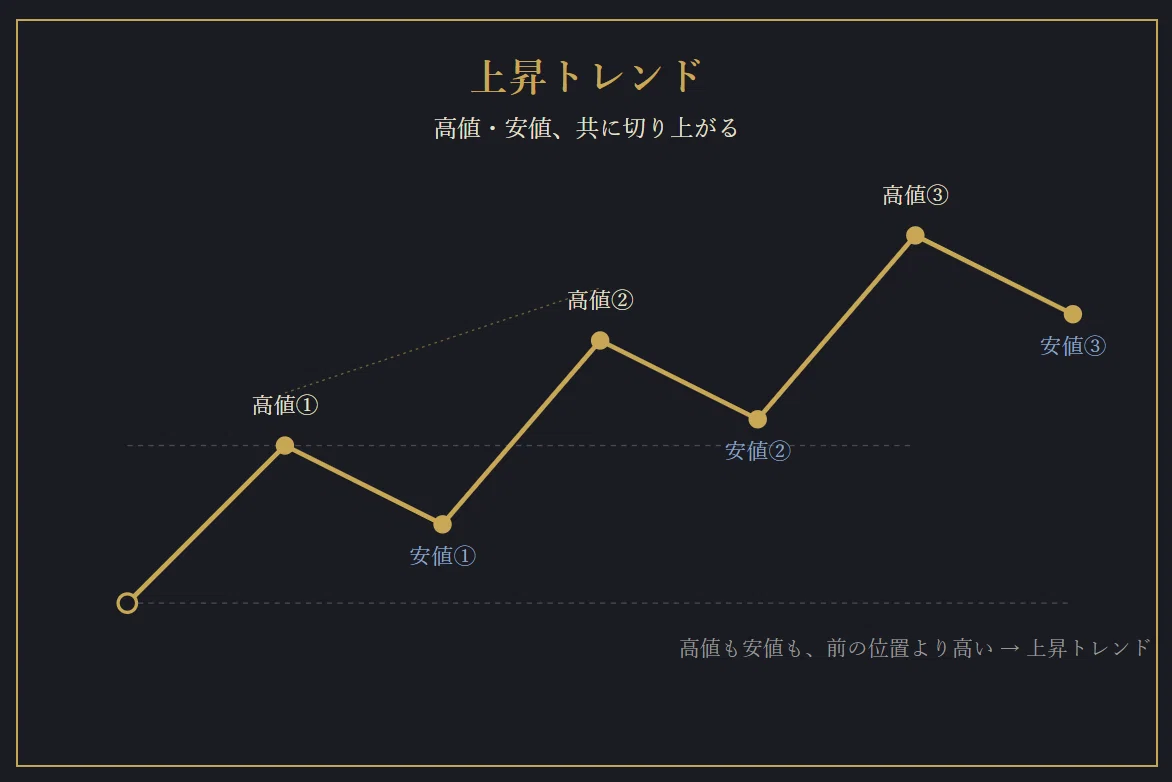
What an uptrend isRefers to a state where both highs and lows are continuously updated at higher levels than the previous highs and lows. It’s not enough to update highs once or twice. The key is whether the sequence of higher highs and higher lows is continuing.
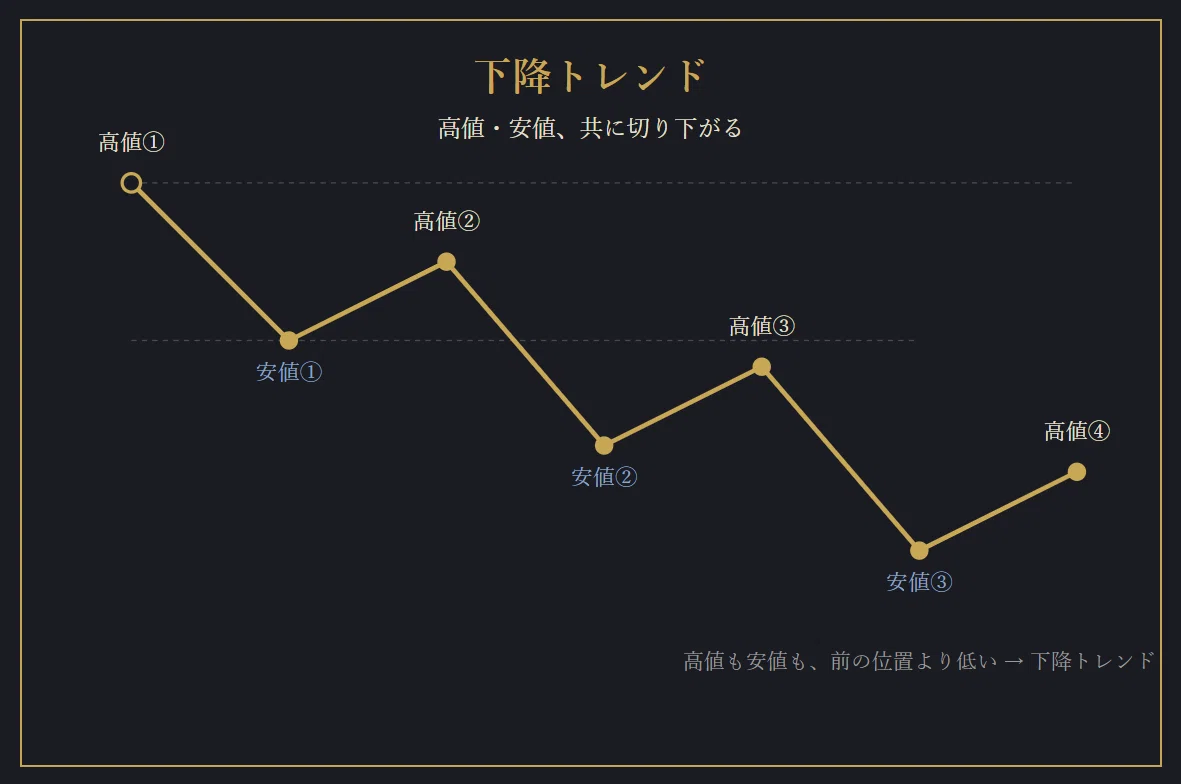
What a downtrend isThe opposite: highs and lows are continually updated at lower levels than the previous ones. Neither side extends in a straight line; it moves up and down, and overall it trends higher or lower, but it’s crucial not to misread the direction amidst the oscillation.
Highs and lows are both rising → Uptrend
Highs and lows are both falling → Downtrend
Neither → Not a trend. 90% of losing traders move here
This is the foundation of the concept “What Dow Theory is.” Once you have this foundation, you only need to check “which way are the highs and lows moving” every time you open a chart. No difficult judgments are required.
So, how do you apply this thinking to actual charts and become sure to “look” without hesitation? From here on, we enter specific steps.
First, the things you need to understand when dealing with Dow Theory.
That is how to view a chart and how to think about it.
This is how you actually view a chart. This is the hidden flavor of the method.