In the first half, most of the people who say they want to win are not doing what is necessary to become capable of winning.
Most people who say they want to win in FX aren’t doing what’s necessary to actually become profitable.
I’ll be blunt, but I used to be in the same position for a long time.
Search for a winning method.
Watch YouTube.
Read books.
Look at charts every day.
Actually trade.
Reflect when you lose.
Look for another method.
Back then, I thought I was really putting in a lot of effort.
Yet I still couldn’t win at all.
But at the time, I always felt like it was almost there.
If I could improve my stop-loss, I’d win.
If I could improve my entry, I’d win.
If I could find a better method, I’d win.
If I studied a little more, I’d win.
That’s all I kept repeating.
But when I look back now, the fundamental mindset was wrong from the start.
What I was focusing on was almost money itself.
How much did I win today?
How much did I gain this month?
How many consecutive wins did I have?
How many consecutive losses?
How much could I grow in a short period?
How can I grow faster?
That’s all I thought about.
But what I should have been looking at wasn’t there at all.
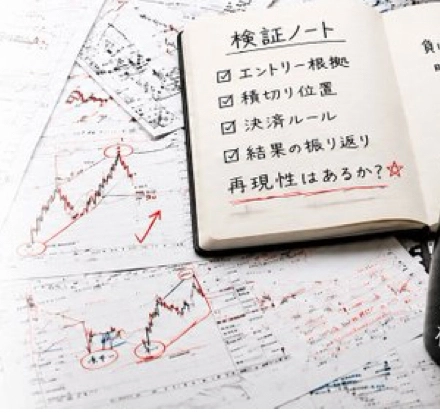
One of the big changes in my own progress was that I stopped focusing on winning or losing, and started looking at whether I could reproduce the result.
Winning doesn’t matter if you can’t reproduce it
For example, today you might win 1,000,000 yen by chance.
Normally, you’d be happy about that, right?
I would have been ecstatic about it in the past.
But you can’t explain why you were able to grab that 1,000,000 yen.
When the same market appears, you might not be able to make the same judgment again.
You wouldn’t know what would happen if you did the same thing in the past.
Then that 1,000,000 yen doesn’t hold much meaning as a trader.
It could be just a lucky win this time.
Conversely, if a trade loses but has reproducibility, it has meaning.
If you lose repeatedly under the same conditions, you should remove those conditions.
If you understand why you lost, you can improve from there.
In short, if you don’t understand the cause of winning or losing, next steps won’t follow.
It took me a long time to realize this.
In the past I thought,
If you win, you’re right.
If you lose, you failed.
That was almost all there was.
But that isn’t true.
Bad trades can win, and good trades can lose.
Looking at a single result alone doesn’t tell you whether that trade was correct.
Gradually, I came to think that whether you win or lose doesn’t matter as long as you can determine if the outcome was justified by the process.
Decide that it’s okay to win or lose.
But you should do things that are reproducible.
Test them, and repeat those that show long-term positive results.
This, I think, was a major turning point for me.
26 Stages I Went Through to Become Able to WinIn the past, I summarized the process of becoming able to win in this way.① Little wins from beginner’s luck↓② Quite a few wins without cutting losses↓③ Wipe out all capital with one loss↓④ Learn to cut losses↓⑤ Stop having big drawdowns↓⑥ Next, become obsessed with cut-lossing↓⑦ Improve entry points little by little↓⑧ Profits improved, but total still negative↓⑨ Also improve entry points↓⑩ Even after all improvements, the method is discarded↓⑪ Start looking for another method↓⑫ Lose more capital⑪ and ⑫ repeating many times.In some cases, you stagnate for years here.↓⑬ Realize there is no holy grail↓⑭ Learn that almost no technique has an edge↓⑮ A fundamental shift in how you approach the market↓⑯ Analyze past charts and formalize repeatedly observed patterns↓⑰ Reversely deduce causes of continued losses and develop your own model↓⑱ Repeat analysis and verification, focusing only on higher-probability points↓⑲ Trade only when there is a real chance↓⑳ Trading becomes refined, profits begin to rise. Sometimes you win big↓㉑ No longer obsess about winning every day↓㉒ Truly understand that the goal is to win overall↓㉓ Prioritize not losing a lot over winning↓㉔ Feels like losses are happening because win rate isn’t high, but somehow assets are growing↓㉕ Over years, you almost stop losing↓㉖ Even if you’re winning now, you don’t assume this state lasts forever and you keep improvingOf course, not everyone goes through this sequence.This is a simplified account of my own experience.However, looking at it again, there are some interesting things.In the first half you’re thinking almost only about yourself.How can I win?How can I avoid losses?Are there better entries?Are there better methods?How can I grow my money faster?Purely self-centered.Then in the latter half,Is there reproducibility to this phenomenon?Has this been repeated in the past?Does this method truly have an edge?Why did you lose?What should be eliminated to improve results?What will the total look like?This is how my view shifted.Even when looking at the same chart, what you’re thinking is completely different.I believe this is one of the big differences between when I couldn’t win and after I started winning.
Long answer, but that’s all for today!
In the past, I summarized the process of becoming able to win in this way.
① Little wins from beginner’s luck
↓
② Quite a few wins without cutting losses
↓
③ Wipe out all capital with one loss
↓
④ Learn to cut losses
↓
⑤ Stop having big drawdowns
↓
⑥ Next, become obsessed with cut-lossing
↓
⑦ Improve entry points little by little
↓
⑧ Profits improved, but total still negative
↓
⑨ Also improve entry points
↓
⑩ Even after all improvements, the method is discarded
↓
⑪ Start looking for another method
↓
⑫ Lose more capital
⑪ and ⑫ repeating many times.
In some cases, you stagnate for years here.
↓
⑬ Realize there is no holy grail
↓
⑭ Learn that almost no technique has an edge
↓
⑮ A fundamental shift in how you approach the market
↓
⑯ Analyze past charts and formalize repeatedly observed patterns
↓
⑰ Reversely deduce causes of continued losses and develop your own model
↓
⑱ Repeat analysis and verification, focusing only on higher-probability points
↓
⑲ Trade only when there is a real chance
↓
⑳ Trading becomes refined, profits begin to rise. Sometimes you win big
↓
㉑ No longer obsess about winning every day
↓
㉒ Truly understand that the goal is to win overall
↓
㉓ Prioritize not losing a lot over winning
↓
㉔ Feels like losses are happening because win rate isn’t high, but somehow assets are growing
↓
㉕ Over years, you almost stop losing
↓
㉖ Even if you’re winning now, you don’t assume this state lasts forever and you keep improving
Of course, not everyone goes through this sequence.
This is a simplified account of my own experience.
However, looking at it again, there are some interesting things.
In the first half you’re thinking almost only about yourself.
How can I win?
How can I avoid losses?
Are there better entries?
Are there better methods?
How can I grow my money faster?
Purely self-centered.
Then in the latter half,
Is there reproducibility to this phenomenon?
Has this been repeated in the past?
Does this method truly have an edge?
Why did you lose?
What should be eliminated to improve results?
What will the total look like?
This is how my view shifted.
Even when looking at the same chart, what you’re thinking is completely different.
I believe this is one of the big differences between when I couldn’t win and after I started winning.
Next time
People who kept their trading on their chart for years
Please like and follow, and look forward to the next article.
For those who truly want to change, a priced-at-20-man-yen教材 that will start tomorrow is on sale
https://www.gogojungle.co.jp/tools/ebooks/67002
Mr.fxtrader’s past
https://www.gogojungle.co.jp/finance/navi/articles/79509?via=users
Popular article picks
https://www.gogojungle.co.jp/finance/navi/articles/123875
https://www.gogojungle.co.jp/finance/navi/articles/124712
https://www.gogojungle.co.jp/finance/navi/articles/124811