
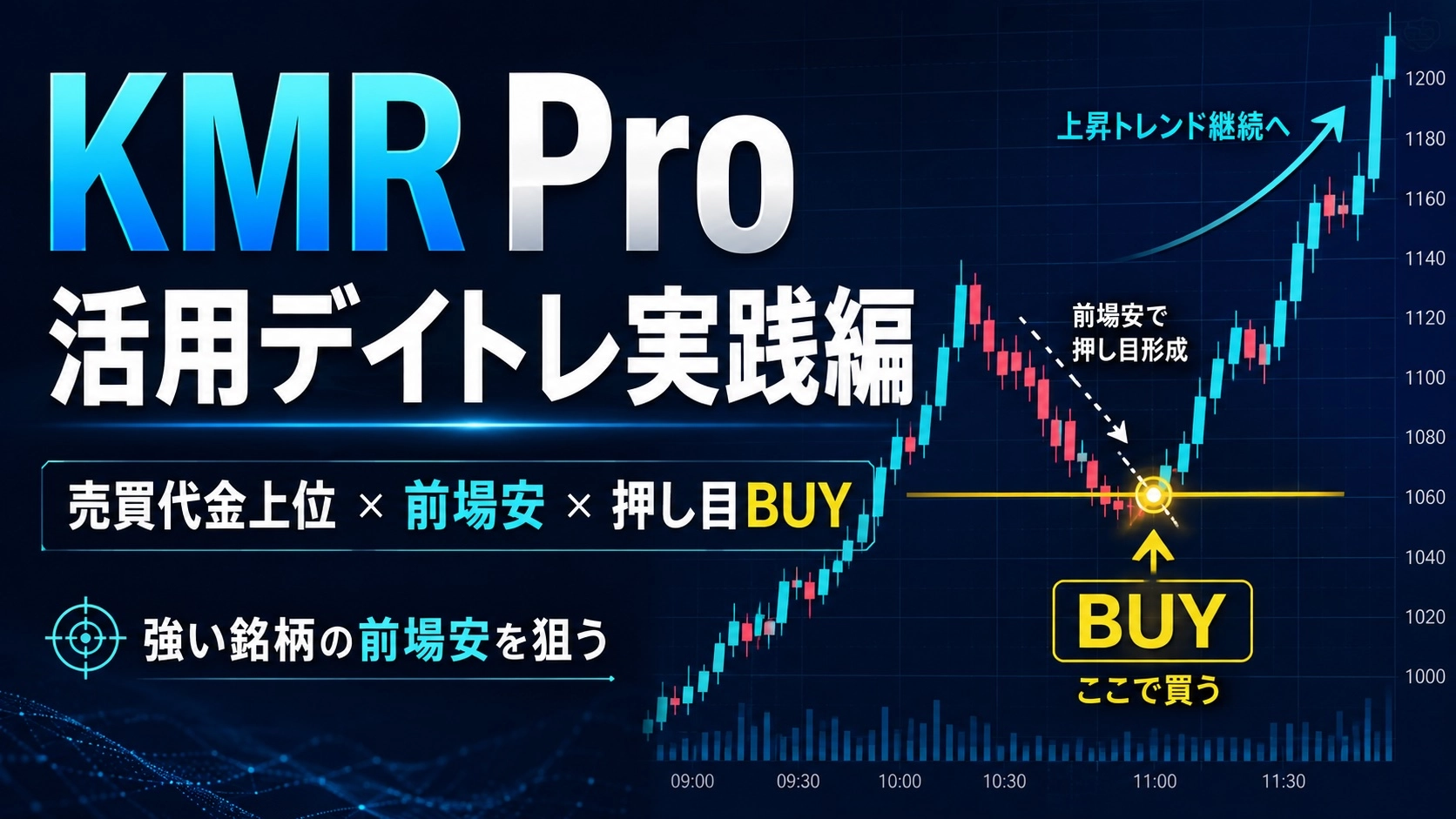
KMR Pro Practical Day Trading Edition: Targeting the "Morning Decline of Strong Stocks" — Top by Trading Volume × Rebound × BUY Signals
In the previous article, I explained the basic concept of KMR Pro.
What KMR Pro values most is
“which stocks to monitor” is decided by humans,
“where to buy” is decided by the indicator.
This is the idea.
This time, we will go a step further and
explain in detail how to actually use KMR Pro in day trading
in practical terms.
【6981 Murata Manufacturing Co., Ltd.】
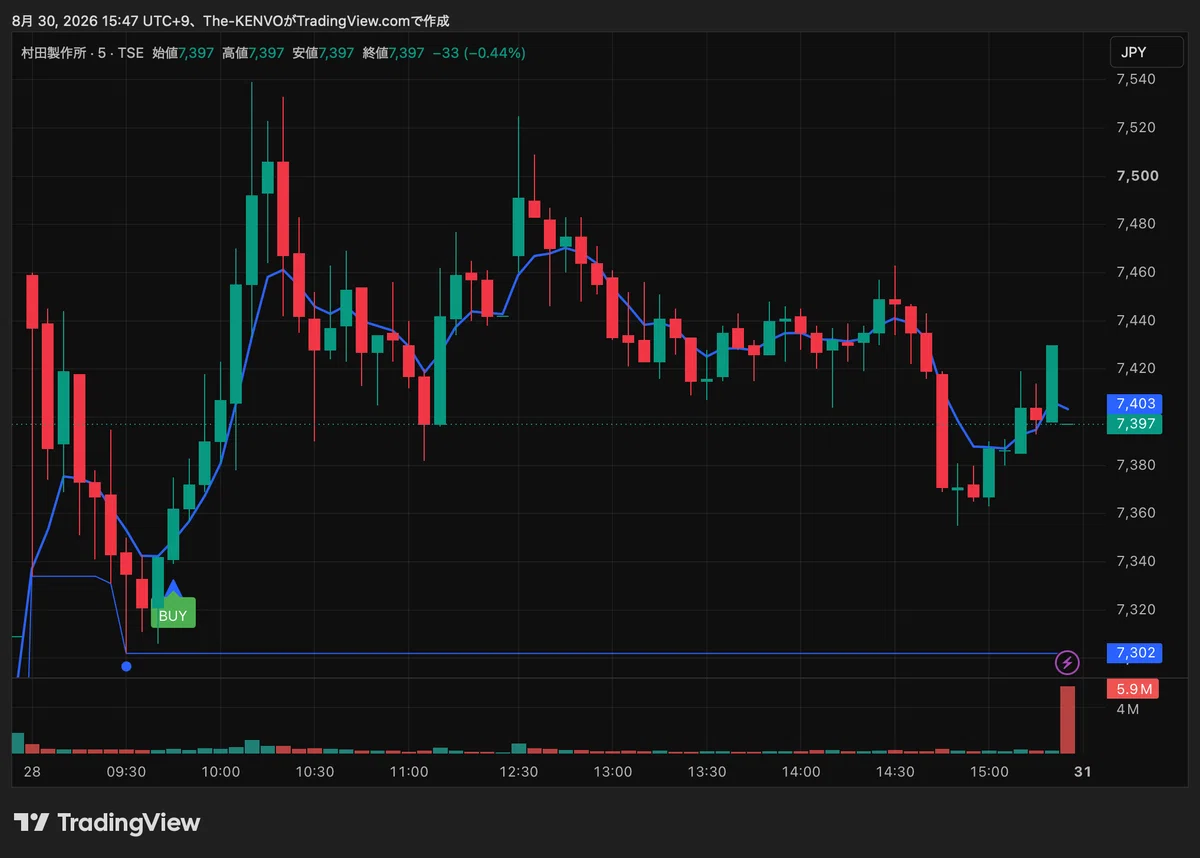
The core of this method is the idea that
? Target high-volume, strong stocks to chase the “morning low”
What I personally refer to is the thinking of a certain individual investor who has been sharing on X about stock investing and day trading for many years.
This person has long advocated
Look at the liquidity ranking
Not only liquidity but also whether there is an uptrend
Aim for the leading stocks
Aim for the morning low in regular trading hours
and has repeatedly communicated such ideas.
In this article, while referencing those ideas, I will organize my own practical method by combining them with KMR Pro.
※This article summarizes the author’s own interpretation and method based on publicly available posts; it has not been supervised or endorsed by any specific individual investor.
? First of all──KMR Pro is not a tool for picking lows
If you get this wrong, how you use KMR Pro will change entirely.
For example, suppose there is a stock that has been falling since the morning.
9:00 1,000 yen
↓
9:30 970 yen
↓
10:00 940 yen
↓
10:30 920 yen
Since it fell to 920 yen,
“It fell quite a lot. It should rebound soon.”
and you buy.
This is not the trade KMR Pro aims for.
What you want to target is,
❌ Autonomous rebound of weak stocks
not,
✅ Temporary deterioration in supply/demand of strong stocks
.
This difference is very important.
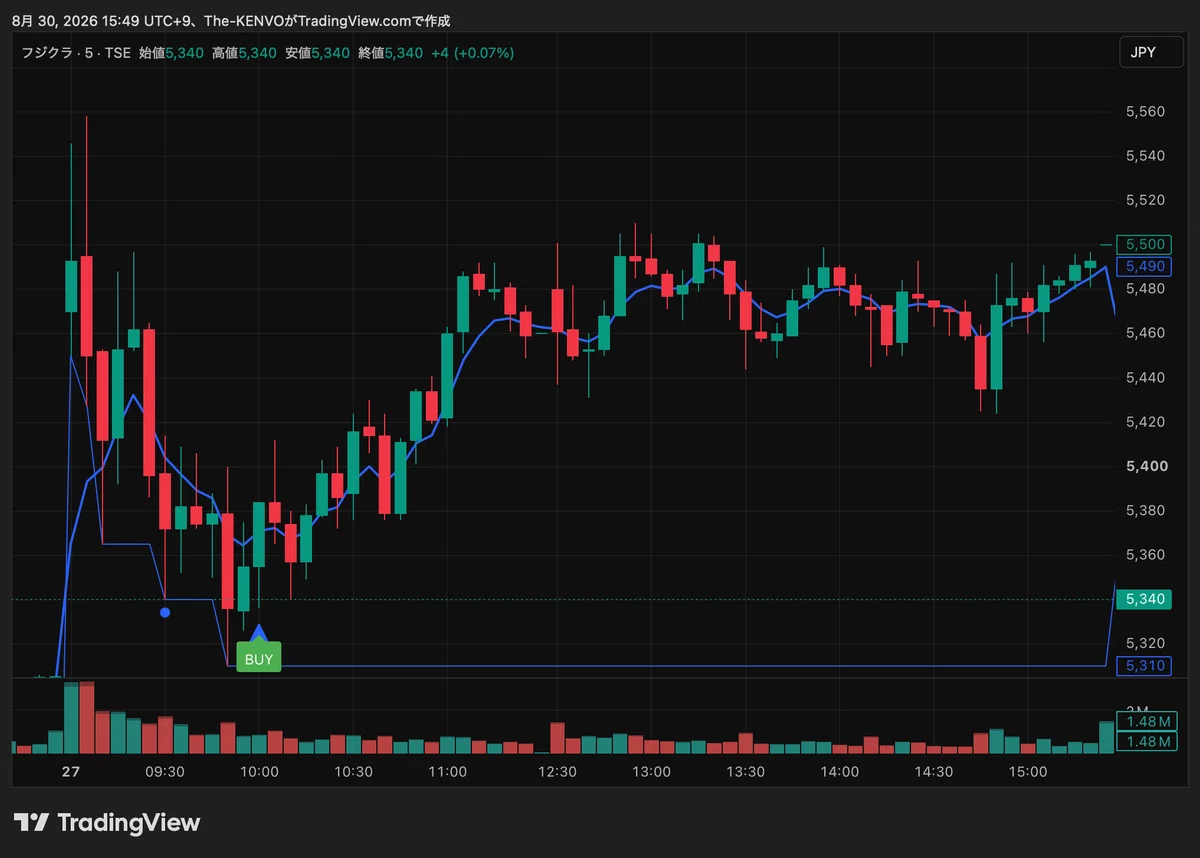
【5803 Fujikura】
? STEP 1 Find today’s lead stock
In the morning, what you look at first isn’t the chart.
If it were me, I would first look at
Liquidity ranking
. It’s not about the rate of increase.
It’s not about the volume ranking alone.
It is to identify stocks with actual large money movement.
A high liquidity means many market participants are trading that stock.
Institutions, big money investors, day traders, and “arugai” (arbitrageurs).
Various participants gather.
In other words,
you are searching for the “main battlefield of today’s market”
.
? Just because something is high liquidity doesn’t mean it’s all buy candidates
This is also very important.
Being high in liquidity ranking does not mean everything is a buying candidate.
For example,
Stock A
Day-on-day change +8%
Liquidity ranking 3rd
5-day and 25-day moving averages both rising
Recent high updated
Volume exploded since morning
Stock B
Day-on-day change −7%
Liquidity ranking 2nd
Disappointing earnings sell-off
VWAP below
Low set new low
Both are high-liquidity stocks.
However, with KMR Pro, you generally want to buy which isStock A.
The purpose of looking at liquidity is not to
“buying stocks with a lot of trading activity”
is not the goal.
? Find stocks with capital in place—“strong stocks”
To that end,
Liquidity × Trend
is the approach.
? STEP 2 Check for an UP trend
After selecting candidates from the liquidity high, the next step is to look at the chart.
What’s important here is
whether you are in an UP trend
.
At minimum, I would confirm
Stock price is in a medium-term uptrend
Recent highs are being updated
5-day, 25-day lines are rising
Trading above the previous day’s close
There are times with price movement staying above VWAP
Highs and lows are being pushed higher
Not all need to be satisfied.
However, there must be a strong directional signal like
“This stock is being bought now”
for two weeks of free trial版} here?

? By now, narrow down today’s monitored stocks to about 5–10
This is where I open TradingView for the first time.
What I have in mind is
① Look at liquidity ranking
↓
② Pick only strong stocks
↓
③ Monitor about 5–10 stocks on TradingView
↓
④ Display KMR Pro
Flow continues.
The important point is
not to display KMR Pro on 100 stocks to BUY
.
First, humans select the stocks.
⏰ STEP 3 Do not jump in right at the open
This is where actual entry begins.
For example, a stock is very strong from the morning.
Previous close 2,000 yen
Open 2,080 yen
And,
2,100 yen
↓
2,130 yen
↓
2,170 yen
Suddenly skyrocket.
In this case,
“It may go higher still”
I think.
But what happens if you chase and buy at 2,170 yen?
After that,
2,150 yen
↓
2,120 yen
↓
2,090 yen
There will just be profit-taking sells,
with a potential loss of about 3–4%
.
Stock picking is correct.
That day it eventually rose.
Even so,
if you buy in a bad place you lose.
That is the difficulty of day trading.
? Therefore, hold off on the first rise
When using KMR Pro, I basically do not try to capture
“the first move up.”
Rather,
“Let it be sold off once.”
I wait with that in mind.
This is important.
For strong stocks,
Wave 1
Buying after the open
There is
of course,
Profit-taking selling
will appear.
That selling pushes the stock price.
The push completes its cycle.
That’s the point to target.
? STEP 4 Wait for the stock of strong stocks to be sold
For example,
2,000 yen
↓
2,080 yen
↓
2,150 yen
↓
2,200 yen
A stock that rose to
2,180 yen
↓
2,150 yen
↓
2,120 yen
↓
2,100 yen
falls to here.
Looking at the chart alone, it’s a scary moment.
But here we think:
Morning liquidity high
Uptrend
There is news or a theme
Large volume from morning
Temporary pullback from the high
In other words,
being weak and going down does not necessarily mean it’s falling.
It could just be early buyers taking profits.
This is the
“temporary deterioration in supply/demand of a strong stock”
.
{Two weeks free trial} here?

? STEP 5 Wait for morning low candidates
From here, KMR Pro’s important phase begins.
Just because it has fallen does not mean you buy immediately.
2,150 yen
↓
2,130 yen
↓
2,110 yen
It falls to
“The price is getting cheap.”
but you still wait.
Because
2,090 yen
↓
2,070 yen
↓
2,050 yen
could drop further.then,
Do not grab a knife while price is falling.
Instead of predicting the low,
the idea is to confirm that selling is stopping
and to wait for that signal.
? What to look at in the low-price zone
For example, on a 5-minute chart,
① Price declines
② Volume expands
③ A lower wick appears
④ The range of the low update becomes smaller
⑤ The next candle stops updating the new low
⑥ A rebound buy occurs
These kinds of changes happen.
Until then,
supply > demand
but then,
supply ≈ demand
and
demand > supply
begins to change.
You target that turning point.
? Use KMR Pro BUY at that point
If you rely solely on discretion for this decision,
“It may still drop.”
“No, is this the bottom?”
“I should have bought earlier.”
and you hesitate.
Therefore,
use KMR Pro BUY signals as a basis for judgment
.
Choose strong stocks in advance,
wait for one selling off,
as lows form and
when KMR Pro meets BUY conditions,
consider entering
as part of the flow.
What’s important is
not to choose stocks because BUY shows up
but to wait for BUY to appear in the stocks you chose
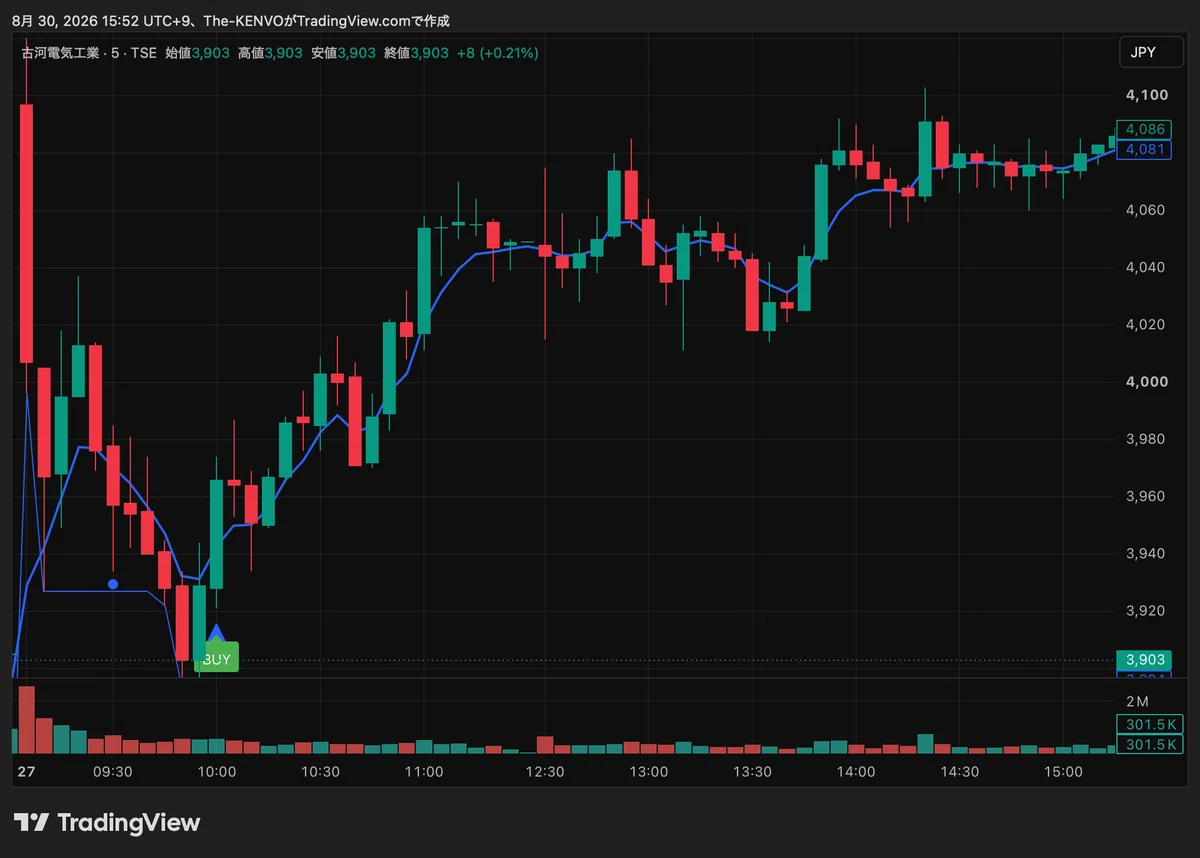
【5801 Sumitomo Electric Industries】
{Two weeks free trial} here?
? KMR Pro practical flow
In summary, the basic form I consider is as follows.
① Look at liquidity high
⬇
② Choose strong UP-trend stocks
⬇
③ Monitor on TradingView 5-minute chart
⬇
④ Do not jump at a sudden rise after the open
⬇
⑤ Wait for pullbacks by profit-taking
⬇
⑥ Attract toward morning low candidate
⬇
⑦ Sell pressure weakens
⬇
⑧ KMR Pro BUY
⬇
? Entry
Very simple.
⏱ How long to target?
In this method, I emphasize
the morning session, and relatively early hours
.
In particular,
around 9:00–10:30
is a time when there are many market participants and the direction of high-liquidity stocks tends to form.
At the latest,
by around 11:00
I consider it as a benchmark for new entries.
Of course it varies by stock, but in the afternoon there is no need to force the same pattern when volume decreases.
? STEP 6 How to handle stop loss?
No matter how good the conditions, some trades will fail.
The important thing is,
what to do when you realize “the place I thought was morning low was not”
.
KMR Pro BUY
2,100 yen
Morning Low at that time
2,080 yen
Then,
2,110 yen
↓
2,100 yen
↓
2,085 yen
↓
2,075 yen
If that happens.
This breaks the hypothesis
“Selling stopped at 2,080 yen”
.
Therefore,
use Morning Low break as a cut-loss criterion
⚠️ “It might come back” is dangerous
If it breaks 2,080 yen
2,070 yen
↓
2,060 yen
and falls to
“Strong stocks will come back, so it will rebound”
begins to be risky.
Buying strong stocks and not cutting losses are entirely different matters.
If it were me,
“cut losses if the reason I entered has collapsed”
would be my stance.
? STEP 7 How to take profits?
In day trading,
“how high it goes”
is not necessary to predict perfectly.
For example,
Then,
2,110 yen
↓
2,120 yen
↓
2,130 yen
and it rebounds.
A method is to lock in about +0.5% as profit.
Alternatively,
VWAP
morning-return high
recent high
morning high
risk-reward
can be used.
The key is to think about an exit before entering.
? Example: One trade with KMR Pro
For example,
Stock A
Previous close: 3,000 yen
Open: 3,080 yen
Morning high: 3,240 yen
Liquidity: top in the market
Medium-term trend: UP
In the morning,
3,080
↓
3,150
↓
3,240
It surges.
We do not buy here.
Then,
3,220
↓
3,180
↓
3,140
↓
3,110
Declines.
Around 3,110 yen,
Long lower wick
Increased volume
Stop updating the low
Sell pressure weakens
is observed,
KMR Pro BUY appears.
Entry
3,120 yen
Morning Low
3,100 yen
Stop loss
clear break of 3,100 yen
Target for profit
about 3,136 yen with +0.5%
or aim for a rebound to 3,150–3,180 yen.
This approach
reduces the loss and only goes for the rebound
trade.
{Two weeks free trial} here?

? The most important thing is not KMR Pro BUY
Surprisingly,
the most crucial aspect of this method is
not the buy signal.
More important is,
“whether that stock is truly strong.”
.
In extreme terms,
Strong stock × somewhat rough entry
and
Weak stock × perfect BUY signal
then,
I would choose the former.
KMR Pro,
because it does not replace stock selection
.
? Buy the lead stock
In day trading,
because the price is cheap,
because it fell yesterday,
because it looks like it will rebound,
these are the reasons you want to pick stocks.
But I focus on
“the stocks everyone is watching today.”
Stocks with high liquidity,
where there is news,
where there are themes,
where there is a trend,
where there is price movement.
In short,
they are the market’s lead players.
Wait for the lead players to be sold once.
This is very compatible with KMR Pro.
? Things not to do with KMR Pro
❌ Buy every stock that has a BUY signal
Stock selection comes first.
❌ Do contrarian bets on weak stocks that have fallen since morning
It’s not simply because they are low-priced that you buy.
❌ Jump on a rapid rise right after the open
What KMR Pro aims for is essentially after one pullback.
❌ Hold even if Morning Low is broken
If the premise collapses, you retreat.
❌ Only look at liquidity
Even with high liquidity, if it’s in a downtrend, it isn’t a buy.
❌ Chase many stocks at the same time
First narrow to about 5–10 stocks,
and actually enter even fewer.
? Morning checklist
If you use KMR Pro, organizing it this way in the morning makes it easier to understand.
【Stock selection】
☑ Is it among the top liquidity stocks
☑ Is it attracting attention today
☑ Is it in an UP trend
☑ Is there a material or theme
☑ Is volume sufficient
☑ Is there price movement (range)
【Entry】
☑ Am I chasing the morning surge
☑ Has it pulled back properly once
☑ Has it attracted toward the morning low candidate
☑ Is selling momentum weakening
☑ Has KMR Pro BUY appeared
【Risk management】
☑ Where is the Morning Low
☑ Have you set your stop loss
☑ Have you set your profit target
☑ Are you overinvested in one stock
☑ Are you trying to recover quickly
? If you had to summarize this method in one line
If I were to summarize how to use KMR Pro in one line,
“buy strong stocks cheaply.”
However,
“buy cheap stocks”
is not the aim.
It means buying the relatively cheap among strong stocks.
For stocks that have money coming in since morning.
Stocks in an uptrend.
Stocks that are market leaders.
Those stocks push up due to temporary profit-taking selling.
Wait for that selling to run its course.
And then,
KMR Pro BUY.
This is the sequence.
? Reiterating KMR Pro’s role
Humans excel at
? Context (situational judgment)
.
Is today’s market strong
Which themes are attracting funds
Which stocks are lead players
What are the catalysts
What about liquidity
Humans decide this.
On the other hand, KMR Pro handles
? Timing
.
Do not chase a rapid rise
Wait for a pullback
Wait for a low formation
Wait until certain conditions align
Visualize BUY candidates
This is how the division of roles works.
? Humans pick stocks × KMR Pro shows the buying window
This is the ideal usage of KMR Pro as I see it.
? About KMR Pro
KMR Pro is a Japan stock day trading indicator used on TradingView.
Because it is offered as an invite-only script for TradingView, the source code is not publicly released; access is granted to the purchaser’s TradingView account.
For detailed specifications and how to purchase, please see GoGoJungle’s product page.
? KMR Pro product page

{Two weeks free trial} here?

? Finally
When people think of day trading,
“What stock will rise tomorrow?”
“Which stock will hit the daily limit up today?”
and similar questions come to mind.
However, it might actually be simpler than that.
Find stocks that are already strong.
And,
wait for the right moment.
That’s all.
I regard KMR Pro as
“an indicator for waiting.”
Not an indicator to guess stocks.
Do not jump on strong stocks just because they are strong.
Do not rush to buy as they fall.
Wait until selling has run its course.
Then act only when the conditions align.
In day trading,
“how much to buy is as important as what to buy.”
I hope KMR Pro becomes a tool that makes that judgment more objective.
⚠️ Disclaimer
This article is created by adding the author’s own interpretation and examination to publicly available investor materials. It has not been supervised, endorsed, or guaranteed by any specific individual.
Also, this article and KMR Pro are intended to provide information and tools for investment decisions, not to guarantee or endorse trading of any specific stock or profits.
Stock investments carry price fluctuation risk and may dip below principal. The BUY signals shown by KMR Pro do not guarantee future price movements or profits.
The entry prices, stop-loss widths, profit targets, and chart examples shown in the article are illustrative and not recommendations for a particular trading method.
For actual trading, please consider market conditions, liquidity, news, earnings, price movement, transaction costs, your own capital and risk tolerance, and make decisions at your own responsibility.
The author cannot be held responsible for any losses or damages arising from use of this article or KMR Pro.
Ultimately, please make your own investment decisions at your own risk.