

【Correcting the assumptions after the plunge】Record the moment of breakdown, not the profit and loss
What you fix after a sharp drop is not an expectation, but the premise you held before placing the order.
Good evening!
This is Masashi^^
After GOLD moves significantly, you can’t stop looking for the reasons.
News, statements from key figures, interest rates, dollar movement. Explanations can be found many times after the fact.
But what you need for the next order is not a clean explanation of the drop.
What you should leave behind before placing the order is what you believed and at what moment that premise was broken!
This week, what you fix after a sharp drop is not an expectation but the premise you held before the order.
✅ Return to the pre-order screen before reading the explanation
In the first scene, if you read the post-drop explanation first, you feel like you understood it from the start.
What tends to happen then is that, since there is no pre-order screenshot, only post-hoc explanations are recorded.
Where to look is to close the explanation and check the high and low you were viewing just before the order.
Don’t rush to conclusions; close the explanation and start by checking the high and low you were looking at just before the order.
The actual record will note【Check: It was based on waiting for a high, but bought before the update】.
Returning to a perspective before knowing the result helps keep judgments and explanations separate.
Skipping this would leave only post-hoc explanations because there is no pre-order screenshot.
【Check: It was based on waiting for a high, but bought before the update】can be used for the next day’s comparison.
In the next practical session, next time, save one screen before the order, then read external material.
After that, review the step “✅ Return to the pre-order screen before reading the explanation” and only record the changed conditions.
When you review the screen again, start by closing the explanation and checking the high and low you were viewing just before the order.
If unsure, return to【Check: It was based on waiting for a high, but bought before the update】.
Close the explanation and verify the high and low you were looking at just before the order as the stopping line for this time.
? Example: Check: It was based on waiting for a high, but bought before the update
? Identify the leg where the premise broke
Before closing the chart, even if you expect the price to rise, the place it breaks differs from person to person.
If you treat the entire large bearish candle as a failure, you won’t see where you could have revoked the decision.
So, what should you check first?
This is a method to return your judgment to its original order by selecting only the price movement that first contradicted your assumption.
The actual record will note【Break point: Could not form a retracement high; recent low divided by closing price】.
Once the broken leg is determined, you can separate delayed stop-loss and unexpected price movements.
If you skip this, marking the entire large bearish candle as a failure makes it hard to see where you could have revoked.
【Break point: Could not form a retracement high; recent low divided by closing price】can be used for the next day’s comparison.
In the next practice, when the same shape appears, stop new orders until that leg is confirmed.
Afterward, review the step “? Identify the leg where the premise was broken” and only record the changed conditions.
When reviewing the screen, start by selecting only the price movement that first contradicted your assumption.
If unsure, return to【Break point: Could not form a retracement high; recent low divided by closing price】.
The act of selecting only the price movement that first contradicted your assumption becomes this stopping line.
? Example: Break point: Could not form a retracement high; recent low divided by closing price
? Place profit and judgment in separate columns
When reviewing records, on days with large losses, the reflective writing is also pulled by the amount.
What tends to happen is that when you look only at the amount, you try to recover with the next order, which becomes your standard.
Where to look is to make the profit/loss column last, and write from location and cancellation conditions.
Don’t rush to conclusions; make the profit/loss column last and begin by writing location and cancellation conditions.
Actual record shows【Judgment: No bounce confirmation / Cancellation condition: Break of the low / Result: Stop loss】.
Changing the order of steps makes it easier to see actions that can be reproduced rather than emotions.
Skipping this, looking only at amount, makes your next order be guided by the urge to recover the loss.
【Judgment: No bounce confirmation / Cancellation condition: Break of the low / Result: Stop loss】can be used for the next day’s comparison.
In the next practice, tomorrow is not about profit targets but whether you followed the cancellation conditions.
After that, review the step “? Place profit and judgment in separate columns” and only record the changed conditions.
When reviewing the screen, start by selecting only the location and cancellation conditions for the initial assessment.
If unsure, return to【Judgment: No bounce confirmation / Cancellation condition: Break of the low / Result: Stop loss】.
Place profit and judgment in separate columns as this stopping line for now.
? Example: Judgment: No bounce confirmation / Cancellation condition: Break of the low / Result: Stop loss
⚠ Phrase the expectation that you should go back
The moment you hesitate, during a drop, even if the basis disappears, you may keep waiting for a rebound.
What tends to happen then is that by holding without putting the expectation into words, the withdrawal conditions gradually drift away.
Where to look is to reread the reasons for continuing the position in the present tense.
Don’t rush to conclusions; start by rereading in the present tense the reasons to hold.
Actual record shows【Holding reason: It reacted to the pullback, but was invalidated by the break of the low】.
A holding that cannot be explained in present tense is likely outside the original plan.
If you skip this, holding without articulating the expectation will gradually push withdrawal conditions away.
【Holding reason: It reacted to the pullback, but was invalidated by the break of the low】can be used for the next day’s comparison.
In the next practice, if you cannot explain, you prioritize the predetermined exit instead of additional analysis.
After that, ⚠ review “? Phrase the expectation that you should go back” and only record the changed conditions.
When reviewing the screen, start by rereading the reasons to hold in the present tense.
If unsure, return to【Holding reason: It reacted to the pullback, but was invalidated by the break of the low】.
Rereading the reasons to hold in present tense becomes this stopping line.
? Example: Holding reason: It reacted to the pullback, but was invalidated by the break of the low
? Do not make exceptions into the new rules for the next day
What’s important here is that after experiencing one sharp drop, you want to add rules to get out faster next time.
What tends to happen then is that if you change conditions on a single scene, you become scared of a normal pullback and decide to pass on it.
Where to look is to not adopt exceptions, but place them in the re-observation box.
Don’t rush to conclusions; no exceptions, place in the re-observation box to start.
Actual record shows【On hold: The first rebound immediately after the indicator should be recorded only for the next three times】.
If you place it on hold, you can distinguish rules made from fear from recurring characteristics.
Skipping this, changing conditions after a single scene makes you fear normal pullbacks and hesitate.
【On hold: The first rebound immediately after the indicator should be recorded only for the next three times】can be used for the next day’s comparison.
In the next practice, until the three times are aligned, you do not move the existing stop-loss criteria.
After that, review “? Do not make exceptions into the new rules for the next day” and only record the changed conditions.
When reviewing the screen, do not adopt exceptions; place them in the re-observation box to start.
If unsure, return to【On hold: The first rebound immediately after the indicator should be recorded only for the next three times】.
Do not adopt exceptions; place them in the re-observation box as this stopping line.
? Example: On hold: The first rebound immediately after the indicator should be recorded only for the next three times
? Align the records across four time points
In practice, if you look at a drop with only a single completed chart, you lose your intermediate doubts.
What tends to happen then is that if you mix before order, while holding, on break and after settlement, you cannot identify areas to improve.
Where to look is to arrange the four time points in the same order.
Do not rush to conclusions; start by arranging the four time points in the same order.
Actual record shows【Record: 19:10 scenario / 19:18 order / 19:24 breakdown / 19:26 settlement】.
Aligning the times helps determine whether the judgment was delayed or the price moved quickly.
Skipping this, when pre-order, holding, breakdown, and settlement are mixed, you cannot choose the area to improve.
【Record: 19:10 scenario / 19:18 order / 19:24 breakdown / 19:26 settlement】can be used for the next day’s comparison.
In the next practice, continue with the same four slots and do not add explanation items.
After that, review “? Align records across four time points” and record only the changed conditions.
When reviewing the screen, arrange the four time points in the same order.
If unsure, return to【Record: 19:10 scenario / 19:18 order / 19:24 breakdown / 19:26 settlement】.
Align the four time points in the same order as this stopping line.
? Example: Record: 19:10 scenario / 19:18 order / 19:24 breakdown / 19:26 settlement
? Create a short check before the next order
What you want to keep for the next day is that long reflective writing may be satisfactory on the day it is written, but you don’t reread it before the order.
What tends to happen then is that if the lessons are abstract, even if a similar screen comes up, it won’t translate into concrete actions.
Where to look is to cut down to confirmations that can be acted on the next day’s screen.
Don’t rush to conclusions; start by cutting confirmations that can be executed on the next day’s screen.
Actual record shows【Pre-order check: Hold off buying until the pullback surpasses the high】.
If the confirmation contains a verb, you can judge whether the movement could be respected even during the move.
Skip this and abstract lessons won’t translate into concrete actions.
【Pre-order check: Hold off buying until the pullback surpasses the high】is usable for the next day’s comparison.
In the next practice, on the next attempt, put only this check on the side of the screen.
Then, review “? Create a short check before the next order” and record only the changed conditions.
When reviewing the screen, cut confirmations that can be executed on the next day’s screen.
If unsure, return to【Pre-order check: Hold off buying until the pullback surpasses the high】.
Cut confirmations that can be executed on the next day’s screen as this stopping line.
? Example: Pre-order check: Hold off buying until the pullback surpasses the high
? Link to Thursday’s article
In weekend reviews, when you reset the premise after a drop, you tend to want to add information next.
What tends to happen then is that adding new material repeatedly makes it unclear which conditions triggered the order.
Where to look is to separate the information to keep from what to discard first.
Don’t rush to conclusions; start by separating retained information from discarded information.
Actual record shows【Retain: price and cancellation conditions / discard: post-settlement post-hoc material】.
If you have a criterion to reduce information, you can preserve judgment consistency rather than analysis quantity.
Skipping this will make adding new material again blur which conditions triggered the order.
【Retain: price and cancellation conditions / discard: post-settlement post-hoc material】is usable for the next day’s comparison.
In the next practice, Thursday will move to a method to find rules moved after stop-loss.
After that, review “? Link to Thursday’s article” and record only the changed conditions.
When reviewing the screen, start by separating retained information from discarded information.
If unsure, return to【Retain: price and cancellation conditions / discard: post-settlement post-hoc material】.
Separate retained information and discarded information first as this stopping line.
? Example: Retain: price and cancellation conditions / Discard: post-settlement post-hoc material
? Split your explanations and your own cancellation reasons into two columns
Before considering the next move, writing the reasons for the drop and the reasons you exited in the same column blends post-hoc material.
What tends to happen is that you substitute the causality of the entire market for your own order reasons.
Where to look is to write facts before the order on the left, and materials learned after settlement on the right.
Don’t rush to conclusions; start by writing pre-order facts on the left and post-settlement materials on the right.
Actual record shows【Left: waited for the high / Right: confirmed key figures after settlement】.
Dividing into two columns allows you to grade judgments based only on information actually usable at the time.
Skipping this will cause you to replace the market-wide causality with your own order reasons.
【Left: waited for the high / Right: confirmed key figures after settlement】is usable for the next day’s comparison.
In the next practice, next time, read only the left column's cancellation conditions during the trade, and check the right column at the end of the week.
After that, review “? Split your explanations and your own cancellation reasons into two columns” and record only the changed conditions.
When reviewing the screen, start by writing pre-order facts on the left and post-settlement materials on the right.
If unsure, return to【Left: waited for the high / Right: confirmed key figures after settlement】.
Write pre-order facts on the left and post-settlement materials on the right as this stopping line.
? Example: Left: waited for the high / Right: confirmed key figures after settlement
⭕ Leave even the withdrawn drop as a record
When lining up a week, scenes you didn’t touch after a big move tend to get left out of records.
What tends to happen then is that only the order-taking scenes are examined, and you cannot reproduce a proper careful inconsequential pass.
Where to look is to leave a one-line note of the reason for considering it a candidate not to take.
Don’t rush to conclusions; start by leaving a one-line note of the reasons for not taking the candidate.
Actual record shows【Seeing off: moved away from the initial move; not enough margin to cancel】.
If you record the withdrawal in the same format, you can compare the consistency of judgments.
Skipping this would make only the order-taking scene verifiable, not the proper avoidance record.
【Seeing off: moved away from the initial move; not enough margin to cancel】is usable for the next day’s comparison.
In the next practice, even on days with zero orders, save just one reason for passing.
Then, ⭕ Review “Seeing off the drop after the initial move” and record only the changed conditions.
When reviewing the screen, start by leaving a one-line reason for passing.
If unsure, return to【Seeing off: moved away from the initial move; not enough margin to cancel】.
Leave a one-line note for the candidate not taken as this stopping line.
? Example: Seeing off: moved away from the initial move; not enough margin to cancel
? GOLD antidote feature has been highlighted ^^
If you want to organize the foundation of your judgments, please check this too.
? Summary
After a drop, check your own premises before explanations about the market.
The pre-order screen, the broken leg, and the initial cancellation condition are the center of the records.
Looking only at profit or loss cannot help you choose the next action to fix.
Only when you record exactly when the basis disappeared and what you did at that moment can you move to the next step.
There is no need to predict the next drop. It is enough to create a form that quickly acknowledges the broken premise.
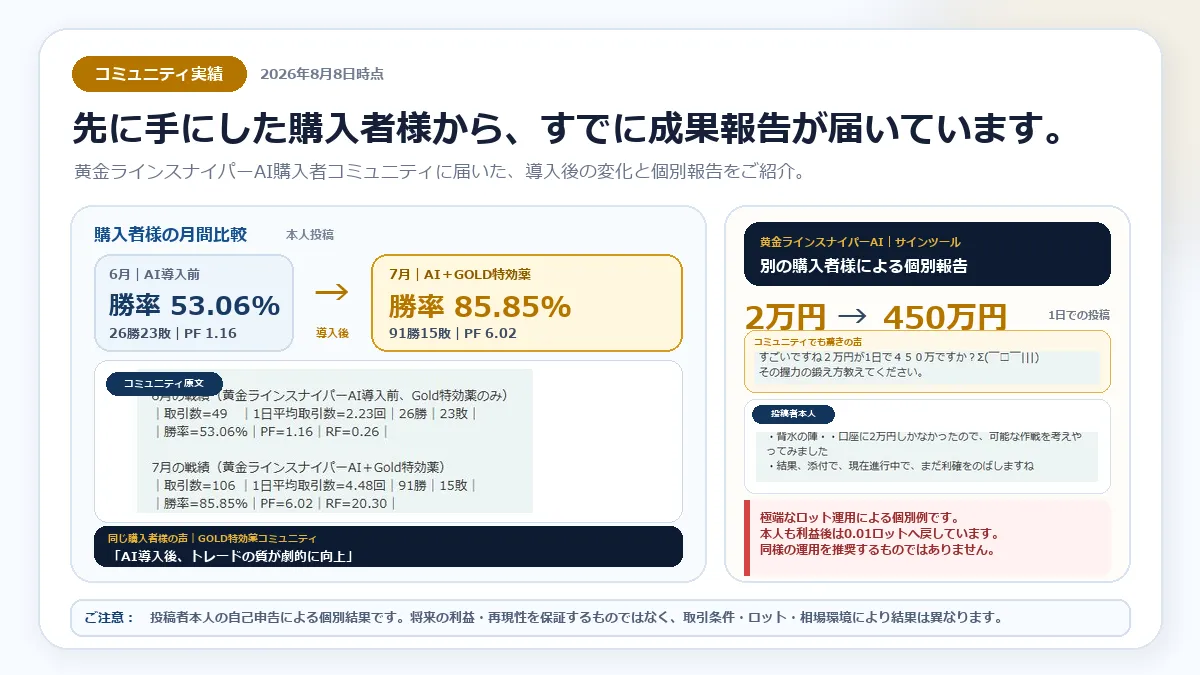
GOLD Line Sniper AI is not a tool to make decisions for you, but a helper to narrow where you start confirming.
Please view it not as having someone decide for you, but as an entrance to return to your own conditions.
? This week's standard: Prioritize records that can return you to your pre-order state over explanations of the results.
View details of GOLD Line Sniper AI
Thank you for reading until the end today as well ^^