【Premium】 When you open the chart, nothing comes to mind about where to aim. The原因 is this.
Have you ever had this experience? “You open a chart and try to think about where it will go next. But nothing comes to mind. It looks like it could go up, but also looks like it could go down. In the end you just watch it, and when you open the same chart a little later, a clear shape has already formed.”
Or you see a winning trader’s profit report and think, “Ah, they got in there. In hindsight it’s obvious, but I didn’t notice it then.” You should have been looking at the same chart, yet at that moment you didn’t see anything.
It’s not that you haven’t studied. You’ve researched methods and tried indicators. Even so, when you face a live, moving chart, you can’t grasp anything.
This isn’t because you lack experience or aren’t suited for trading. There’s just one thing you don’t have yet.
This time, we’ll organize the reasons why charts are hard to read.
By the time you finish reading, you should have a handle on the first step to change how you see, and where that single step alone won’t be enough.
Now, let’s get to the main topic.
- Popular articles
https://www.gogojungle.co.jp/finance/navi/articles/123875
- Mr. fxtrader’s past
https://www.gogojungle.co.jp/finance/navi/articles/79509?via=users
- My best teaching material
https://www.gogojungle.co.jp/tools/ebooks/67002
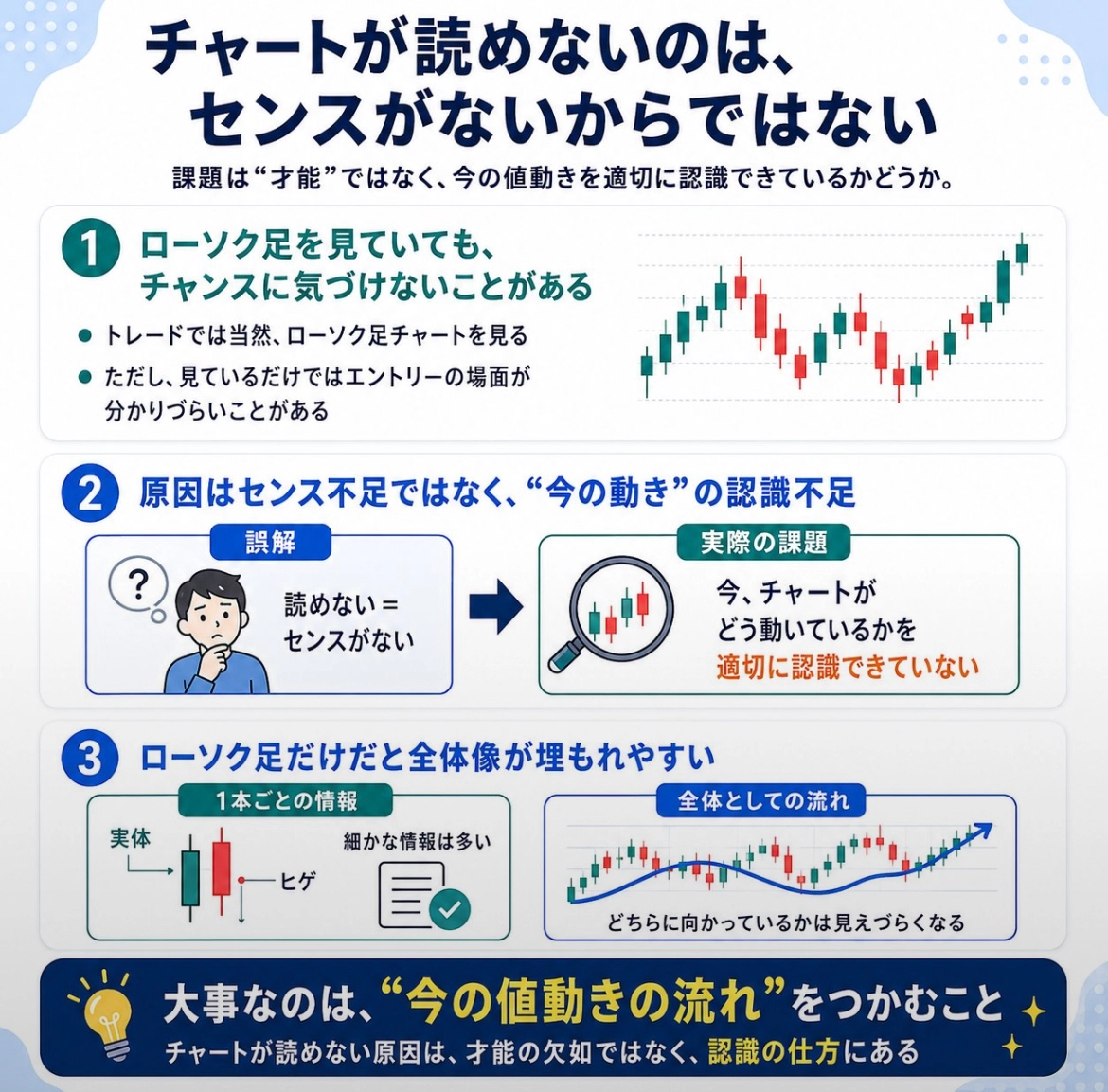
Not being able to read charts isn’t because you lack talent
When you trade, of course you look at candlestick charts. But if you only look at the candles, you may struggle to notice your entry chances.
This isn’t a matter of talent. It’s that you’re not properly recognizing “how the chart is moving right now.” That’s where the issue lies.
And as for what the current movement is doing, just looking at candlesticks makes it quite hard to tell. Because each body and wick is packed with information, the overall direction gets buried.
First, learn with lines
What you need here is a viewpoint that looks on a line (trendline) basis.
Set aside the fine ups and downs for a moment and grasp price action abstractly.
By doing so, it becomes easier to sense what the current situation is.
So, while beginners should of course look at candles, in parallel it’s important to stay aware of “how it’s moving on a line basis.”
However, just memorizing isn’t enough
You understand patterns and are actually trading. Even so, that alone won’t secure consistent wins. So what’s missing?
Let’s go through it step by step.
Patterns only tell you “tendencies”
It’s similar to studying a foreign language. Even if you memorize 1,000 words, that doesn’t mean you can hold a conversation. But without vocabulary, it’s hard to even catch what the other person is saying. Words become the cue for listening comprehension.
Patterns occupy the same position.
What patterns indicate are guidelines like “price tends to progress this way” or “it tends to move in this direction.” They don’t tell you anything beyond that.
So even if you can see a pattern, if you can’t actually take a good position from there, it won’t lead to profit. It formed exactly as anticipated, but only you failed to catch it. If you’ve had that experience, the cause isn’t a lack of pattern knowledge—it lies beyond that.
You don’t memorize patterns to predict price action. You memorize them to notice changes in price action more easily. And whether you can turn that awareness into profit is determined by a different skill.
Even so, the value of learning patterns doesn’t diminish
Reading this far, you might think there’s no point in memorizing patterns. But that’s not the point.
Patterns are tools for building your trading strategies. There’s great value in correctly positioning them as tools and increasing your repertoire. The more drawers you have, the more situations you can respond to.
What’s important is not to confuse these two.
Patterns for building strategy, and taking positions to actually convert to profit. These are different and must be learned separately. No matter how many patterns you add, that alone won’t improve the precision of your entries. Conversely, even if you only hone entries, you won’t have a chance to use them if you can’t notice the setups in the first place.
So, how do you acquire the latter?
This is where price action comes in. While patterns teach you “where to look,” price action corresponds to the part where you decide on the spot whether you can actually take a position.
So in terms of order, when you see a pattern on top of a foundation of price action, it becomes easier to connect it to profit. Conversely, if you have the foundation, all that remains is to increase the situations you can recognize.
Summary
Charts are hard to read because you don’t yet have patterns to compare against. First, learn simple shapes on a line basis. Doing so will gradually make the movements buried within the candles easier to see.
However, what patterns indicate is only tendencies.
Turning that into profit is a different skill called taking positions. If you separate these two in your thinking and increase your repertoire, your options will steadily increase in line with what you’ve learned.
- Mr. fxtrader’s past
- My best teaching material