

What is the role of each time frame in multi-timeframe analysis? [MTF Analysis Introduction Part #2]
Hello! This is SAKU!
Last time, as an introduction to MTF analysis,the fractal nature of marketsI talked about this, and today I will continue to discuss MT F analysis!
Even if you zoom in on part of the market, there are sections that move in a similar way; this self-similarity is what we call a fractal structure.
This time, to apply market fractality to analysis by dividing it into multiple time frames, we will look at the roles of each time frame and other details!
The roles of time frames in MTF analysis
In my style of MTF analysisUpper time frame, main time frame, lower time framethree time frames (and sometimes more) are basically used for analysis.
Let's look at the roles of each.
・Upper time frame
Upper time framehasthe role of grasping the overall trend and situation.
It’s about understanding the general market trend and the overall picture by confirming the major trend and situation.
・Main time frame
The term “main time frame”isused to mean the time frame you are currently focusing on as your primary.
First, after deciding the main time frame, the higher and lower time frames are determined relatively.
For example, if you set the 1-hour chart as the main time frame, the 4-hour chart or longer would be the upper time frame, and the 30-minute chart or shorter would be the lower time frame.
The role of the main time frame is, as the name suggests, to structure trading around this time frame (as the axis/main).
More specifically, it’s about confirming setups and watching triggers.
・Lower time frame
Lower time framehas the role of,being used to view more detailed price movements when the main time frame’s setup is in place and you are considering entries.
In other words, in my case I don’t look at the lower time frame unless the main time frame’s setup is ready.
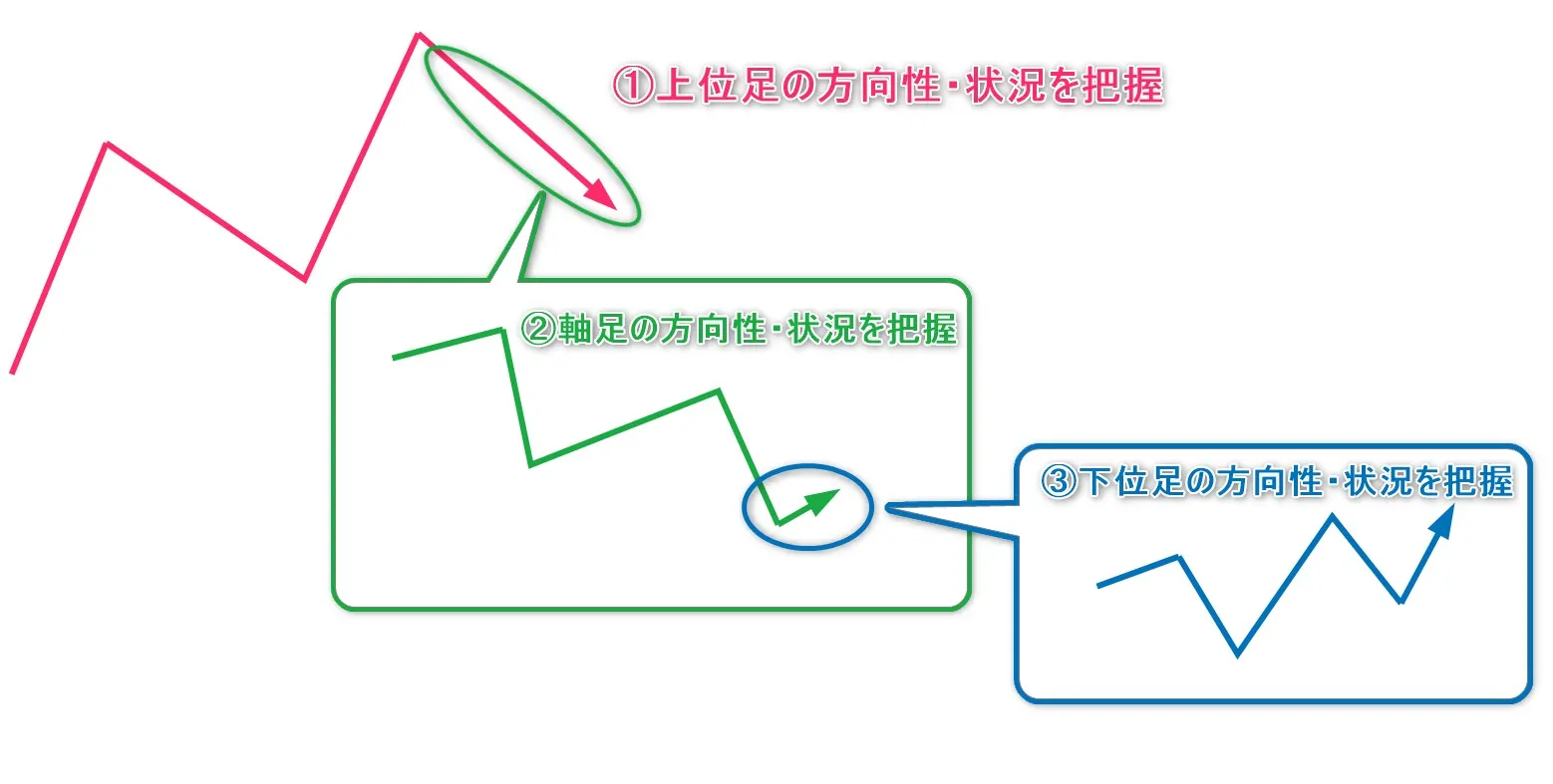
If we were to liken the roles of time frames to something…
Let’s compare it to driving a car
I’ll compare each role to driving a car.
Check the destination with a GPS or map. It’s northward. (Grasping the overall picture on the upper time frame)
→ To go to the destination, I’ll stay in this lane and keep heading north for a while. Let me map the route with the main time frame. (understanding the route)
→ The GPS says, “You’re near the destination.”
Just go straight a little more and turn right at the next convenience store corner to reach the destination (lower time frame understanding the detailed route)
That’s how it works.
If you don’t have the full picture of the destination relative to your current location, you won’t even know which direction to head.
And you won’t reach the destination unless you check which numbered road or lane to take.
Even when you’re close, you need to look for landmarks or turns to reach it.
I said I don’t look at the lower time frame until the setup is in place, but in this driving analogy,looking into minute details of the destination area before you’re close isn’t very meaningful because there’s still distance to go.
But once the destination (entry point) is near, it’s better to specifically determine which corner to turn and check the lower time frame’s status.
So, only when the entry environment is ready do I drop to the lower time frame to make the actual entry decision.
Let’s compare to fishing
Now, let’s compare it to fishing.
Check wave height and wind direction. It’s near high tide and the wind is calm. (grasping the environment with the upper time frame)
→ I found a promising spot. I’ll cast the line and “wait” until a good bite comes. (watching with the main time frame)
→ It bites! I set the hook and reel it in! (entry with the lower time frame)
Something like that.
If you cast your line in a place where there are no fish and you don’t expect to catch anything, you won’t catch anything, right?
And even if a fish bites, if your hook setting or catching method is poor, the fish will sense it and swim away.
Even in places where fish are present, casting repeatedly without a purpose wastes bait.
For people with a habit of position-flipping (ポジポジ病), if they cast and reel without properly confirming whether there are fish (a potential catch), isn’t the goal simply to feel like they are fishing?“FISHING FEEL”.
Continuing to cast at places where there are no fish or where one’s skill isn’t matched only wastes bait and line, right.
Which time frame should each be?
Setting time frames
Some people may wonder which upper, main, and lower time frames to use.
This depends on your trading style, but for upper and lower time frames, it’s good to look at one or more time frames in addition to the main time frame.
First, find the main time frame that fits your trading style!
From my experience, for Swing trading:
・If the daily chart is the main time frame
Upper time frame → Weekly, lower time frame → 4-hour
・If the 4-hour chart is the main time frame
Upper time frame → Daily, lower time frame → 30-minute
・If the 1-hour chart is the main time frame
Upper time frame → 4-hour or daily, lower time frame → 15-minute
For Day trading,
・If the 30-minute chart is the main time frame
Upper time frame → 4-hour, lower time frame → 15-minute
・If the 15-minute chart is the main time frame
Upper time frame → 1-hour, lower time frame → 5-minute
That’s about the idea.
Of course, since market conditions vary and certain wave patterns are easier or harder to recognize, this is not absolute, but it’s roughly like this.
Be careful of mismatches between target price range and time frame!
However, when looking at upper or lower time frames,you should avoid straying too far from your main time frame, as it tends to confuse your perspective.
For example, if your main time frame is 5 minutes, looking at weekly or monthly as the upper time frame can cause too large a time gap and ultimately cause confusion.
Also,watch out for the mismatch between target price range and time frame.
To relate it to fishing again, scalping targets many small fish, day trading targets medium fish, Swing targets large fish.
You need to choose the rod, bait, and depth appropriate to the target you’re aiming to catch.

…And that’s all for now!
Next time, while looking at charts, I will explain how to view the main time frame, upper time frame, and lower time frame in concrete terms, so please study this article carefully and think about it in your own way!
By the way, in my e-book (see link below),there is a lot of content to deepen your understanding of MTF analysis and to achieve higher-level trading!.
A practice method to master MTF analysis, as well as setups (entry patterns) and trigger conditions, and even how to set stops and take profits, along with the rationale and underlying concepts, is described in detail so it can contribute to improving your trading skills, so if you’re interested please check it out!Currently, there is a discount campaign until August 31, 2026!
For details on the author’s MTF trading method, see here ↓
MTF Multi-Time Frame Analysis: The Secret(Discount until August 31, 2026 23:59campaign!)
Next article is here ↓