

What is the role of each time frame in multi-timeframe analysis? [MTF Analysis Introduction Part #2]
Hello! This is SAKU!
Last time, as the beginning of MTF analysis,the fractal nature of the marketwe discussed, and this time we will continue talking about MTf analysis!
Even if you zoom in on part of the market, there are sections that move in a similar way; this self-similarity is what we call a fractal structure.
This time, to analyze the market fractality by dividing it into multiple timeframes and apply it to analysis, let's look at the roles of each timeframe!
The Roles of Timeframes in MTF Analysis
In my style of MTF analysis,three basic timeframes are used: higher timeframe, core timeframe, and lower timeframe (in some cases, more than these).
Let's look at the roles of each.
・Higher timeframe
Higher timeframehasthe role of understanding the overall trend and context.
It’s about grasping the general trend and market context to understand the big picture.
・Core timeframe
Core timeframeisthe timeframe you are currently focusing on.
First,the core timeframe is chosen, and then relatively the higher and lower timeframes are determined.
For example, if the 1-hour chart is the core, then the 4-hour or higher timeframes are the higher timeframes, and the 30-minute and smaller are the lower timeframes.
The core timeframe’s role is to trade with this timeframe as the main axis, as the name suggests.
More specifically, to check setups and look at triggers.
・Lower timeframe
Lower timeframeplays a role inwhen the core setup is in place, to view more detailed price action for entries.
In other words, in my case I do not look at the lower timeframe unless the core timeframe's setup is already in place.
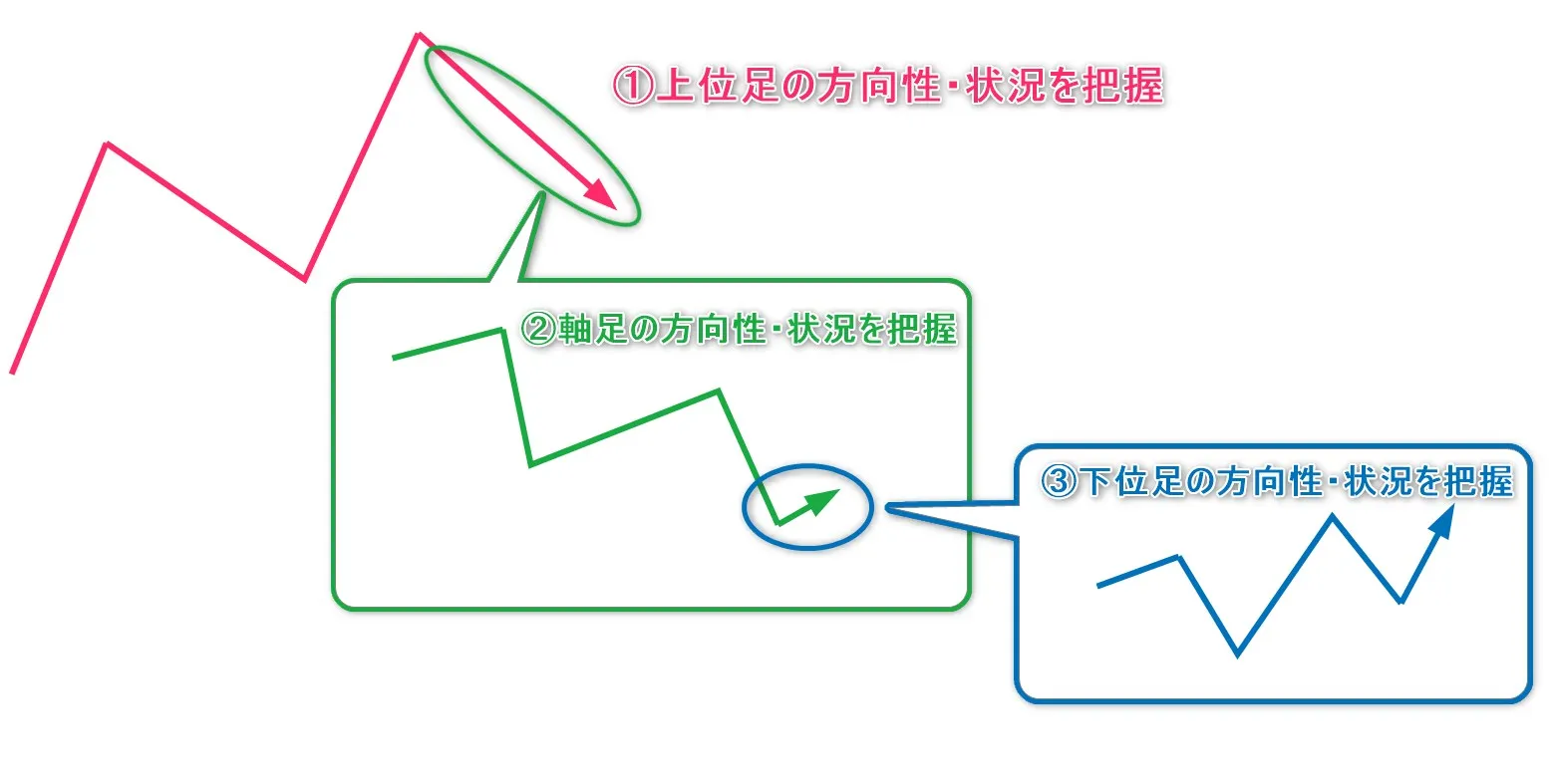
If I were to liken the roles of timeframes…
Let’s compare it to a car drive
I’ll compare each role to a car drive.
Check the destination with a navigator or map. It’s to the north. (Grasping the overall picture on the higher timeframe)
→ To reach the destination, I’ll drive north in this lane for a while. For now, drive to near by. (Grasping the route with the core timeframe)
→ Navigator: “Near the destination.”
If I go a little further straight and turn right at the next convenience store, I’ll reach the destination. (Grasping the detailed route with the lower timeframe)
That’s how it works.
If you don’t have the overall plan from your current position to the destination, you won’t know which direction to head.
And you won’t be able to approach the destination unless you confirm which road or lane to take.
Even when you’re close, you’ll need to look for signs or turns to arrive.
I said I won’t look at the lower timeframe until the setup is ready, but in the driving analogy,it would be pointless to investigate every detail around the destination when you’re not close yet—there’s still distance to cover.
However, once the destination (entry point) is near, it’s better to specifically see which corner to turn (the lower timeframe’s status), right?
So, I only drop down to the lower timeframe and make actual entry decisions once the environment for entry is ready.
Let’s compare to fishing
Now, let’s compare to fishing.
Check wave height and wind direction. It’s near high tide and the wind is calm. (Grasping the environment on the higher timeframe)
→ I found a promising fishing spot. I’ll cast the line and wait until a good bite. (Watching the situation on the core timeframe)
→ It bites! I strike and reel in! (Enter on the lower timeframe)
That’s more or less how it works.
If you drop the line where there are no fish and it looks unlikely to catch anything, you won’t catch anything, right?
And even if a fish bites, if you strike and reel poorly, the fish will get away.
Throwing the line repeatedly in a place where there are fish but the bait is wasted is also wasteful.
People with a position-positivity habit might cast and reel without properly confirming whether there is fish or not, making "the act of fishing" the goal instead of catching fish, right? Isn’t that the aim?
Continuing to cast in a place with no fish or where your skill doesn’t match will simply waste bait and line, right?
Which timeframe should each be?
Setting timeframes
You might wonder which higher, core, and lower timeframes to use.
It depends on your trading style, but for the core and lower timeframes, it’s best to look at one or more timeframes beyond the core.
First, find a core timeframe that fits your trading style!
From my sense, for swing trading:
・When using the daily chart as the core
Higher timeframe → weekly, lower timeframe → 4-hour
・When using the 4-hour chart as the core
Higher timeframe → daily, lower timeframe → 30-minute
・When using the 1-hour chart as the core
Higher timeframe → 4-hour or daily, lower timeframe → 15-minute
For day trading, it’s roughly
・When using the 30-minute chart as the core
Higher timeframe → 4-hour, lower timeframe → 15-minute
・When using the 15-minute chart as the core
Higher timeframe → 1-hour, lower timeframe → 5-minute
that’s the general idea.
Of course, depending on market conditions, perception of waves may be easier or harder, so this is not absolute, but generally it’s like this.
Be careful of mismatches between target range and timeframe!
However, when looking at higher or lower timeframes,it’s important to avoid looking at timeframes that are too far from the core, as it can confuse your perspective.
For example, if the core is the 5-minute chart, looking at weekly or monthly timeframes as higher timeframes could create too large a gap in time intervals and lead to confusion.
Also,watch out for the mismatch between target range and timeframeas well.
In fishing terms, scalping aims for many small fish, day trading aims for medium fish, swing aims for large fish.
You must choose rods, bait, and sea depth appropriate for what you’re after.

…And that’s it for now!
Next time, while looking at charts, I’ll explain how to view the core, higher, and lower timeframes in concrete terms, so please review this article thoroughly and think about it in your own ways!
By the way, in my e-book (link below),there is plenty of content to achieve a deeper understanding of MTf analysis and higher-level trading.to master MTF analysis,
practices to acquire MTF analysis,including setups (entry patterns) and trigger conditions, as well as how to cut losses and take profits, with the underlying rationale and assumptions laid out clearly, which should contribute to improving your trading skills, so if you’re interested please check it out!
For details on the author’s MTF trading method, see here ↓

→MTF Multi-Time Frame Analysis: The Essentials (also a free sample edition)
【Campaign limited to 11/1 (Sun)!】
If you found this article helpful, please give it a like or a♡. It is encouraging!
Next article is here ↓